

Seeds of Exchange explores the exchange of botanical knowledge shared between Canton (now Guangzhou) and London between 1766-73 through a collection of Chinese botanical art and objects. It is the first time the album of paintings has been seen in Britain since it was commissioned 235 years ago. The show examines the relationship between John Bradby Blake (1745-1773), an English botanist who worked as a supercargo for the East India Company (EIC) in the 1770s, his Chinese interlocutor Whang At Tong (circa 1753-84), and the artist Mak Sau, the botanical artist Bradby Blake commissioned to document plants native to Canton.
The position of supercargo was that of a senior merchant and agent for all commercial transactions during a voyage, as well as being, in Blake’s case, the ‘on-the-ground’ EIC representative. As supercargoes managed the sale of incoming goods, it naturally brought the foreigners into contact with the local officials, merchants, interpreters, and general ‘go-betweens’. Supercargoes also oversaw the profitable procurement, quality control, and packing of tea, silk, and porcelain for the return trip. The China trade mainly consisted of Chinese tea, silk and export porcelains that were exchanged for silver, and eventually the EIC’s substitution for opium and encouragement of the narcotic trade.
The Canton System
Blake’s time in China aligned with the Canton System (1757-1842) that grew out of the desire for the Chinese to control maritime trade. The system decreed that foreigners were prohibited from entering the interior of China and restricted to a small area outside Canton city and Macau where they could establish ‘factories’, trading during ‘season’ from October to March dictated by the trade winds (the southwest monsoon to China from April to October, and northeast monsoon winds from China that began in November).
Lord Macartney’s visit to the English Factory in Canton in 1793, during his Embassy to China, records the strengthening trade between China and the rest of the world, especially in relation to the EIC’s dealings, ‘According to the present regulations of the Empire, all trade with any of these places is absolutely interdicted to Europeans, and Canton is the only port which they are allowed to frequent. A few years ago, the exports to China on the Company’s account in English goods scarcely exceeded £100,000 per annum, but since the Commutation Act [of 1784, which reduced the tax on tea from 119% to 12.5%], the exports have been gradually rising and not yet reached their highest point’. He also noted that ‘The value of export from China to England in 18 Company ships this season is above 4.58 million taels, or £1,537,776 (prime cost), which when sold will certainly produce above £3 million (about £565 million today).
There was a strict hierarchy in the Canton System, which answered to the Imperial court: merchants known as the Cohong handled all trade, acting as brokers and guaranteeing payment of duties to the government; and a Hoppo, an Imperially appointed official, supervised trade and enforced regulations on foreign traders. This system severely limited direct contact between Chinese and foreigners in a trade that was already strictly regulated and open to high levels of corruption. The policy originally arose from the Qing court’s suspicions of foreigners and their defensive position after civil unrest in the empire in Xinjiang and Mongolia.
Appointed as a Supercargo
Appointed a supercargo in 1766, Blake arrived in China by 1767-78, taking up his permanent position in 1769. Blake’s position in the EIC not only allowed him close contact with the Cohong, it also gave him the opportunity to pursue his own interests in his free time during the lull between EIC ships arriving and departing port. In London, before leaving for Canton, Blake had met with the best naturalists of the day such as Daniel Solander and John Ellis to discuss the recently created Linnaean system that he could use to classify previously unknown plants that he would find in China. As a young man of the age, and in the service of the EIC, it was only natural that he was inclined to find plants of some commercial worth. Blake was particularly interested in medicinal herbs and crops, and potential new dyes for the textile trade. Once established in Canton, he used his father to develop a network of connections with botanical interests in England and abroad. His father was the perfect choice, as he had been a ship’s captain in the EIC himself and was able to deftly distributed his son’s finds to interested parties in Kew, as well as commercial nurseries, and wealthy private individuals with an interest in the natural world.
During his time in Canton in the late 1760s and early 1770s, he commissioned more than 150 botanical paintings of Chinese plants, originally intended to comprise part of an unfinished ‘Compleat Chinensis’. In his garden in Canton, he grew local plants such as Camellia japonica, kumquat (Citrus japonica), and tangerines from seeds and cuttings, documenting and recording information about seed germination and their growing conditions, eventually sending seeds and plants to England.
Whang At Tong, Blake’s Interpreter
Whang At Tong, Blake’s interpreter in Canton, played an important part in the collection and recording of the plant and seed specimens. Huang’s botanical knowledge made him a suitable conduit to supply firsthand information to British naturalists. Blake sent Whang At Tong to England to facilitate the transfer of botanical knowledge between China and Britain. He became one of the earliest Chinese people to have visited England. However, Blake fell ill and died in Guangzhou just before Whang arrived in England, and his father, Captain John Blake, initially looked after the young Chinese man, in exchange, Whang also helped mediate the return of Blake’s papers and paintings to England after his death.
Blake’s material was obviously of great interest to Kew. By this point, Sir Joseph Banks (1743-1820) had already completed his celebrated voyage on The Endeavour with Captain Cook (1768-71) and had been appointed in 1773 as the informal director and botanical adviser at Kew. It is through his efforts that Kew changed from a domestic royal garden into a base for research-orientated study of plants. Blake’s China materials and knowledge had helped form and direct future plant collecting in Britain.
Whang At Tong at the Duke of Dorset
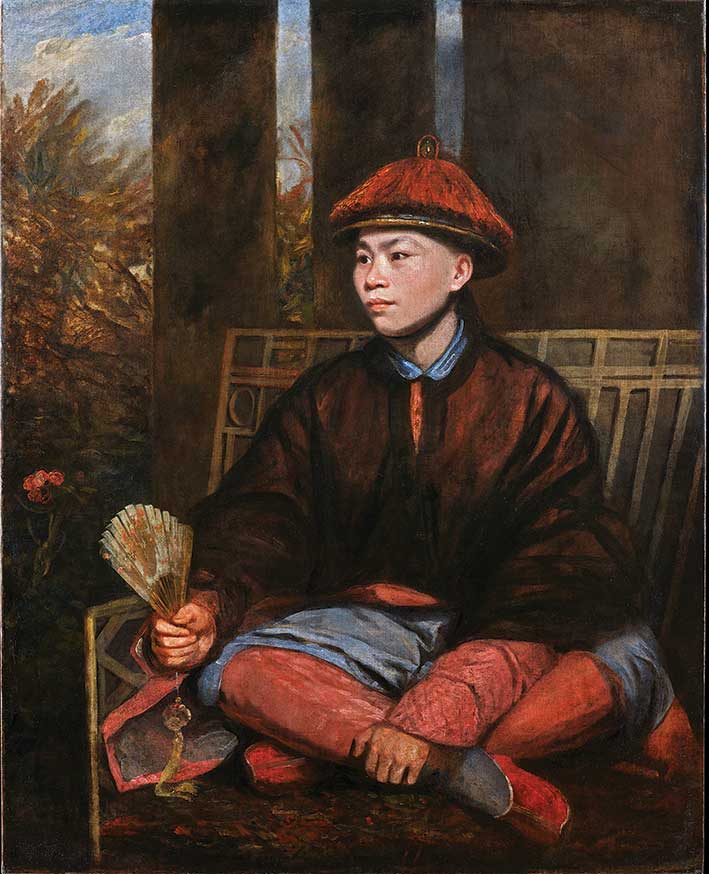
After staying at Blake’s father’s house, Whang became a page in the Duke of Dorset’s house at Knole, where he also attended Sevenoaks School. He must have been well liked, as the duke commissioned a portrait of Whang in 1776 by Sir Joshua Reynolds (1723-1792). This is included in the exhibition, but is usually found in the Reynolds Gallery at Knole. A letter attributed to Sir Joshua Reynolds (18 February 1775). In The Bee, vol 11 (12 September 1792). ‘I have lately met in company Whang-At-Ting [Huang Ya Dong], the Chinese, who is now in London; of whom, if you have not received any account, you may perhaps like to hear some particulars. He is a young man of twenty-two, and an inhabitant of Canton, where having received from Chitqua, the Chinese figure-maker, a favourable account of his reception in England, two or three years ago, he determined to make the voyage likewise, partly from curiosity, and a desire of improving himself in science, and partly with a view of procuring some advantages in trade, in which he and his elder brother are engaged. He arrived here in August, and already pronounces and understands our language very tolerably, but he writes it in a very excellent hand, which he acquired with ease by using the copy books recommended by Mr Locke’. Whang eventually returned to China to work as a trader in Canton in 1784-85.
Kew Gardens
By the end of the 18th century, the gardens at Kew were becoming a major hub in a wider botanical exchange network. The late 18th century was a period of rapid development for the former royal gardens at Kew, as they grew from pleasures gardens into a centre of study, science, and botanical exchange. Kew not only worked on specimens sent to them from all over the world, but they also despatched plants for research to the then colonies and other botanical gardens. These gardens were not merely for scientific curiosity but aimed to facilitate the industrial, commercial, and agricultural interests of the EIC. Kew became the hub for a network of colonial botanical gardens, collaborating closely with institutions in India set up by the EIC like the Calcutta Botanic Garden (1787) and the Madras Garden (1789). They facilitated the introduction of crops such as spices, tea, and crucial medicinal plants like cinchona (for quinine) from South America to India. Botanical interest in China remained with work on tea, camellias, and rhododendrons.
An important part of this knowledge exchange was the existence of precise and finely detailed paintings to identify and record dried specimens and seeds. Canton Trade botanical paintings needed to rely heavily on local artists. Mak Sau, who painted plants in a scientifically accurate manner, was the main artist used by Blake, completing over 150 paintings of Chinese plants for the unfinished Compleat Chinensis project that blended Chinese painting styles with Western botanical or scientific requirements.
Chinese Botanical Paintings
The genre of these Chinese botanical paintings is a hybrid between the established European botanical tradition and the Chinese bird-and-flower paintings (huan niao hua). China’s artists have for centuries linked flora and fauna with auspicious meanings and scholarly virtues. Flowers and plants are especially associated with the four seasons and 12 months that convey a sense of time passing and celebration of the unique characteristics of the season. It is believed that bird-and-flower images and motifs became popular in China as early as the Tang dynasty (618-907), but by the end of the Northern Song period (960-1127), this specific category of painting had taken on a clearly defined social relevance. It has remained a part of traditional Chinese painting practice today.
Winnie Wong, writing about Mak Sau for the Garden Museum, explains ‘Through John Bradby Blake’s notes, we can reconstruct every visual detail demanded of the painter, how much time each part of the painting took, how colours were mixed, from whom Blake sought opinions on the quality of the paintings, and even the exact date each painting was made. We also find the painter’s apparent name: (Mandarin Mai Xiu, Cantonese Mak Sau). It is an extraordinary record, likely unprecedented in the archives of Chinese painting, of the specific demands placed upon a painter by his patron, and what exactly he painted’.
She goes on to explain the amazing discovery of more of Blake’s collection in the cathedral town of Canterbury: ‘Since I was in California at the time, I asked Jordan Goodman in London to visit Canterbury to see the book, so that we could understand what Blake and Mak Sau may have been looking at themselves when they were making their botanical paintings. Little did we expect to find not only the same edition of the book, but Blake’s personal copy of it! And not only that, during his visit, and with the archivist’s and librarian’s assistance, Goodman was able to identify more notebooks belonging to John Bradby Blake, sea charts and maps probably belonging to his father, Captain Blake, a complete edition of the Bencao Gangmu, the most popular materia medica in Chinese history, and even, a beguiling, three-dimensional miniature portrait of Captain Blake himself. Indeed, the collection of materials at Canterbury would turn out to be in every way as extraordinary as the collection at Oak Spring’.
This London exhibition gives visitors an extraordinary opportunity to see these two collections together, over 200 years since Blake and Mak Sau produced the paintings together, and 200 years since his father Captain Blake and the Chinese visitor Whang At Tong worked together to disseminate the information after John Bradby Blake’s death.
Comprising 30 botanical paintings by Mak Sau together with herbals, maps, models, the portrait of Whang At Tong by Sir Joshua Reynolds (1723-1792), and watercolours and drawings of Canton from the V&A collection, the exhibitions reveal the story of this little-known international botanical collaboration the seeds of exchange.
Until 10 May, Seeds of Exchange, Garden Museum, London, gardenmuseum.org.uk


