

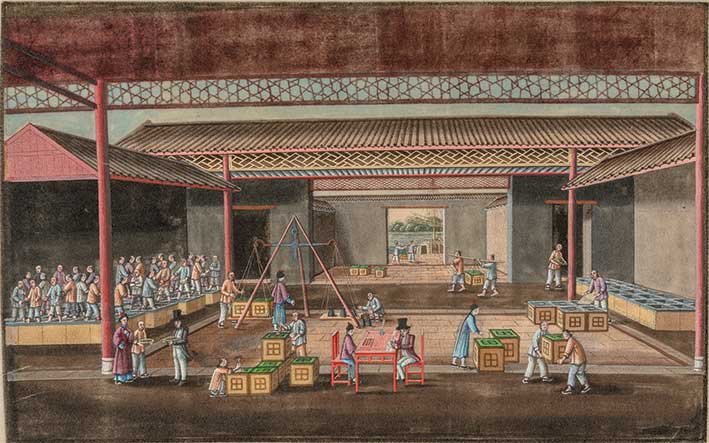
Eager to prove itself worthy of trading on the world stage as a newly formed nation 250 years ago, America – and especially Philadelphians – embarked on the risky venture of trading with China by entrusting private citizens with the work of establishing trade and diplomatic relationships with the Chinese. Merchants saw dramatic opportunities to make money, building some of the fortunes that helped expand Philadelphia’s role as a major port and city.
To celebrate the country’s 250th anniversary in March 2026, Independence Seaport Museum (ISM) is showing Seeking Profit and Power: Philadelphia, China Trade, and the Making of America, an exhibition taking into account the latest scholarship that features approximately 150 rarely seen objects from its collection ranging from ship logs and cargo manifests to examples of Chinese export porcelain, Chinese silks and sample books, as well as portraits of American and Chinese merchants, some of which are exhibited for the first time.
Early American Trade in Asia
Museums and private collections have also loaned objects to ISM for the exhibition to help tell the story of early American trade in Asia as it is uniquely positioned share this journey through its mission and location on the Delaware River, where Philadelphia’s China trade vessels launched and the first cargoes were unloaded in the late 18th century. Peter S Seibert, president and CEO of ISM, explains, ‘When the United States declared its independence from Great Britain, we also separated ourselves from the rules and regulations that governed overseas trade. As we came together as a nation 250 years ago, we also stepped out onto the world’s stage for the first time to become a new global power’.
Guest curators Susan Gail Johnson and Brett Palfreyman explore this story in five essential themes: Making a Nation focuses on why the US opened direct trade with China; Making it Work illustrates the technical and logistical feat of travelling the route from Philadelphia to China; Making Money shows the broad range of commodities the new nation could trade for sought-after Chinese tea, porcelain, and other goods; Encountering Each Other explains how the two cultures learned about one another through the goods that they traded; and the final section, The Old China Trade, explores the end of the era and the place it still holds in American memory.
The Canton System
By the mid-18th century, the Canton System (1757-1842) had been designed as a means for China to control trade with the West by focusing all trade on the southern port of Canton. Implemented through several imperial edicts, it was finally firmly established when the Qianlong Emperor (1711-1799) responded to perceived threats from abroad and confined all maritime trade to Canton. This allowed for a concentration of export workshops and shops to be established on China’s south coast. From the late 17th century onwards, Chinese merchants, known as hongs, managed all the foreign trade in the port. Once the Canton System had been implemented, the hongs, or the 13 Canton Factories, were organised into the monopoly, or guild, called the cohong.
By 1715, the British East India Company had set up office in Canton, quickly followed by Dutch, French, Danish, Swedish and in 1784, American interests were also registered. Views of these ‘foreign factories’, as they are known, are beautifully recorded in one of the staples of the China Trade, porcelains, as well as oil and watercolour paintings of the period. Many of these were created as souvenirs to be taken home to Europe and played their role in documenting rather than idealising China.
Among the selection of objects that visitors can see in the exhibition is a rare letter carried by Captain John Green (1735-1796), a Philadelphian and former officer of the Continental Navy, which introduces him as a citizen of the United States and requests that he be treated ‘in a becoming manner’ and allowed to do business in China as he saw fit. Green captained the Empress of China, the first trading ship to make the journey to China (and back) setting sail from New York Harbour on 22 February 1784, only five months after the Treaty of Paris ended the Revolutionary War.
Empress of China
The ship, largely funded by Philadelphians, carried ginseng roots and Spanish silver dollars. In addition to this sea letter, Green brought with him a copy of the Declaration of Independence as well as copies of the several treaties made with the different European powers. He was instructed by Daniel Parker, the ship’s owner, to present the documents as necessary to prove that he was representing a legitimate, if newly formed, independent nation.
This illustrates that early Americans saw the Empress’ voyage as not only a private effort by merchants to make money, but also a quasi-diplomatic mission to introduce the new United States as a nation worthy of conducting trade on a global scale. Approximately 15 months after the Empress of China left for the Pearl River, she returned home, arriving in May 1785. It was a successful voyage and began a new era of relations with one of the youngest nations in the world and one of the oldest.
Other objects in the exhibition point to the volume of trade established in certain desirable Chinese goods, such as export porcelains made specifically for the West. On show is a porcelain bowl newly acquired by the ISM, on display for the first time, that dates to circa 1790s, with a motif of a ship with American flags. Made in Jingdezhen, China, and decorated in Canton, this bowl shows how Chinese artisans customised porcelain for the new American market. Classic designs for the export market featured generic, idealised Chinese landscapes with pagodas, bridges, willow trees, and rivers. Customised orders, such as armorial porcelain, personalised motifs or monograms, were also produced in huge quantities to serve the growing demand from the West.
Chinese Trade Ceramics
Although Chinese ceramics were already well known outside China as early as the Tang dynasty (618-907), and had reached Europe by the early 14th century, it was only after the opening of the sea routes to the East by the Portuguese in 1513 that the export of Chinese porcelain began to expand and become a global commodity. During the Ming dynasty (1368-1644), the export market became increasingly important, initially with the production of celadons and underglaze-blue porcelains.
Once Europeans started trading and commissioning porcelains to bring back to the West, they quickly became the first truly global commodities. The markets were concentrated in different regions at different times, but the influence of this trade was sustained for centuries, especially in Europe and later the United States.
A punchbowl in the exhibition depicts a ship outfitted with an American flag that closely resembled the flag of the British East India Company, with which the Chinese were familiar. Although some pieces of custom porcelain were less detailed featuring just a coat of arms, initials and the like, more elaborate examples such as this feature intricate hand-painted imagery. It is likely that the motif was copied from a print rather than painted from ‘life’ in port. While the original owner of this bowl is unknown, it was custom- made for a wealthy American, likely a merchant, and would have been part of a larger set that may have been divided and dispersed to various family members through the generations.
Another porcelain punch bowl (circa 1784) featuring scenes of the Canton Hongs adorning the outside and with a probable image of the ship Empress of China on the inside has been loaned from The Dietrich American Foundation. The decoration on the bowl depicts the Danish, French, Imperial Austrian, Swedish, English, Dutch, and American flags flying before their respective trading houses along the Pearl River waterfront.
Also on show is a saucer owned by Martha Washington from the collection at George Washington’s Mount Vernon. Dutch merchant Andreas Everardus van Braam Houckgeest (1739-1801) arrived in Philadelphia from Canton on April 24, 1796, with ‘A Box of China for Lady Washington’. It features a chain of 15 wide green links outlined in black joined by smaller gilded links outlined in red, each of which contains the name of a state.
China Trade Paintings
No exhibition on the China trade would be without paintings documenting the period, and this exhibition is no exception. Among the portraits on view is one of the best-known examples of Wu Bingjian, known as Houqua (1769-1843), who was regarded as one of the most respected of the Hong merchants of Canton and was once the richest man in the world. Houqua commissioned portraits of himself for his American trading partners and gave them almost in a manner of giving someone a business card.
There are several paintings of Houqua in existence in both museums and private collections; ISM’s oil on canvas (circa 1825) descended through the family of Benjamin Chew Wilcocks (1776-1845). A key player in the development of trade relations with China, in 1813 Wilcocks was commissioned as the consul in Canton, serving until 1822, after which he remained in Canton until 1827 as a merchant before returning home to Philadelphia, where he continued to invest in the China trade. This particular painting is reproduced in the style of the English painter George Chinnery (1774-1852), who spent the last 27 years of his life on the China coast and Macau following time spent in India and who had become a popular artist of the China trade companies.
Chinese Silk and Trade Textiles
Textiles were also a popular choice for traded goods, and an example of Chinese silk made particularly for the female marked is a burgundy-coloured embroidered shawl, made and purchased in Canton in the mid-19th century, of Chinese silk crepe and embroidered with silk floss. Shawls such as this were fashionable accessories for well-dressed Philadelphia women at that time.
At the end of the 18th century, shawls became essential ‘must-have’ luxury accessories for European and American women, driven by a fascination with Oriental fashion and the desire for warmth over lightweight neoclassical garments. Although Indian shawls were popular, the popularity of Chinoiserie in the West prompted the Canton trade to cash in on the demand. This shawl was purchased by Rodney Fisher (1798-1863) for his wife, Eliza Bella Fisher (1808-1880). Fisher was a prominent Philadelphia merchant and the unofficial United States consul in Canton from March 1825 to 1827. ISM acquired the Fisher collection, of which this shawl was included, from a direct descendant of the family.
While there are many stories to be celebrated as America celebrates its 250th anniversary this year, the role Philadelphia played in shaping the new nation’s trade ambitions with China is less known. Seeking Profit and Power: Philadelphia, China Trade, and the Making of America actively explores this important and unique aspect of the anniversary’s narratives. The exhibition encourages visitors to discover the engaging story of America’s early trade with China and the history of the international China trade in general.
Until 3 January 2028, Independence Seaport Museum, Philadelphia, phillyseaport.org


