

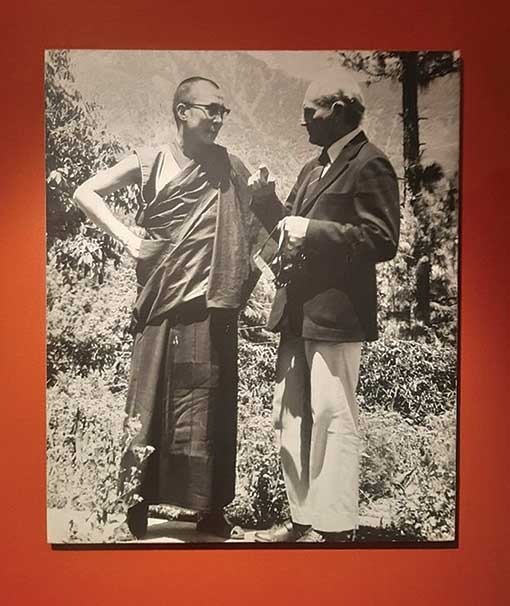
Eighty years ago, in 1946, the Austrian mountaineer Heinrich Harrer (1912-2006) first reached Lhasa. Harrer had escaped a British internment camp in India with Peter Aufschnaiter (1899-1973) to begin their epic 21-month journey through the Himalayas, crossing over 60 mountain passes, to reach freedom in Tibet. He was to record these experiences in the book Seven Years in Tibet (1953), which was made, in 1979, into a Hollywood film. The mountaineers had been interned by the British during the Second World War, due to their Austrian nationality, just after an abortive attempt to climb Nanga Parbat in the Western Himalayas.
On 15 January 1946, they set out on the last part of their journey – the last march towards Lhasa. Harrer recalls in his book, ‘We turned a corner and saw, gleaming in the distance, the gold roofs of the Potala … This moment compensated us for much. We felt inclined to go down on our knees like the pilgrims and touch the ground with our foreheads’.
Reaching Lhasa
On reaching Lhasa, they were not met with hostility but with remarkable kindness from officials and locals alike, despite their status as uninvited foreigners without passes in a ‘closed’ city to foreigners. Tibet had traditionally kept its borders closed to outsiders for centuries with successive governments tightly controlling entry, prohibiting most Westerners from entering. They initially began their life in Lhasa with Mr Thangme, the ‘Master of Electricity’, his young wife, and their five children. Their permission to remain in Lhasa was initially at stake until it was greatly helped by an invitation from the 14th Dalai Lama’s family to visit them at their residence.
The visit was a success and eventually led to Harrer forming a friendship with one of the Dalai Lama’s (b 1935) brothers, Lobsang Samten. It was through Lobsang Samten that Harrer learnt that the Dalai Lama was taking an interest in his activities, recording that ‘he had often watched me through his telescope as I had worked in the garden’.
Life in Lhasa
After settling into life in Lhasa, Harrer explains after a trip out of the capital he had a bold idea, ‘When I got back to Lhasa it was already winter. The small tributary of the Kyichu was already frozen – and that caused us to think of something new. With a small group of friends, including the Dalai Lama’s brother, we founded a skating club’. Harrer goes on to explain as the Dalai Lama could not see their activities from the Potala, he sent Harrer his cine camera to film the action. After the film returned from processing in India, Harrer went to the Potala to deliver the result in person.
He reminisces, ‘Through this film I made my first personal contact with the young ruler of Tibet. It seems curious that a product of the 20th century should have been the starting-point of a relation which despite all conventions eventually became a close friendship’. This was also the start of their informal friendship – Harrer conversed with the young Dalai Lama, teaching him English, as well as about life in the West, engineering principles, films, and international politics. The Dalai Lama also talked about their first meeting in an interview in 1992 (at the opening of the Heinrich Harrer Museum in Austria) that he had learned of Harrer’s existence from his elder brother and asked that Harrer should help him with his film projector and cine camera.
Seven Years in Tibet
Fascinated by the Tibetan way of life, Harrer set about documenting the rich cultural heritage of the city. He records in Seven Years in Tibet, ‘Lobsang Samten told me that his brother [the Dalai Lama] wished me to film different ceremonies and festival scenes for him. He always sent me the most precise instructions’. These cine films and numerous documentaries on Harrer’s life in Tibet are now housed in a museum in Austria. A 1956 documentary film directed by Hans Nieter also explores Harrer’s escape from India and life in Tibet, including about 20 minutes of 16 mm footage taken by Harrer himself of the young Dalai Lama and daily life in Lhasa, Seven Years in Tibet produced in 1958 (a DVD of this documentary is still available).
The two Austrians, who were complete opposites, settled into life in Lhasa – Harrer was gregarious, sociable, and ambitious, whilst Aufschnaiter was quiet, reserved, and scholarly (he had already studied Tibet during his years as a lead mountaineer). Aufschnaiter was an agricultural scientist and a cartographer as well as an experienced mountaineer. His own less-well-known book, Eight Years in Tibet, includes many of his photographs and sketches.
Other Foreigners in Tibet
Other foreigners occasionally visited Lhasa at this time – with government permission. Aufschnaiter corresponded with the well-known Italian archaeologist Giuseppe Tucci after meeting him on a visit to the city, as well as befriending the handful of other foreigners living in Lhasa, among them the Scottish diplomat and Tibetologist Hugh Richardson (1905-2000), the British and then Indian government’s last political officer to be stationed in Lhasa. Hugh Richardson’s extensive, historically significant photographs of Tibet (taken between 1936 and 1950) are primarily held by The British Museum and the Pitt Rivers Museum in Oxford. Many of these images are available online through The Tibet Album project, which documents British interaction with Tibet during the 20th century. Richardson also informally communicated with the Dalai Lama through Harrer and Aufschnaiter, which allowed him to send messages and gifts.
In an interview, Harrer explained the Tibetans’ faith and devotion to their leader, ‘The Dalai Lama is the living Buddha, a child, but the heart of the concentrated faith of thousands. Pilgrims would arrive from all over to see the Dalai Lama at least once in their lives’. In the spring the Dalai Lama and his entourage would leave the Potala in a great procession for the official summer palace, Norbulingka, marking the beginning of the warm season. The Norbulingka, in a western suburb of Lhasa on the banks of the Lhasa River, has been a UNESCO World Heritage site since 2001 as part of the ‘Historic Ensemble of the Potala Palace’.
Tibetan Buddhist Ceremonies
Another important cultural and religious event in the Tibetan calendar is The Golden Procession, a major Tibetan Buddhist ceremony that starts on the 30th day of the second Tibetan month of the ceremonial year, when a set of sacred objects, including texts and thangkas, are paraded around the Potala Palace. The procession stems from a 17th-century vision of the Fifth Dalai Lama, who saw a golden rosary surrounding the Potala Palace. The ritual serves to spiritually protect the Potala Palace, the official winter residence of the Dalai Lamas.
Another major highlight were the ceremonies and festivities that marked the Lunar New Year – Losar. While often close to the Chinese New Year, Losar is calculated differently based on the Tibetan calendar. The first three days include the main celebrations, featuring prayers at monasteries, wearing new clothes, family gatherings, and watching the sacred masked dances performed in monastery courtyards – cham. These performances, portraying such topics as the triumph of good over evil, involve complex choreography, masks, and costumes and are closely associated with the festival calendar during the year. These events were held in the courtyards of monasteries such as Tsurphu and Samye around Lhasa during significant periods such as Losar (falling between February and March) and the Saga Dawa festival (the auspicious fourth lunar month in Tibet falling between May and June, which celebrates the birth, enlightenment, and nirvana of the Buddha).
To record such important events, Harrer took over 2,000 photographs during his time in Tibet. A selection of 200 of these photographs, published in an album in the 1990s, Lost Lhasa: Heinrich Harrer’s Tibet, documents nomadic, feudal, and monastic life of Tibetans well into the 1940s and 50s – a time capsule of a disappearing way of life. These were the last years of the old Tibet, before the Chinese invasion in 1951, a world now mainly lost. In May 1951, the Tibetan representatives were forced to sign an agreement, which in exchange for nominal self-governance, Tibet agreed to be part of China.
Harrer Leaves for India – The Kalimpong Hotel
Harrer eventually left for India in 1951 because of the worsening relations with China and, en route back to Europe, stayed at the famous Himalayan Hotel in Kalimpong, in the Indian Himalayan foothills. The hotel was originally the family home of the MacDonalds. David MacDonald had been the interpreter on Francis Younghusband’s expedition to Tibet in 1904, and 20 years later, he turned the family home into a hotel that became the favoured stay for Everest-bound mountaineers, travellers, and spies heading north to the Tibetan plateau. Over the years, many famous names found hospitality with the MacDonalds,, such as Sir Charles Bell, George Mallory, Hisao Kimura, Alexandra David-Néel – and Heinrich Harrer. It was here that the Harrer started to write his first book Seven Years in Tibet before returning to Europe.
By 1952, Harrer had returned to Austria, settled back into European life where he remained active as a writer, international explorer, and public figure. In his hometown of Hüttenberg, he built a museum dedicated to his experiences in Tibet and the other expeditions and challenges he experienced around the world in Indonesia, Africa, and South America. The museum includes a complete floor that is dedicated to Tibet, plus a reproduction of part of the Lingkhor, the pilgrim’s five-mile circumambulatory trail around Lhasa that winds up a rock in front of the museum. This route around the city was used by Buddhist pilgrims to gain merit and the chance of a better rebirth – it is particularly auspicious to complete during the Saga Dawa festival on full moon day, when merit is believed to multiply by 100,000. The museum was opened by the 14th Dalai Lama in 1992.
Sadly, the Lingkhor that encompasses the Potala Palace, Chagpori Hill, and numerous temples has now almost disappeared due to the modernisation of the city. Happily, echoes of this older Tibetan world are scattered across museums, libraries, institutions, monasteries, and heritage projects, allowing this lost world to still be found.
MORE INFORMATION
Seven Years in Tibet by Heinrich Harrer, 1953, English version published by Rupert Hart-Davis
Return to Tibet by Heinrich Harrer, Weidenfeld Nicholson, ISBN 0297783173
Eight Years in Tibet by Peter Aufschnaiter, 2002, edited by Martin Brauen, Bangkok: Orchid Press, ISBN 9789745240124
Seeing Lhasa by Clare Harris and Tsering Shakya, catalogue for the Pitt Rivers exhibition Serindia, ISBN 1932476040, includes early photographs and descriptions of life in Lhasa by foreigners, including images from The Tibet Album
The Tibet Album, organised by the University of Oxford, tibet.prm.ox.ac.uk/album
Heinrich Harrer Museum, Hüttenberg, Austria, huettenberg.at


