

This new exhibition at the British Museum aims to dispel some of the myths, and reveal the facts, that swirl around the samurai. All the elements you would expect from an exhibition on these iconic Japanese warriors and their life is here – with some unexpected connections and discoveries. Surprising facts such as half the samurai were women and samurai, although a uniquely Japanese phenomenon, were not restricted to Japan as they also interacted with China and Korea, as well as in Europe and Southeast Asia.
Evolution of the Samurai
To start this exploration, the show traces the evolution of the samurai over the past 1,000 years – looking at how their image and surrounding myths were created. The bushi (fighting man) or musha (warrior), which later evolved into the samurai (the elite class that served their daimyo or feudal war lord), appeared at the end of the 9th century. It was then that they formed small armed groups around the provincial nobles in the service of the imperial court in Kyoto. This nascent class developed in regions distant from the influence and control of the emperor and court during the 10th to the 12th centuries, which allowed them to establish their own networks of loyalties and dependencies. Eventually, the influence and power gained by this new warrior aristocracy led to the samurai also gaining political power that enabled them to form a feudal military government, bakufu, at the end of the 12th century.
From this period to the last quarter of the 16th century (the Kamakura (1135-1333) and Muromachi period (1392-1573), infighting was fierce between the various clans, which created a consistent state of war in the archipelago, threatening the country’s economy and its population. This Sengoku period (1467-1568), when the daimyo (the feudal lords at the top of the samurai class) fought bitterly to maintain their territory and control, took action to control Japan. The success of Ieyasu Tokugawa at the Siege of Osaka (1615) saw the end of the Warring States period to herald a long era of peace, allowing the samurai to move away from the battlefield to serve as government officials, scholars, and patrons of the arts.
By the late 19th century, their hereditary status had been abolished, and the samurai myths of bushido – promoting patriotism and self-sacrifice – was promoted. This emphasis helped the samurai myth that has evolved into the globally recognised image that continues to inspire writers, film makers, and artists today.
To explore this long history, the British Museum’s exhibition looks at the world of samurai myths in three sections to explore the samurai class’s rise to power, the times of peace during their domination, and the aftermath – the myth and legacy of samurai warriors and their way of life. This evolution explores how they rose from mounted guards to the nobility during the 12th century to their subsequent ascent as military leaders and administrators of Japan until the end of the 19th century.
Samurai and the Way of Tea
During the peace of the Muromachi period, many samurai became devoted to the Way of Tea (Chado or Chanoyu). The tea ceremony has its origins in the late 15th and 16th centuries, when celebrated tea masters became established in elite Japanese society. The way of tea was literally shaped by the architecture of the 15th-century Silver Pavilion (now Ginkakuji Temple) in Kyoto, by pioneering the shoin (study-style) for tea, built by the shogun Ashikaga Yoshimasa as a retirement villa in the eastern hills of Kyoto. Although the ritual of the tea ceremony originally featured Chinese ceramics and utensils, the influential tea master, Murata Juko (d 1502), who transformed the tea ceremony in the late 15th century, initiated a taste for the imperfection of Japanese utensils that evoked a simple, unpretentious beauty (wabi). Murata believed that upon entering his small and austerely appointed tearoom, the trappings of daily life, particularly one’s status, must be discarded, as each participant was considered equal.
Murata also imbued his tea ritual with performative elements from Noh theatre and the philosophy of Zen Buddhism, which placed an emphasis on the communal nature of life. The most striking element of the ceremony was that participants were often required to use the same tea bowl. These were authentic rustic wares from Japanese or Korean kilns rather than luxurious porcelains from China. As a result, tea bowls became the most prominent utensils of Murata’s wabi-cha, with the most spectacular examples coveted by the wealthy merchants of Sakai and powerful daimyo seeking to express their own prestige and power. For the samurai, the ‘way of tea’ would become essential to their lifestyle and essential for cultivating their own aesthetic sensibilities.
Initially the samurai practiced these elaborate forms of tea in great splendour, at times involving huge gatherings, with tea identifying contests, or day-long events in which meals and saké were also served. During the Sengoku period (1467-1615) Oda Nobunaga (1534-1582) and Toyotomi Hideyoshi (1537-1598), two of Japan’s most powerful daimyo, were both ardent collectors of tea utensils – Nobunaga is known to have awarded prized tea bowls to his vassals for loyal duty in battle. Under samurai patronage, the celebrated tea master Sen no Rikyu (1522-1591) developed the simple, more intimate and rustic form of tea practice that survives today in modern tea lineages.
The Way of the Warrior
These elite tea ceremonies, of course, were not attainable by all of the samurai. However, the ‘way of the warrior’ (bushido) did apply to all levels of the warrior class and was not limited to the handling of weapons and military skill and discipline. It also attached fundamental importance to the arts of the scholar and culture. In earlier periods, like most Japanese of their time, the samurai followed Buddhist religious teachings as well as the practices of Japan’s native religion, Shinto. In response to the anxieties of a turbulent age in the 13th and 14th centuries, a new Buddhist sect known as Pure Land rose to prominence. The name refers to the western paradise of Amitabha, a powerful and compassionate Buddha to whom the samurai were devoted.
The attraction of Pure Land Buddhism lay in its reliance on a simple, expedient device for salvation: recitation of a short prayer, invoking the name of Amitabha. By the 12th century, another, a quite different sect appeared, which attracted many samurai adherents – Zen Buddhism. Zen stresses seated meditation and pondering of koan – paradoxical statements or questions – as practices leading to enlightenment. This patronage of the samurai class continued throughout the period of rule by the Ashikaga shoguns, accounting for the great concentration of Zen temples in Kyoto, where the emperor and court held power. The art of ink painting was also later associated with samurai life, as in addition to their military abilities, most elite samurai were expected to be versed in the cultural arts.
Japanese Society in the Edo Period
By the Edo period (1603-1868), Japanese society had adapted some concepts of Chinese origin and saw itself as ideally made up of four categories: warriors (shi, whereas in China this term designated literate civil servants), peasants (no), craftsmen (ko) and traders (sho). The culture of the samurai also aligned with this assimilation of class into Japanese life. Other assimilations include ‘warrior Buddhism’ that could blend with Shinto, the ancestral religion of Japan. This meant that the samurai shared similar practices with Buddhist monks: the way of tea (chado), the way of fragrant woods (kodo), or incense, and the way of flowers (ikebana). However, it was in the field of literature and poetry that shoguns, daimyo, and other samurai, distinguished themselves the most. By learning Chinese characters, they also appropriated poetry from the continent and, in imitation of the imperial nobility, devoted themselves to a new type of Japanese poetry – the 31 syllable waka and haiku.
This emphasis on cultural skills grew from the samurai’s need to govern lands they had acquired through warfare. Literacy was required to rule effectively, as these skills were needed to draft documents with at least rudimentary knowledge of calligraphy and literary conventions. The ability to participate in courtly arts like classical Japanese verse (waka) strengthened the samurai’s authority, lending dignity and bringing prestige to warriors who frequented aristocratic and court society. Like the aristocracy, samurai often attended social gatherings where poems were recited, written, or exchanged.
Samurai and the Visual Arts
Among other pastimes, high-ranking samurai were often connoisseurs of painting. Shogunate patronage of painters and artisans advanced the visual arts throughout the period of military rule, as daimyo and samurai vied to fill their mansions and castles with screens and paintings, as well as beautifully decorated objects for daily use in their newly built castles. Samurai children were expected to prepare for life by studying Chinese and Japanese literature, as well as Confucian texts, alongside martial skills like archery and horseback riding.
Apart from daily life and aesthetics, the exhibition also pays attention to the important role of women in the samurai class something not usually considered when dealing with samurai myths. The exhibition catalogue explains that women from this class were expected to acquire an education befitting their role as wives and mothers. Although women made up half the social class during the Tokugawa period, they did not play an extensive role or have much representation in popular storytelling, with the exception of the celebrated female warrior Tomoe Gozen, whose story is told in the Tale of the Heike, which recounts four occasions when she appeared in battle. Tomoe appears in the Edo-period woodblocks prints that are on show in the exhibition, Tomoe Gozen Defeating Uchida Saburo Ieyoshi at the Battle of Awazu (1780-1819) by Katsukawa Shun’ei and Evening Glow at Awazu (1852) by Utagawa Kuniyoshi, both showing the heroine dressed in samurai armour.
Samurai Women and Samurai Myths
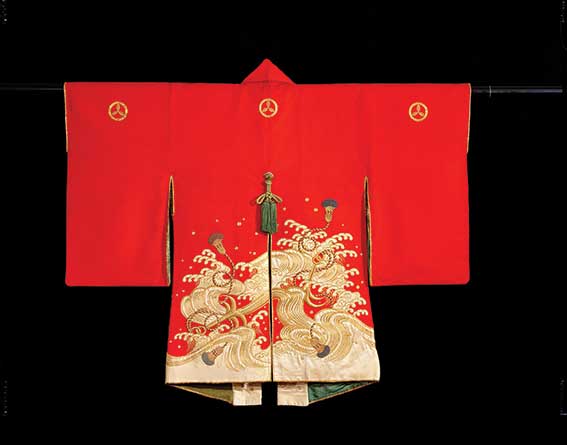
Other duties, apart from those of domestic life and child rearing, included participating in the fire watch. Fires occurred so often in Edo, a city built of wood, that they were called the ‘flowers of Edo’. The shogunate established fire-fighting companies, with high-ranking samurai responsible for raising the alarm, supervising fire fighting and evacuations, and preventing looting. Women living and working in Edo Castle were similarly trained and needed to protect the women’s quarters, where men (apart from the shogun) were banned. On show is a female fire-fighting coat, 1800-1850, for use in the women’s quarter at Edo Castle.
Catholicism Reaches Japan
Elsewhere in the exhibition, one fascinating period in Japan’s history is explored – the introduction of the Catholic faith to the country. The Spaniard Francis Xavier (1506-1552), one of the founders of the Jesuit order, was the first of the notable priests who arrived in 1549 to find a country of complex politics and competing war-lords, with a litany of bloody hostilities breaking out from time to time. He spent barely two years in the country but managed to convert most of the inhabitants of Hirado Island (near Nagasaki) to Christianity – a trend continued under the efforts of further visiting priests – and by 1570, some 26,000 were followers of the faith.
Relations with the Japanese elite improved even more as the Jesuit Luis Frois (1532-1597) found himself on the right side of the powerful and otherwise murderous warlord, Oda Nobunaga (1534-1582) who, though having no religious convictions of his own, permitted and encouraged Christian endeavours in the Imperial capital Kyoto and other parts of the country under his control. The faith flourished, possibly because it offered a message of peace and goodwill at odds with the warring sentiments of the time, and because it was associated with the much-admired and prosperous Portuguese trade and their scientific know-how. During the latter part of the 16th century, Nagasaki grew from being a small fishing village into a sizeable town under Jesuit administration with churches, seminaries and hospitals, to became known in Japan as ‘little Rome’.
The Tensho Embassy
In 1582, the first Japanese diplomatic mission, known as the Tensho Embassy, was sent to Europe under the sponsorship of three daimyo who had converted to Christianity and the management of the Jesuit Head of Mission in Japan, Alessandro Valignano (1539-1606). The participants were four well-born, educated Japanese Christian boys together with servants and an interpreter who set sail on a voyage that took over two years, stopping en route at various Portuguese outposts in China and India, arriving in Lisbon as summer was ending in 1584.
One of the party was Ito Mancio (1570-1612). The party travelled through Spain and on to Rome, and were well-received everywhere, meeting royalty, dukes, and even a couple of popes, all the time recording their experiences and observations before returning to Japan in 1590. The visit attracted great interest across Europe and, in Venice, Ito even had his portrait painted by Domenico Tintoretto (1560-1635), this painting is included in the exhibition. Their embassy also brought diplomatic gifts, including suits of armour.
Interest in the samurai continues, with their stories being fabricated, idealised, glorified, and adapted for many purposes. This exhibition explores myth and fact alongside each other to consider what is truth and what is myth, through 280 objects and digital media from their own collection as well as from 29 national and international lenders. It dramatically reveals the many identities of Japan’s warrior class across the centuries, going beyond the predictable arms and armour, by showing paintings, woodblock prints, books, clothing, ceramics, and photographs. Shown alongside these traditional artefacts are examples of film, television, manga, video games and art, including a newly commissioned work by the contemporary artist, Noguchi Tetsuya (b 1980), bringing the samurai story and related samurai myths up-to-date for another generation of enthusiasts.
Until 4 May 2026, Samurai Myths and Facts, the British Museum, London, britishmuseum.org


