

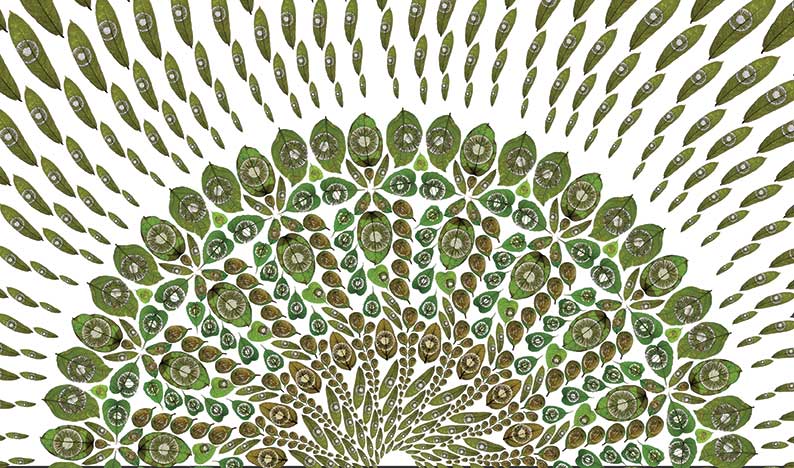
In celebration of Singapore’s 60th anniversary of independence, the Asian Civilisations Museum is exploring how the peacock in decorative art and how it has been depicted across cultures and its enduring role as a symbol of beauty, power, and divinity in Asia. Featuring over 100 works from the National Collection and important lenders, Peacock Power spans diverse mediums, from ceramics to textiles.
The exhibition traces how the image of the peacock travelled across Asia, inspiring sacred imagery, luxury ornament, and everyday adornment. Peranakan art, shaped by the convergence of multiple influences, is the ideal starting point for this journey, inviting the viewer to consider how motifs move between contexts, revealing the networks that connect peoples and how artistic traditions evolved through exchange.
Peranakan Culture
In Peranakan culture, the peacock symbolises good fortune, luxurious beauty, and prestige. This is most evident in Peranakan wedding ceremonies, where peacocks prominently featured alongside other auspicious symbols like the phoenix. Together, these birds suggest the pairing of male and female energies, reflecting the yang and yin principles of Daoist belief that inform Peranakan wedding symbolism. The association of the peacock with courtly rank also aligns with the practice of treating the bride and groom as ‘king and queen for the day’.
Peacock feathers also have a role in faith. Prized since ancient times for their iridescence and alluring ‘eye’ patterns, peacock feathers were used in ritual objects, textiles, and ornament. Focusing on the bird’s most mesmerising features, the exhibition examines them in an array of contexts, uncovering their dual symbolism: in sacred rituals they serve as emblems of purity, prosperity, and good luck, while for the ruling elite they are markers of sovereignty, status, and splendour.
Peacocks in Indian Art
The birds are a pervasive motif in Indian art, appearing from ancient cave paintings and Indus Valley artefacts to Mughal miniatures and contemporary designs, symbolising royalty, beauty, love, and divinity. They are featured across various mediums like paintings, sculptures, textiles, and jewellery, and are often linked to Hindu mythology, such as the god Kartikeya’s mount, and national and religious significance.
Peacocks are also closely associated with Hindu gods themselves. The god Kartikeya (Murugan or Skanda) has a peacock, named Paravani, the primary mount of Kartikeya, the god of war and commander of the gods’ army. Here, the peacock symbolises the god’s victory over ego and sensual desires; in iconography, it is often shown gripping a snake (representing ego/desires) with its claws. The bird is also associated with Krishna, who is an avatar of the god Vishnu, and is consistently depicted with a peacock feather (or mor pankh) adorning his crown or headband. This is a prominent symbol of his connection with nature, his playfulness, and purity.
In some households, peacock feathers are associated with Lakshmi, the goddess of wealth and fortune, and it is considered auspicious to keep the bird’s feathers at home to bring prosperity. Elsewhere in India, the peacock is also a common motif in Pichhavai paintings, the large devotional painted pictures from Rajasthan, often associated with love and the divine love of Radha and Krishna, and designed to hang in Hindu temples of the Pushtimarg tradition.
The Koh-i-Noor
One of the most infamous diamonds in history is closely linked to peacocks – the Koh-i-Noor. The diamond came from India’s alluvial mines thousands of years ago, sifted from the sand. According to Hindu belief, it was revered by gods like Krishna. Although it is impossible to know exactly where the Koh-i-Noor came from and when it first came into the possession of kings, there is a definite point at which it appears in the written record. The original Peacock Throne, commissioned by the Mughal emperor Shah Jahan in 1628, was dismantled and broken up for its valuable gems after Nadir Shah conquered Delhi in 1739. After Nadir Shah’s assassination in 1747, the throne likely disappeared completely during the ensuing chaos.
The Koh-i-Noor diamond arrived in the UK in 1850. Following the British annexation of the Punjab in 1849, the diamond has been part of the British crown jewels, and was first exhibited to the public at the Great Exhibition in 1851. Today, there are numerous interested parties and countries claiming ownership and the right to repatriate the stone.
One of the deities most closely related with the colourful bird is the Hindu deity Kartikeya (also known as Sri Murugan), who is widely revered in southern India, Malaysia, Singapore, and Sri Lanka, and who rides a peacock as his mount. During the festival of Thaipusam, devotees honour him by carrying kavadi decorated with peacock feathers, one of which features prominently in this exhibition.
The Peacock as a Universal Symbol
Over the centuries, the peacock has become a universal symbol that transcends faiths and borders: a creature of the divine realm, and an emblem of beauty and power on earth. In Buddhism, peacock feathers symbolise wisdom, and the transformation of poison (or negative emotions) into a form of beauty (enlightenment), as well as the Bodhisattva path of compassion to navigate the suffering of the world. This symbolism stems from the belief that peacocks can eat poisonous plants and venomous snakes without coming to harm; instead, these toxins are thought to enhance the brilliance of their plumage. This is a powerful metaphor for a Bodhisattva, who can take the suffering and defilements of the world and transform them into something beautiful and beneficial on the path to liberation. These feathers can be seen as the unfolding of wisdom, much like when a peacock displays its tail.
They are also used in various Vajrayana or Tantric Buddhist rituals, such as sprinklers for consecrated water or as decorative elements for ritual items, symbolising protection and purification from defilements. Its image graces the throne of the Amitabha Buddha (the principal Buddha in Mahayana Pure Land Buddhism), evokes paradise in Christian and Islamic art, and continues to inspire artistic and spiritual expression across Asia. They are also closely associated with the deity Mahamayuri (the Peacock Myoo), who is associated with protection and curing illnesses. The deity is a prominent female Wisdom King (one of the five Vajra-rajas) and Bodhisattva in Mahayana and Vajrayana Buddhism, revered for protecting against poisons, diseases, and disasters and popular in Chinese, Japanese, and Tibetan Buddhism.
This long representation of the bird symbolises its enduring beauty, opulence, and admiration across Asia, with their graceful forms inspiring and influencing artists and craftsmen through centuries of trade and exchange. The motif appears across many forms of media, from luxury objects to everyday adornment. In textiles, peacocks enliven textiles across southeast Asia and are a favourite motif in Javanese batiks, especially those from Pekalongan – a cosmopolitan port shaped by generations of cultural interaction.
The exhibition closes with a newly commissioned work, Thousand Eyes by Ernest Goh. Through a contemporary lens, Goh reflects on the peacock’s enduring symbolism across cultures, linking the ‘thousand eyes, of its tail to fallen leaves as sacred vessels, inviting reflection on both cultural heritage and present-day ecological concerns.
Until 30 August 2026, Asian Civilisations Museum, Singapore, nbh.gov.sg/acm


