

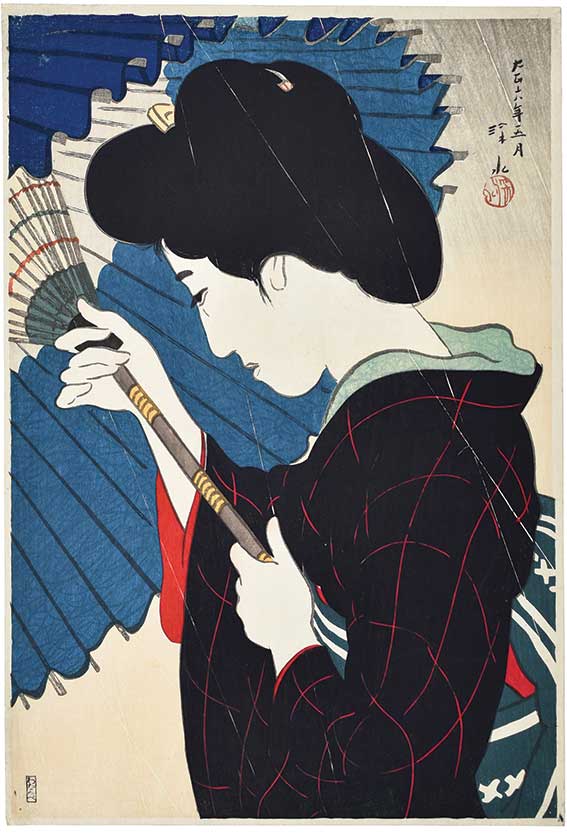
Asia Week New York 2026 is now in its 17th year of celebrating Asian art and art from the Islamic worlds. A mix of 25 international and American dealers are showcasing works of art with a couple of members choosing to be present online only. The main event runs from 19 to 27 March. As usual, Asia Week New York coincides with the spring sales at the auction houses, which are also hosting both physical and online sales. For ease, we are listing a selection of the in-gallery shows, see below for details.
Kogei: Metal and Lacquerware
Onishi Gallery, 19 March to 3 April
Onishi Gallery, is known for its focus on Kogei (contemporary craft art from Japan), and this year’s exhibition is entitled Kogei: Metalwork and Lacquerware, features work by leading Japanese artists including several designated as Living National Treasures. Two artists featured in the show are Rusu Aki (b 1976) and Onihira Keiji (b 1973). Rusu creates her sculptural forms in iron that evolves through rust, welding, and time itself—poetic works that reshape space through material rhythm and presence. Based in Wajima, Onihira is celebrated for his lacquer pieces that integrate ancestral techniques with celestial, botanical, and cosmic imagery. Each work is a meditation in material, with layered lacquer, gold, and iridescent shell forming sculptural, glowing surfaces.
The show not only presents contemporary masterpieces shaped by centuries of tradition but also serves as the curtain-raiser for a major exhibition project scheduled to tour leading US museums from 2027. Metalwork specialists transform gold, silver, copper, lead, iron, and unique Japanese alloys through techniques such as casting, chiselling, hammering, and overlay. Bending hard, unyielding materials to their creative will, they produce masterworks of grace and refinement.
Equally compelling are the lacquerware pieces, born from the artistic potential of urushi, the sap of the lacquer tree. Contemporary lacquer artists work with delicately carved bases of paulownia, cherrywood, cypress, and other timbers, patiently applying, drying, and polishing multiple layers of lacquer. These lustrous surfaces become canvases for decoration in precious metals and shell, marrying natural beauty with meticulous craftsmanship.
• 16 East 79th Street, New York, NY 10065, onishigallery.com. Opening reception 19 March, 5-8pm.Hours: 10am-5pm every day during Asia Week. Other times Tues-Fri, 10am-5pm.
Fu Xiaotong and Wang Tiande
Alisan Fine Art, 12 March to 18 April
This year the gallery is presenting two solo shows. Fu Xiaotong: NUN-7. The artist is known for her intricate paper pinhole creations of ‘traditional’ landscape compositions. The title NUN has been used by Fu Xiaotong since 2020, with this exhibition marking the seventh iteration of the ongoing series. Nun (or Nu) refers to a chaotic life-force in ancient Egyptian mythology, known as the ‘Great Earth Mother’. Often considered the oldest god, Nun is the personification of the boundless primeval waters of chaos, representing the primordial abyss from which all life and existence emerged. In both her paper works and sculptures, Fu consistently engages with the void – the spaces created by the armature of her sculpture, the holes created with each pinprick. The works show how she interprets the natural world from two contrasting perspectives: from afar, in her serene, distant mountain and waterscapes, and on a microcosmic level, in her investigation of plant cells and organic tissue. In some pieces, forms appear densely aggregated, resembling cellular structures; in others, the dispersion and branching of pinholes evoke patterns of growth, division, or migration found in living systems.
The second exhibition is Wang Tiande: Of Streams and Clouds. Wang Tiande is an innovative avant-garde ink artist known for his creative use of incense sticks as a form of brush. Well-versed in traditional Chinese art and culture, Wang searches for new possibilities in the realm of ink art. His most groundbreaking practice replaces brushes with incense sticks, burning into layered rice paper and ink. This unique approach reimagines traditional landscapes and calligraphy, conveying the ephemeral nature of art. This practice began several years ago, while viewing Ming-dynasty paintings in a friend’s collection, Wang considered the potential to combine authentic historical paintings and calligraphy with his own burned and painted works. An avid collector of older artwork, he began layering and attaching pieces from his collection to his own creations. The resulting works occupy a hybrid state, part historical ‘ready-made’ and part contemporary painting, presented as artefacts in pristine, black shadow-box frames. Two large-scale works anchor the exhibition; Clear and Distant Amid the Dense Forest is presented in a long, horizontal scroll. In contrast, Sheshan Resting Over Water is a tall vertical work – not unlike the paintings of the Song dynasty (960-1279).
• 120 East 65th Street, NY 10065, alisan.com.hk. Asia Week reception 12 March, from 6-8pm.
Event: In Conversation: Wang Tiande and Einor Cervone, On Materiality, 21 March 1-4 pm
Contemplation / Meditation Concepts and Cultures
Fu Qiumeng Fine Art, 5 March to 11 April
This exhibition explores how Eastern and Western artistic traditions have visualised inner stillness, reflection, and states of heightened awareness. Rooted in classical Chinese philosophy, the exhibition draws inspiration from Confucian, Daoist, and Buddhist thought, where inner cultivation and cosmic order are understood as deeply interconnected. From Confucian contemplation – emphasising moral clarity, calm reflection, and self-perfection – to Daoist and Zen practices of meditation that quiet the mind, dissolve conceptual thinking, and release ego attachment, Eastern traditions have long approached art not as visual imitation, but as a conduit for spiritual resonance and embodied presence.
In contrast and dialogue, the exhibition also considers Western artists who, whether intuitively or through direct engagement with Eastern philosophy, pursued similar contemplative states. Featuring works that range from classical and modern East Asian art to modern and contemporary American painting, the show presents images that are sometimes representational, often abstract, and always oriented toward inducing clarity, calmness, or mental sharpness.
• 65 East 80th Street, G/F, New York, NY 10075, fuqiumeng.com. Hours: 10-6pm, otherwise by appointment. Opening reception 19 March, 5-8pm
JAPANESE AND KOREAN ART – ASIA WEEK NEW YORK 2026
Ceramic Modernisms New Perspectives on 20th Century Japanese Ceramics
Dai Ichi Arts, 19 to 27 March
In the first of a series of exhibitions, this show for Asia Week presents key works that trace the development of modern Japanese ceramic expression during the early 20th century. Together, the three artists in this show unveil a complex narrative, re-examining current histories that largely locate the advent of ceramic modernisms and vessel-art expressions in the Kyoto avant-garde circles.
The show also adds Tokyo as a vital site of experimentation, where modern Japanese ceramics emerged through artists who strove to express a liberating and contemporary vision during an important period of rapid change. The artists are Yasuhara Kimei (1906-80), Kusube Yaichi (1897-1984), and Miyanohara Ken (1898-1977), all of whom championed new expressions of art, design, and beauty through vessels.
Yasuhara Kimei, who was active in Tokyo and known as Yasuhara Yoshiaki, declared in 1930 at the founding of the Totokai Ceramic Association (Society of Eastern Potters) that ceramic works can transcend established forms and tradition. His work exemplifies the spirit of individualist mid-century modernism in Japanese vessel art.
Miyanohara Ken was born in Kagoshima but was also heavily active in Tokyo. He was Yasuhara’s peer as a student of Itaya and Miyagawa. Inspired deeply while apprenticing under Itaya, he excelled in slip inlay, carving, and complex glazes, bridging continental ceramic traditions with contemporary abstraction. His work, influenced by European art, particularly French Art Nouveau, earned him major recognition at the Nitten exhibitions and the Japan Art Academy Award.
Kusube Yaichi was born into a Kyoto pottery family known for export wares. During his life, he developed an avant-garde ceramic practice in the 1920s and 1940s. Early international exposure led him to exhibit abroad, winning awards at the 1924 and 1936 Paris World’s Fairs. His mastery spans white porcelain to overglaze painting, reflecting both technical command and a forward-looking vision. His modern forms, as appreciated in flower vases, incense containers, water droppers, and other classical ceramics from the later years are particularly coveted.
• 18 East 64th Street,1/F, New York, NY 10065, daiichiarts.com. Opening reception 19 March, 4-7pm
Captivating Cats in Japanese Prints and Painting
Egenolf Gallery, 22 and 23 March
Japanese prints and paintings with cats have always held a special attraction, much like the alluring yet unknowable felines themselves. In Japan, cats historically served as mousers, companions, muss and even monsters. This group of works includes 19th-century classical ukiyo-e prints and drawings of beauties with cats, as well as ink paintings and prints from the early 20th century that feature the felines as the primary subjects. Also featured is a curated selection of fine 18th-to 20th-century Japanese prints and drawings in the gallery’s only New York appearance for the year.
• Exhibiting at The Mark Hotel, 25 East 77th St, New York, NY 10075, egenolfgallery.com. Hours: 11-6 or by appointment
Banquet of LifeNihonga Paintings by Daisuke Nakano
Ippodo Gallery, 19 March to 18 April
This is the Japanese painter’s long-awaited third New York solo exhibition, coinciding with Asia Week New York 2026. The 10 new works on view mark the pivotal transition of the seasons. Daisuke Nakano
(b 1974) celebrates the natural world through glorious depictions of flora and fauna: blanketed in shimmering snow, at the turning point of the springtime thaw, and in full blooming colours. Nakano stands out as a luminary force among the few remaining Nihonga traditionalists today, evoking classical ideas and pushing them to their limits of colour, composition, and craftsmanship. His scenes are overflowing with flourishes of complementary colours and a dynamic interplay of lively birds, insects, and flowers.
Native to Kyoto and a master of nihonga painting traditions, Daisuke Nakano draws upon historical Japanese image-making to paint bright scenes of nature in a state of undisturbed purity. Each pigment is ground from rare and precious minerals mixed with nikawa, deer-collagen glue, and placed upon a background of gold and silver leaf on washi paper in keeping with methods developed in Japan over centuries. Nakano’s influences draw primarily from paradigms codified during the height of Edo (1615-1868) aesthetics, which often centred on imagined landscapes and the life teeming within them.
• 35 N Moore Street, New York, NY 10013, ippodogallery.com. Opening reception 19 March, 5-8pm
Japanese Paintings and Prints, 1900-1860
Sebastian Izzard, 20 to 27 March
In the 19th century, ukiyo-e artists were organised into two main schools, the Katsushika and the Utagawa, but as the century progressed the fortunes of the Katsushika rose during the Tenpo period and then faded after the death of Katsushika Hokusai (1760-1849), their leader, in 1849. Hokusai and his students specialised in surimono and book illustration in the first decades of the 19th century. It was only in 1830, when faced with a family crisis, that the artist returned to commercial printmaking, with spectacular results. These works are represented here by the some of his more interesting prints from this period. The better organised Utagawa school came to dominate the field by the end of our purview. Their stock-in-trade were images of actors and beautiful women, but they also turned to other areas, including landscapes and illustrating classics of Japanese and Chinese poetry and literature, which were now simplified, annotated, and modernised by astute authors and their artist collaborators. Figures such as Genji, the ‘shining prince’ of Murasaki Shikibu’s 10th-century novel and poets such as the Heian courtier Ariwara no Yukihira, were reimagined in amusing, irreverent and inspiring ways. Chinese-inflected bird-and-flower prints also became popular, as did both Chinese and Japanese themes for warrior prints.
Landscapes are the crowning achievement of this era and are fully represented in this exhibition. Landscape prints were first published in the 18th century, but in the early 19th century, the market was stimulated by the emergence of a leisure travel industry centred on pilgrimages. Tours of far-off shrines and temples required expertise in how to navigate the problems that might be encountered on the way, which in turn created a flourishing market in travel guides describing post-stations, local beauty spots, and other famous places.
This literature not only gave artists such as Hokusai, Utagawa Hiroshige (1797-1858) and their peers a receptive market, it also provided them with recondite local information and descriptions of topography that they could employ to enliven their designs. Patrons of the artists could enjoy escapist tourism vicariously, without the upheaval and discomfort that actual travel might incur. Landscapes never went out of fashion and could be repeatedly printed until the blocks wore out. Collectors are therefore cautioned to seek out only the finest impressions available.
Also on show is an important handscroll by Hishikawa Moronobu (1618?-1694), considered a seminal figure in the history of ukiyo-e (pictures of the floating world). More than any other artist, Moronobu can be credited with transforming fuzokuga, a tradition of genre paintings depicting scenes of contemporary life, by integrating it into the elegant art of the floating world, with its initial focus on the theatre and the pleasure quarters. Since the early 16th century, Japanese painters had developed and refined the art of genre painting, produced primarily and most dramatically on folding screens, but also on other formats, such as handscrolls, hanging scrolls, and albums. It is difficult to pinpoint exactly when Japanese genre painting shifted in emphasis or was somehow transformed into, or replaced by, ukiyo-e, but the process is generally agreed to have occurred sometime around the 1670s and 1690s, years that align perfectly with those of Moronobu’s career.
This handscroll, rich with expensive ground mineral and metallic pigments, is a work that exemplifies Moronobu’s artistry and depicts an idealised world of pleasure detailing the entertainments offered in Edo, one of the largest cities in the world at the time. Produced in the 1680s, it is one of eight such handscrolls securely attributed to Moronobu or his workshop, and is unusual among them for its unique combination of scenes from the Yoshiwara pleasure quarters and theatres, as well as scenes illustrating pleasurable activities across the seasons in Edo.
• 17 East 76th Street, 3/F, New York, NY 10021, izzardasianart.com. Hours: 11-5pm, or by appointment
Six Celestials
Joan Mirviss, 19 March through April
On show are 40 works by six artists whose careers established the foundations of contemporary Japanese clay art. Born as the 19th century drew to a close, three of the artists in this exhibition played critical roles ushering Japanese clay into the 20th century. As the founder of the ceramics department at Kyoto City University of Arts and longtime professor, Tomimoto Kenkichi (1886-1963) was a fierce advocate of individuality, a trait that is captured in his own elegantly formed and decorated porcelain vessels, as well as in the diverse body of work produced by his many students.
The work of Ishiguro Munemaro (1893-1968) is bold and undeniably modern, even as it was rooted in the ancient Chinese techniques that he dedicated his life to researching. In contrast with these contemporaries of his, both of whom were designated with the prestigious title of Living National Treasure for their work, Kawai Kanjiro (1890-1966) held true to the spirit of the Mingei (folk art) Movement he helped pioneer by eschewing official honours or recognition for his undisputed mastery of historical glazes.
As representatives of the next generation, the remaining three artists of this exhibition developed their ceramic legacies in the second half of the 20th century. Though he studied the historical glazes of Shino, Oribe, and celadon, Okabe Mineo (1919-1990) breathed new life into these traditions with his innovative and entirely unique forms. With his ever-evolving palette of glazes, patterns, and forms, Kamoda Shoji (1933-83) created some of the most evocative and sought-after works of the 20th century. Finally, Tanaka Sajiro (b 1937) continues to hone his skills in the art of wood-firing with natural glazes to create vibrant and contemporary works inspired by the historical tradition of Karatsu wares.
• 39 East 78th Street, Suite 401, New York, NY 10075, mirviss.com. Hours: Weekdays 11-6 pm and by appointment, including Sat 21 March. Hours: Sun 22 March 12-5pm
Sterling 25 Years in New York
Scholten Japanese Art, 19 to 27 March
This year celebrates the gallery’s silver anniversary and to celebrate, they have organised a selection of works reflecting their continuing commitment to exploring the intertwining development of Japanese woodblock prints from the early to mid-20th century by artists who designed shin-hanga (new prints) and sosaku-hanga (creative prints), while expanding their collective understanding of the art and artists who contributed to this field. The prints on offer are supplemented by several paintings related to the design and/or aesthetics of the period, with a fresh look at new artists and related genres. Important and coveted works by highly sought-after artists such as Hasui, Shinsui, and Yoshida Hiroshi are juxtaposed with intriguing finds by little-known or unknown contemporaries. The timeline begins at the turn of the 20th century and includes the creative explosion seen during the post-war period.
In keeping with the silver theme, there are several woodblock prints which are enhanced with sparkling mica – an expensive embellishment using the finely ground mineral, which had been popular in the late 18th and early 19th century, but the application technique had been largely forgotten by the turn of the 20th century. The lost art of mica printing returned to use principally due to the efforts of the influential artist Hashiguchi Goyo (1880-1921), as is found on two works by the artist, both dated 1920, included in the exhibition.
Goyo was the first established Japanese artist (who was not a printmaker at the time) to venture into the nascent genre being developed by the visionary publisher Watanabe Shozaburo (1885-1962) in the mid-1910s, who wanted to create modern prints that utilised Japanese printing techniques featuring Western influences.
• 145 West 58th Street, Suite 6D, New York, NY 10019, scholten-japanese-art.com. Hours: Duration of the exhibition: 19-27 March, 11-5pm, with appointments appreciated. Otherwise by appointment
until 3 April 2026.
Japanese Bamboo Art: Tradition and Transformation
Tai Modern, 19 to 23 March
Exploring the enduring dialogue between historical tradition and contemporary innovation in Japanese bamboo art, this show weaves together historic and contemporary pieces. It also brings together works by artists across generations, demonstrating how the medium continues to evolve while remaining deeply rooted in traditional techniques and philosophies. Among the highlights is Kanchiku Flower Basket by Tanabe Chikuunsai I (1877-1937), a masterwork from one of Japan’s most important artistic lineages. This work, made from the gnarled roots and stalks of kanchiku (marbled bamboo), exemplifies the literati aesthetic, sensitivity to material, and technical precision that established the Tanabe family’s enduring influence on the field.
Contemporary bamboo sculpture is represented by Kizaki Kazutoshi (b 1976), whose Words that Shape Me II brings a deeply personal and conceptual approach to the medium. Reflecting on his inspiration, Kizaki states: ‘I gathered together the many precious words I received from family, friends, and acquaintances around me. With the desire to bring myself closer to an ideal form and to give back to those around me, I created this work using a new method of construction’.
• Exhibiting at Colnaghi, 23 East 67th Street, New York, NY 10065, taimodern.com Hours: daily 11-5pm. Opening reception 19 March 5-7pm
KOREAN ART – ASIA WEEK NEW YORK 2026
Suki Seokyeong Kang
Tina Kim Gallery, 12 March to 2 May
This is a solo exhibition of the late Korean artist Suki Seokyeong Kang (1977-2025) to coincide with the one-year anniversary of the artist’s untimely passing; this exhibition stands as both a memorial and a celebration of her singular artistic vision. The presentation brings together significant sculptural and two-dimensional works from the last decade of the artist’s life and will mark the New York debut of pieces from some of Kang’s most influential series.
For Kang, art was a method of measuring how the individual inhabits the world, a practice deeply rooted in the Korean concept of jari, denoting a ‘place’, ‘seat’, or ‘territory’. Initially trained in traditional Korean painting, Kang transcended the static representation of landscape, reimagining it instead as a lived experience defined by the body and its equilibrium. Working with industrial materials like steel and aluminium alongside the organic warmth of silk, thread, and hanji (Korean mulberry paper), she developed a unique visual vocabulary defined by the limits of her own physicality. The scale of her sculptures was often determined by what she could lift, carry, or embrace. Consequently, her objects exist not as monumental, imposing structures, but as tender extensions of human motion, balance, and mutual support.
The exhibition also features major works from the artist’s Jeong–step and Mora–nuha series, which further articulate her investigation into the structural rhythms of earthly existence. The wall-mounted Jeong–step works are grounded in the logic of the grid, referencing the Jeongganbo – a 15th-century Korean musical notation system where each square represents a unit of time and pitch. With the Jeong–step works of delicate silk thread framed in wood, Kang unites the delicacy of traditional Korean painting materials with hard-edged architectural structure.
• 525 West 21st Street, New York, NY 10011, tinakimgallery.com. Opening reception 12 March 6-8pm
Genealogies of Time: Korean Modern and Contemporary Art
Space 776, 6 to 31 March
This exhibition examines the present condition of South Korean contemporary art through the coexistence of multiple temporal layers. Rather than following a chronological narrative, the exhibition brings together works from different generations to reveal how artistic questions persist, shift, and reemerge over time by exploring the practices of Jeoung Keun Chan (b 1965, South Korea), Hyeongsoo Kim (b 1961, South Korea), and Hak Il Kim (b 1965, South Korea). Working across distinct formal and conceptual approaches, these artists articulate current positions within South Korean contemporary art, engaging with enduring concerns related to form, materiality, perception, and structure. Their works reflect how inherited artistic sensibilities are tested and reconfigured under present-day conditions.
Alongside these contemporary practices, works by Kim Guiline (1936-2021, South Korea) are presented to expand the exhibition’s temporal scope. Shown in proximity to contemporary works, his paintings allow different moments in South Korean art history to be viewed together, emphasising continuity and transformation rather than linear progression. Through the juxtaposition of works across generations, the exhibition offers a focused view of how contemporary practice appears from layered historical conditions while remaining firmly grounded in the present.
• 37-39 Clinton Street ST, New York, NY 10002, space776.com. Opening reception 20 March 5-9 pm
INDIAN AND HIMALAYAN ART – ASIA WEEK NEW YORK 2026
Indian Classical Paintings and Courtly Objects
Art Passages, 19 to 25 March
Highlights of this year’s show include a large textile painting of Vishvarupa, a universal form of Krishna, as revealed to Arjuna, largely based on the Hindu concept of the universal man in the Rig Veda. Other highlights include a painting on paper from an obscure Bhasmasura series, or the story of the ash demon, depicting Bhasmasura, obsessed with Parvati, chasing Shiva and Parvati with a magic bracelet to destroy Shiva and obtain Parvati for himself.
Another painting, presumably from the last episode of a Bhasmasura series, depicts Mohini, an enchantress form of Vishnu, coming to Shiva’s aid to deal with Bhasmasura. In this scene, Mohnini tricks Bhasmasura in imitating her dance moves with a final act of touching her head. Bhasmasura touches his head forgetting all about his magic bracelet, which starts to burn him instantly.
• Exhibiting at 115 East 72nd Street, Suite 1 B, New York, NY 10021,Hours: 10-6, or by appointment. Opening reception 19 March, 5-8 pm
Luminaries, Myth and Fantasy in Indian and Persian Painting
Oliver Forge Brendan Lynch, 19 to 27 March
This year’s show comprises 40 court paintings from India and Persia, dating from the 17th to the 19th century. Highlights include a folio from a Ramayana series, Pahari Hills, circa 1800-1815, a Mughal-period depiction of a tragopan (pheasant family), and an early Qajar portrait of a courtesan, signed Mirza Baba (fl 1789-1810), from Persia.
• Exhibiting at 67 East 80th Street, Suite 2, New York, NY 10075, forgelynch.com
Objects of Veneration: Buddhist Art from India and the Himalayas
Carlton Rochell Asian Art, 19 to 27 March
A highlight of the show includes a 3rd-century Gandharan stone relief panel portraying the Maitreya in Tushita Heaven. Carved in schist, the relief presents the future Buddha enthroned beneath an elaborately rendered baldachin, flanked by bodhisattvas, celestial beings, and architectural elements derived from Greco-Roman visual traditions. The work exemplifies the sophisticated synthesis of Indic religious iconography with Hellenistic sculptural naturalism that defines Gandharan art. The sensitive modelling of the figure, rhythmic drapery, and narrative clarity reveal the technical mastery of early Buddhist workshops operating at the crossroads of South Asia, Central Asia, and the Mediterranean world. The panel stands as a powerful testament to Gandhara’s role in shaping early Buddhist visual culture.
Other works include the Nepalese figure Vasudhara, goddess of wealth and abundance, a gilt-alloy sculpture from the 12th/13th century that exemplifies the extraordinary achievements of Newar metalworkers during Nepal’s medieval artistic flowering.
Also on offer is a 13th-century Tibetan portrait painting of a monk from Central Tibet. Depicting a youthful lama seated in meditation with hands raised in the teaching gesture (dharmachakra mudra), the painting presents the figure enthroned within an elaborate cosmic setting populated by lineage masters, Buddhas, Bodhisattvas, and protective deities. Distinguished by its refined line work, subtle shading, and jewel-like palette, the painting belongs to an extremely small group of surviving portraits associated with the Kagyu monastery of Yazang, founded in 1206. Scholarly analysis suggests that the portrait likely represents Rinchen Jose, the second abbot of Yazang, who died in 1242.
• Exhibiting at Adam Williams Fine Art, 24 East 80th Street, New York, NY 10075, carltonrochell.com
INDEPENDENTS
Landscape Masters : Hokusai, Hiroshige, Hasui & Yoshida
Ronin Gallery, until 30 April
Celebrating Japan’s most iconic interpreters of the natural world, this show brings together works of both ukiyo-e and shin-hanga to trace more than a century of artistic innovation — from the bold vistas of the Edo period to the atmospheric modern landscapes of the early 20th century. Featuring works by Hokusai Katsushika, Hiroshige Utagawa, Hasui Kawase, and Hiroshi Yoshida, the show invites visitors on a journey through Japan’s seasons and scenery. From mist-laden harbours and snow-capped mountain passes to luminous evenings and bustling city streets, these prints reveal the enduring allure of the Japanese landscape.
As travel restrictions eased in the 19th century, a new wanderlust swept through Edo. The merchant class embraced the freedom to explore, and woodblock artists responded with meisho-e – pictures of famous places. Rather than idealised visions, these images offered recognisable landscapes that allowed viewers to revisit memories or dream of future journeys. Hokusai and Hiroshige defined the form, combining human presence with nature’s vastness in compositions that later captivated Western artists such as Monet, Whistler, and Van Gogh.
The Meiji Restoration ushered in photography, lithography, and sweeping modernisation, challenging the future of woodblock printing. Yet by the early 20th century, a powerful revival emerged. Artists like Hasui and Yoshida fused Western Impressionist influence with traditional carving and printing techniques, creating shin-hanga – a modern reinvention of the Japanese woodblock print. Their work introduced nuanced light, shifting weather, and a heightened realism while remaining deeply connected to ukiyo-e’s lineage.
Though separated by a century, all four masters share an abiding love for Japan’s natural world. Highlights of the exhibition include selections from Hokusai’s Thirty-Six Views of Mount Fuji, Hiroshige’s One Hundred Views of Edo, rare pre-earthquake editions by Hasui, and Yoshida’s luminous explorations of time and space – each offering a distinct perspective on place, season, and the passage of time. Together, these works stand as a testament to the universal appeal of the Japanese landscape and the enduring power of the woodblock print.
• 32 West 40th Street, New York, NY 10018, roningallery.com. Hours: Mon-Fri 11-6pm


