

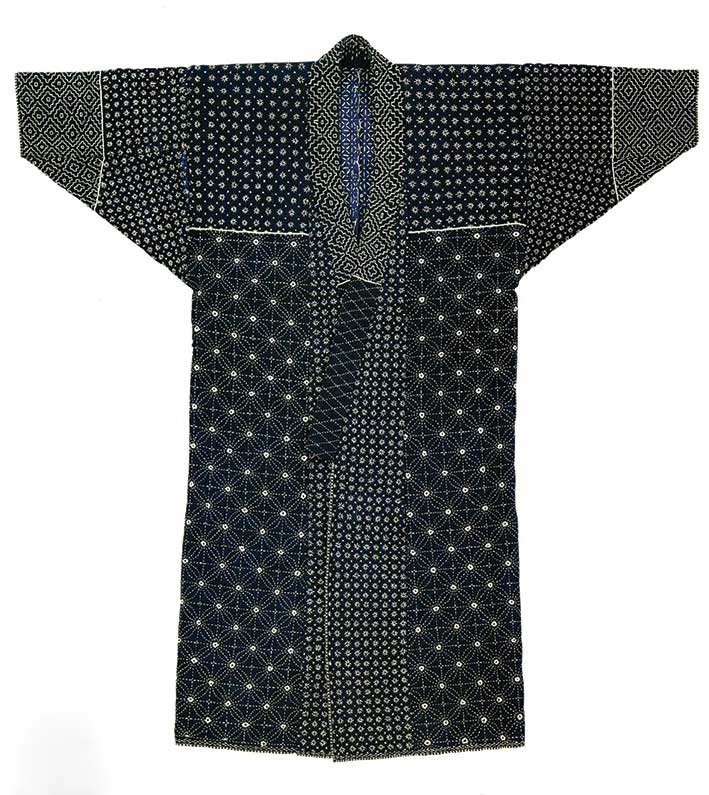
Awaji Island, in the Seto Inland Sea, is considered Japan’s ‘first island’ according to the Kojiki (712), and holds great cultural significance as the legendary birthplace of the nation, being the first island created in the Japanese archipelago by deities Izanagi and Izanami. Izanagi (Male-who-invites) and Izanami (Female-who-invites), are the central Shinto creator deities in Japanese mythology. They created Awaji Island as the very first of the Oyashima (eight great islands) of the Japanese archipelago. After descending from heaven, they stirred the sea with a spear, and the brine dripping from it formed Onokoro Island, where they established their home and began the kuniumi (birth of the land) process. It is also the home of sashiko no donza, Japanese indigo fisherman’s coats.
Situated between Honshu and Shikoku, the island served as a vital, historic, and agricultural conduit for the imperial court. During the Heian period (794-1185) and earlier, the island was first known as Miketsukuni, providing abundant food and marine products to the Imperial court. Today, it preserves ancient traditions in the Awaji Ningyo Joruri puppetry, traditional incense making, and is the location for significant Shinto sites, including the oldest shrine, Izanagi Jingu. It is also home to a distinctive regional dress – the fishermen’s coats of Awaji.
At the northern tip of Awaji, a steep-hilled island 50 kilometres long and 20 kilometres wide, lies just off the port city of Kobe. In imperial times the island’s name was changed to Mikkekoku (Land of Food) in recognition of the abundance of its farm produce and the seafood caught off its shores. Today, highways and bridges connect Awaji Island to its larger island neighbours, Honshu and Shikoku. Sadly, many of the historic buildings in the fishing villages were destroyed in the 1995 Great Hanshin earthquake.
Indigo-dyed quilted cotton coats called donza were traditionally worn throughout rural Japan prior to the 20th century. Like many traditional costumes that have fallen out of favour in past decades, the elaborately embroidered coats of the Awaji fishermen are no longer worn as indicators of status within the community. These coats are renowned for their intricate white-on-indigo geometric patterns, created by women to provide warmth and strength for fishermen. These heavily stitched, layered indigo-dyed cotton coats, popular through the 1920s, functioned as protective, durable work wear and stylish, symbolic garments for community festivals. The coats, which could take many months to make, represented care and protection. While most sashiko no donza were made by fisherwomen for their husbands or grandmothers for their grandsons, wealthier families would commission skilled needlewomen to embroider more elaborate sashiko designs. Many of these designs date back to at least the 17th century and were talismanic, protecting the wearer from misfortune at sea. The Iwaya Shinto shrine, on the northern tip of Awaji, still preserves a small number of these jackets for use at the annual Bountiful Fish Festival, where the creator deities of Japan, Izanagi-no-mikoto and Izanami-no-mikoto are enshrined.
According to historian Luke Roberts, of the University of California at Santa Barbara, who
co-curated the exhibition Japanese Fishermen’s Coats from Awaji Island in 2001 with Los Angeles County Museum of Art Japanese textile expert Sharon Sadako Takeda, sashiko no donza were rarely worn after 1930, when fishermen began putting engines in their boats and other forms of mechanisation significantly altered the way of life in the string of villages along the island’s northern coast. In the wake of industrialisation, men’s formal clothing styles changed to factory-made business suits and jackets. Running-thread sashiko quilting long practised by the fishermen’s wives and mothers was replaced by machine-stitched clothing. Thanks to one man’s determination, however, more than 20 fine examples of the island’s unique sashiko no donza have been preserved. In 1975, Tominaga Takashi began a personal mission to collect sashiko no donza historical artefacts from the five villages that comprise the town of Hokudan. Among the representative items of the region’s fishing culture that Tominaga acquired are thousands of clay octopus pots, some dating from the Jomon period (circa 10,000 BC to circa 300 BC). As well as collecting old fishing gear for his museum, he searched out examples of the garments fishermen wore – not for work on the boats, but for related activities such as selling fish and the annual blessing of the fishing boats.
Although farmers in northern Japan also traditionally wore sashiko-quilted coats, on Awaji Island and throughout much of central and southern Japan they were worn solely by fishermen and sailors. The fishermen wore their sashiko no donza about town, to parties, while visiting friends, and while assuming positions of authority on the job. Sailors wishing to appear well-dressed wore them into ports of call for an evening’s entertainment.
Wives and mothers created these coats for their menfolk. The finest, most elaborate of them, which took from two to six months to complete, were saved for special or formal events. Fishermen would wear the coats unbelted – without either the traditional straw rope (nawa) obi worn for work or the silk obi used for dressing up – so that the designs enveloping the body could be viewed without obstruction.
Since no two sashiko no donza are identical, people would marvel at the different designs. The construction of sashiko no donza differs from most Japanese quilted items, which are padded with unspun cotton. When wet, such wadding becomes heavy and is slow to dry. Instead, sashiko no donza were composed of three or more layers of dyed cotton fabric stitched together with white cotton thread. More like thick darning yarn than fine thread, the overall patterning of white stitching added another layer of protection against cold and damp weather, as well as identifying the wearer’s occupation within the feudal hierarchy.
The most intricately stitched sashiko no donza patterns dazzle the eye, visually transforming the flat surface of the cloth into three-dimensional shapes. Each coat part – front, back, centre-front overlaps, collar, and sleeves – functions as a logical, predetermined section on which to organise different sashiko stitch patterns. Many of the coats are simply decorated with parallel vertical running stitches.
Others feature dense zigzag or herringbone designs or variations on traditional persimmon flower and lozenge patterning. The most locally derived of all the sashiko patterns are the geometric grids overlaid at each intersection with criss-cross stitches which, in appearance, resemble the knotted configuration of fishing nets.
While sashiko no donza are still worn by performers during the Bountiful Fishing Festival, held at Awaji Town on the second Sunday of March each year, their proud role as distinctive regional costume has almost faded into the realm of cultural memory.


