

This exhibition continues our theme of botany and empire, exploring the link between Britain and East Asian and South Asian worlds. The connection is the East India Company (EIC) and its unrelenting drive for enhanced profits through the discovery, scientific analysis, and study of plants with potential commercial profit in Asia. Sitting alongside the Company’s demands are the interests of amateur scientists, often surgeons of Scottish origin that were attached to the EIC, initiating their own research of the natural world. In some cases, these plants of empire were also the catalyst for ware and the struggle of competing empires for control of botanical sources – the earlier wars the British fought with the Dutch for the spice routes (nutmeg) and the later struggle to maximise profits of something quite different – tea (and its consequences) in the Opium Wars (1839-1842 and 1856-1860).
Oxford Botanical Garden
The story told in this exhibition is linked to the Oxford garden that helped the scientific study of plants with an original gentler aim than the brash profits of empire. The Oxford Botanical Garden is the oldest example of its type in the UK, founded in 1621 by Henry Danvers, 1st Earl Danby. Originally established as a ‘physic garden’ to grow medicinal plants for teaching and research at the University of Oxford. While many of the original plantings were European medicinal herbs, 17th-century gardens quickly began importing plants from wider areas as trade routes expanded, including Asia and beyond. The early part of the exhibition explores the work and international connections of these early scientists and the establishment of established scientific bodies in the British Isles.
The Ashmolean Museum itself owes its existence to two obsessive gardeners who set out to ‘collect the world’. In the 17th century, John Tradescant the Elder and the Younger, gardeners to royalty and aristocracy, travelled to the Low Countries, France, Russia and North America, gathering plants, seeds, specimens and intriguing objects that later formed the Ashmolean’s founding collection.
Many of the most beloved species of plants and flowers in Britain, including tulips, roses, orchids and camellias, reached the country through the networks of empire linking Europe, Asia, Africa, and the Americas. Seeds, dried specimens and living plants travelled along the same maritime and commercial routes that transported people and goods, a movement that often depended on the expertise of local people that went unrecorded in Western accounts. Some arrivals triggered intense public interest. Tulips fuelled the Dutch speculative bubble known as ‘tulipomania’ which, at its height in the 1630s, saw rare tulip bulbs being sold at the cost of a canal-side house. These plants were natives of Central Asia, from such high mountain ranges as the Pamirs, but were eventually imported into the Ottoman Empire. Ferns, orchids and rhododendrons too inspired later Victorian collecting frenzies. Other plants also became woven into the fabric of everyday life.
Hortus Malabaricus
The earliest drive to document useful or medicinal plants in India is credited to the Dutchman, Hendrik van Rheede tot Drakestein (1636-1691). Vinita Damodaran in her essay Botany and Empire, In Bloom catalogue, writes it was van Rheede ‘who pushed the boundaries of knowledge even further, and took it upon himself to compose a materia medica for the Malabar region. For him, the aesthetic qualities of the Malabar forest and its plants were unsurpassed. Compiling the Hortus Malabaricus, a twelve-volume illustrated ‘Herbal’ (a book that describes plants and their culinary and medicinal properties), was a stupendous exercise for van Rheede and his team, which included European engravers and native informants and took over 25 years to complete. It was published between 1678 and 1693, and is now regarded as the first survey of tropical botany in South Asia’.
Many tales of plant exploration and discovery relating to botany and empire come from the Americas, South Africa, and beyond are also found in the exhibition, including one plant that has become a sympathetic friend, comforter, and pick-me-up in Britain for centuries. It also was one of the British Empire’s most important commercial botanical trading connections with Asia – tea. Tea, now integral to British identity, grew into a powerful commodity whose cultivation and trade had far-reaching economic and political effects.
The Tea Trade, Botany, and Empire
The tea trade was inextricably linked to the demand for Chinese porcelain and the need to counteract silver outflows by trading Indian cotton and opium for tea. By the early 1840s, Britain was emerging as one of the world’s most powerful nations with colonial expansion a large part of the nation’s drive to power. The EIC still maintained its strength and eye on territorial expansion, although its role had shifted from a purely mercantile business into an ‘agency’ for the British government. It had also lost its monopoly on Indian trade in 1813 and the monopoly on the tea trade was revoked in 1833 (the sole right to import tea was given in 1700). There had been a rise in private merchants, although technically illegal, who traded in goods (including opium and textiles) out of Canton.
Objects relating to the story of tea in the exhibition include a pair of 18th-century tea jars. Even as China had opened up to a controlled trade with foreigners, Qing-dynasty China continued to strictly forbid foreigners to travel to the interior, to learn how tea was cultivated, or manufactured. The trade in tea was also strictly controlled by Chinese officials through the Canton System. After the Second Opium War and the Nanking Treaty, which allowed Britain to settle on the barren island of Hong Kong and four other ports, along with Canton, were opened to foreigners: Shanghai, Ningpo, Foochow, and Amoy. In the 1840s, to break a weakened China’s monopoly on tea, the Horticultural Society in London sent Scottish botanist and plant hunter Robert Fortune to carry out industrial espionage on their behalf.
The Plant Hunter Robert Fortune in China
Fortune had trained at the botanical garden in Edinburgh before accepting a job at the Horticultural Society – and learned another surprising skill – adopting a disguise as a Chinese mandarin accompanied by his servant Wang. It was at the society’s bequest that he travelled to China to learn about their gardening techniques, collecting new plants and seeds. On another trip in 1848, Fortune was sent by the EIC for ‘the purpose of obtaining the finest varieties of Tea-plant, as well as native manufacturers and implements, for the Government plantations in the Himalayas’. He amazingly managed to transfer to the foothills of the Himalayas approximately 17,000 seedlings, along with eight Chinese tea growers and their equipment. This allowed tea gardens to be established in Assam and Sikkim, samples to be sent to the Calcutta Botanical Gardens. By the 1860s there were over 100 tea gardens in India.
Chinese plants such as the tiger lilly (found by the plant hunter William Kerr), Hydrangea macrophylla, the tree peony (Paeconia suffruticosa), and chrysanthemums had already started to appear in Britain in the 18th and early 19th centuries. The beautiful Wisteria sinensis is believed to have been introduced (through seeds) in 1816 by John Reeves (1774-1856), a retired tea inspector who sent back specimens while being stationed in Canton.
As European demand for profitable and desirable plant species grew, collecting and cultivation began to reshape local ecologies and economies, especially in the colonies or empires. In many colonised regions, land was reorganised for export crops and large single-species plantations, creating ‘monocultures’ that replaced local biodiversity and made communities more vulnerable to environmental and economic shocks. For example, Britain’s role in the opium trade, which contributed directly to the Opium Wars, was a notoriously exploitative chapter in the nation’s history. The global spread and demand for tea along with other cash crops shows how botanical collecting, commerce, and imperial ambition often carried consequences beyond the plants themselves.
Company School Paintings
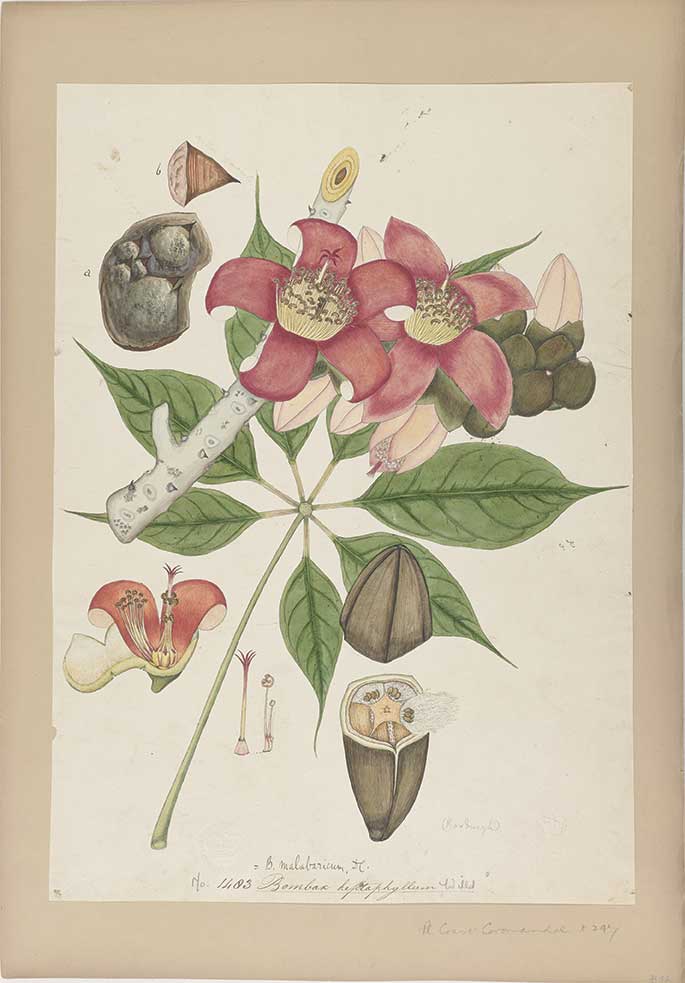
Whereas the plant hunters were physically seeking out new plants and seeds, others who worked or lived in India, and to some degree in China, were anxious to record them as objects of scientific study, and often for commercial reward. There is a great tradition of Scottish surgeons in the employment of the EIC who have left tangible records of their curiosity, research, and ambitions. Drawings were commissioned from local artists to depict plants in a detailed and life-like manner and those from India have come to be known as Company School paintings – a mix of local painting styles and scientifically correct documentation of the subject matter.
Martyn Rix in his essay Art and Botany, In Bloom catalogue notes that the French, operating from their base in Pondicherry, South India, also used artists to create botanical paintings. ‘Local artists had been employed by the Mughal rulers, and a fine tradition had become established in Lucknow, so they were soon employed by the French to record interesting plants’. A well-known character from this period was Claude Martin (1735-1800), who was a French soldier in the service of the EIC. He became a pioneering patron of botanical art in Lucknow, one of the main centres for Company School art. He commissioned over 1,800 botanical and zoological drawings for his collection. A selection of these works are now in the collection of the Royal Botanic Gardens at Kew. In the case of a painting of garden peas [not in the exhibition, but in the catalogue], it clearly shows the meeting of the Mughal and European styles of plant illustration. Another illustration commissioned by Nathaniel Wallich (1786-1854), the Danish doctor and botanist, and successor to William Roxburgh at the Calcutta Botanical Garden, is the detailed painting of Begonia multijuga by Vishnupersaud (fl 1810s-30s).
An important innovation that greatly helped the survival of plants during their long voyages back to Europe is the Wardian Case, a sealed glass container, invented by Dr Nathaniel Ward in 1829 and successfully used commercially for transport by 1833. An example dating to the 1870s is on show in the exhibition. This ingeniously simple solution facilitated long-distance plant transport and made it possible for living specimens to survive long voyages, encouraging the mass movement of plants across the world, although the invention would have a significant effect on colonised and indigenous peoples.
In Bloom brings a fascinating insight into the relationship between plants and people and the history of botany and empire by documenting the journeys of Britain’s most familiar blooms and their arrival in the UK. Featuring more than 100 artworks, including botanical paintings and drawings, historical curiosities, and new work by contemporary artists, the exhibition follows the passion and ingenuity of early plant explorers and the networks that influenced science, global trade, and public consumption. It was during the Age of Discovery in the West, in the 16th and 17th centuries, that new species began to appear in Europe from the Americas and Asia, this exhibition looks at these imports over the centuries to discover how plants have changed the world, related to botany and empire, and left a legacy that still shapes our environment, food and drink, and horticulture and gardens today.
Until 16 August, Ashmolean Museum, Oxford, ashmus.ox.ac.uk. Catalogue available.


