

The mighty range of the Himalayas spans five countries: Bhutan, China, India, Nepal, and Pakistan. Stretching roughly 2,400 km, this range forms a natural, high-altitude border between the Indian subcontinent and the Tibetan Plateau, with Nepal and Bhutan located almost entirely within the mountains. These countries produce a distinctive brand of Himalayan culture. However, the modern-day geopolitics of the Himalayas have transitioned from a natural buffer zone separating the Indian subcontinent from Central Asia into one of the world’s most tense, militarised borders, primarily driven by the competition between India and China for regional supremacy.
Precolonial history saw the Himalayas act as a cultural and economic bridge rather than a strict border. Small kingdoms (Ladakh, Bhutan, Sikkim, Nepal) and Tibet maintained fluid trade and religious exchanges with the trade routes connecting these high mountain worlds. This allowed different cultures to flourish and spread with a rich mix of local religions, shamanism, Buddhism, and Hinduism shaping the nomadic population’s culture with aesthetic tastes evolving in the region of diverse landscape and distinct regional kingdoms.
The Tibetan Empire
The Tibetan Empire (7th-9th centuries) formed a major hub along the Silk Road, bridging trade and cultural exchange between China, India, and Central Asia, commanding key sections of the Silk Road in the Tarim Basin, while the tea-horse trade connected the Qinghai-Tibet Plateau with central China. Buddhism entered Tibet primarily through these trade networks during the 7th century. By the 8th century it had become established as the state religion, with scholars and monks travelling between India, China, and the Tibetan plateau, making the region a cultural bridge.
The cultures in the Himalayas are the results of this cross-fertilisation and the Indic and Tibetan civilisations. All the peoples of the Himalayas, despite their culture or ethnicity, consider its peaks, lakes, and rivers holy. The Sanskrit word himalaya literally means ‘house of ice or snow’. In Hindu mythology, Himalaya is personified as the father of the goddess Parvati, ‘daughter of the mountain’. She resides with her spouse, the Hindu god Shiva, on Mount Kailash in West Tibet, a mountain peak that is equally sacred to Tibetan Buddhists, who regard it as Mount Meru, the axis of the world that connects the celestial and earthly realms. Therefore, it is no wonder that the arts produced in this realm of the gods should primarily reflect divine forms. The mountains are also home to numerous spirits and semi-divine beings, peaceful and wrathful celestials that vary from region to region, from passes to valleys, sometimes from village to village, hence the great diversity of their representations.
Hindu and Buddhist Deities
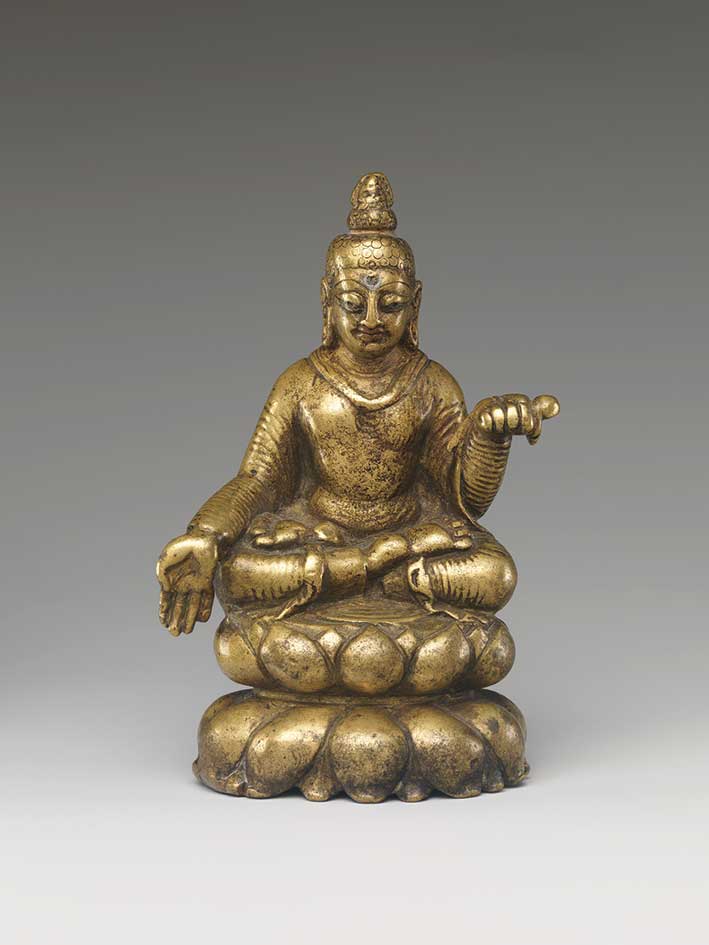
These sculptures and paintings of Hindu and Buddhist deities give viewers a glimpse of the divine in tangible form and are an important part of Himalayan culture. As these objects serve religious purposes, it is imperative that they conform to established iconographic precepts, essential for both Hindus and Buddhists, to visualise and eventually enable a pilgrim or worshipper to unite with a deity during prayer. Although it might appear that personal expression was not considered a virtue in creating these works, it would be untrue to say that the artists who created these paintings and sculptures were unconcerned with aesthetics. In fact, the artists of the Himalayas were remarkably inventive in their response to formal directives. Individual talent and eccentric tastes are universal and irrepressible. By examining these religious works, one can begin to understand both the spiritual and aesthetic considerations of generations of unknown master artists of the Himalayas.
Hinduism, the ancient religious practice of the Indian subcontinent, has no precise date of origin. It is monotheistic in philosophy and pluralistic in practice. The ‘Ultimate Being’ in Hindu belief is formless but can assume many forms, creating a diverse and plentiful pantheon (Indra, Shiva, Vishnu, and Devi are examples) and through the ages a mythology has been created to support it that, at the same time, provides a rich repertoire and inspiration for artists.
Buddhism recommended a simpler spiritual path involving meditation and mental discipline. The worship of a single deity was not incorporated into Buddhism, but the well-established Indian ideas of karma, rebirth, and nirvana were accepted. In due course, however, Buddhism could not escape the spell of devotion and the strong urge to seek the help of gods and goddesses for both material and spiritual welfare. This led to the creation of a Buddhist pantheon and the introduction of rituals that brought it close to Hinduism. Both religions, however, continued to flourish in the Himalayas, with Buddhism becoming the principal faith in Tibet, where Hinduism is not specifically practised.
Similarities Between Hinduism and Buddhism
Although Hinduism and Buddhism are separate faiths, with distinct philosophies, rituals, and arts, they have strong similarities and are a vital part of Himalayan culture. Both share similar aesthetics and stress the idea of personal devotion. Both have been influenced by yoga and tantric practices. While religion has been the principal inspirational force for the creation of most of the arts across the Himalayas between the 17th and 19th centuries, the courts of the hill states in northern India encouraged artists to paint pictures that did not have a religious function. Their subjects were often derived from religion, even though the painting’s purpose was really to provide aesthetic pleasure.
Until the mid-18th century, when the kingdom now known as Nepal was established under the rule of Prithvi Narayan Shah, the designation ‘Nepal’ generally referred only to the Kathmandu Valley. Throughout this central valley, the indigenous Newar people have been noted as builders and artisans, responsible for creating most of the temples and shrines, and for maintaining an artistic tradition rich in painting and sculpture. These indigenous people were responsible for creating most of the artworks and architecture in the Kathmandu Valley. Generally, these artists were professionals and of a separate class with divisions for Buddhist and Hindu communities with Buddhism being the dominant religion. The Newari culture is distinguishable from the other people living in the Kathmandu valley with their language related to the Tibeto-Burman family and distinct from the Nepali language which belongs to Sanskrit.
Their Himalayan culture is often seen as the bridge that connects the Tibetan culture of the north and the Sanskrit culture of the Indian subcontinent, having absorbed influences from both through their roles as traders and craftsmen. Yet though Nepali artists may have borrowed aesthetic norms and artistic conventions from India, they very quickly assimilated them to give expression to their own aesthetic impulses. Works of art from Nepal cover a period of more than a thousand years of Newari creativity and demonstrate the Nepali aesthetic penchant for slender proportions, restrained sensuousness in modelling, clean silhouettes, and youthful faces with gentle expressions.
The Arts of Nepal
Being an artist in Nepal was usually a hereditary occupation, and several families in the Kathmandu Valley, which to this day remains the major cultural centre of the nation, continue the tradition. The Newars are divided into Hindu and Buddhist communities, the latter being more numerous. This predominance of Buddhism facilitated the access that Newar artists and merchants had to Tibet. Since approximately the 7th century, Newari artists and artisans have been an inspired presence across Tibet, contributing to the art and aesthetic history of that country.
The artists of the vast area of the western Himalayas, stretching from Kashmir in the west, to roughly Mount Kailash in Tibet in the east, and including the modern Indian state of Himachal Pradesh, seem to have shared a common aesthetic between the seventh and 13th centuries. The mountain is a profoundly sacred site, revered as the spiritual centre of the universe by both Hindus and Buddhists, as well as Jain and Bon followers. Hindus believe it is the home of Lord Shiva and his consort Parvati and is a path to moksha, while Buddhists view it as the home of Chakrasamvara (Buddha Demchok) representing supreme bliss – and the manifestation of Mount Meru, the centre of the universe. The mountain is associated with tantric master Guru Rinpoche (Padmasambhava), who brought Buddhism to Tibet, and the poet-saint Milarepa, who is believed to have won a magical duel against a Bon practitioner to secure the mountain for Buddhism. Its significance for all religions is highlighted by the tradition of kora (circumambulation) to wash away sins.
Buddhism in Kashmir
At the far end of the Himalayas, another culture’s creativity and aesthetics is witnessed in a small valley in Kashmir. The majority of the people in Kashmir follow the Islamic faith with the process of conversion having begun in the 14th century with the conversion by the Sufi saint Babul Shah of the first Kashmiri ruler, the former Ladakhi Buddhist monk Renchan, who adopted the name Sadr-ud-Din (ruled circa 1320-1327).The rise of the Shah Mir dynasty in 1339 solidified Islamic rule in the region. However, from the 7th century until the 14th century, Kashmir was the hub of Hindu and Buddhist religious and intellectual activity, which had a profound effect on the arts within Kashmir and beyond.
Travel by monks from Kashmir to central Asia, China, and Tibet abetted the migration of artworks and aesthetic style, as the area was on a route for pilgrims on their way to India. This allowed artistic styles to be disseminated in both directions. Early figural works at this time are characterised by round, fleshy faces, often with inlaid silver eyes, and stocky, robust bodies. A particular feature of the Kashmiri aesthetic is the depiction of luxurious textiles, with which the region had been long been associated, in examples of their decoration of metal sculpture, which showed intricate engraved patterns and inlays of copper and silver on the garments. It was also seen in painting techniques, with the delineation of sumptuous brocades, highlighted with gold.
Unlike Kashmir and Nepal, where both Buddhism and Hinduism inspired the arts, in Tibet Buddhism became the principal religion alongside the native Bon religion. Tibetan Buddhism has an extensive pantheon of deities that have provided rich visual inspiration for centuries of artists. The diversity of these figures and depiction of deities is bewildering to non-experts. In addition to Buddhas and bodhisattvas, there are yidam (personal deities) who can be both benign or wrathful; Dharmapalas (defenders of the faith); and numerous protective deities.
Tibetan Pantheon
As it developed, the Tibetan pantheon also accommodated innumerable regional and local spirits and nature divinities, expanding the aesthetic possibilities in proportion to their cosmic numbers. Although the idea of spiritual lineages of teachers is of Indian origin, neither in Kashmir nor in Nepal is there such visual exaltation of human teachers as exists in Tibet. The exaltation of lineage and spiritual teachers (lamas) is the foundational structure of Tibetan Buddhism, ensuring unbroken transmission of teachings from the Buddha to the present day. This tradition places immense value on the living lineage, the chain of realised masters whose experiences are passed down, rather than just intellectual knowledge, as can be seen in the choice of and reverence for the 14th Dalai Lama in the world today.
Although with the advance of technology from the 20th century, religious sculpture and aesthetics in Tibet have a rival – it is a photograph of the Dalai Lama, rather than a sculpture that would be seen in a home today, with the memory of past reincarnations held in the sculptural figures of the past.
MORE INFORMATION on HIMALAYAN CULTURE
• Himalayas, An Aesthetic Adventure, The Art Institute of Chicago
• Tibet: Treasures from the Roof of the World, Bowers Museum
• From the Sacred Realm: Treasures of Tibetan Art from the Newark Museum
• Himalayan Art in 108 Objects, Rubin Museum
• Collecting Paradise: Buddhist Art of Kashmir and Its Legacies, Rubin Museum
• Mandalas: Mapping the Buddhist Art of Tibet, The Metropolitan Museum of Art
• Realms of the Dharma, LACMA
• The Dragon’s Gift: The Sacred Art of Bhutan, Honolulu
• Himalaya: A Human History by Ed Douglas, Bodley Head


