

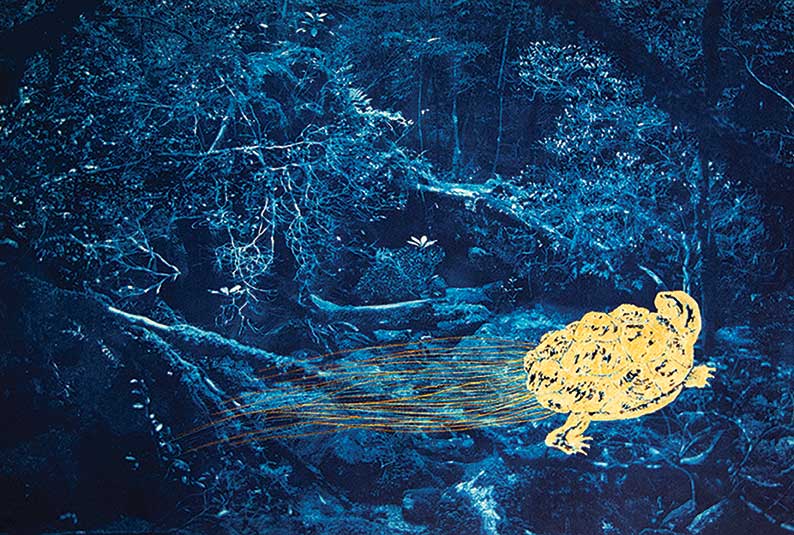
The National Maritime Museum in Amsterdam is showing the exhibition Eko – Japan in Two Visual Narratives. Curated as artists conversing across time, the show juxtaposes early photographs of Japan from the museum’s own collection, including those by Felice Beato (1832-1909), with the contemporary work it inspired, as captured by photographer and visual artist Anaïs López.
In 1859, photography was flourishing in Japan after the country opened its ports to international trade. As gateways to areas still unknown to the West, port cities were inextricably linked to photography. The burgeoning photo industry at the beginning of the Meiji period (1868-1912) found a good market in the influx of Westerners to Japan. Initially the photos were taken as souvenirs, but they soon served as travel guides. Immediately after arriving in Japan, the tourist often visited a photo studio first. There, he ordered the beautifully made photo album that would help him determine his itinerary. It is notable that these photos also became increasingly popular among a Japanese clientele. They even competed with the woodcut market. This was because these photographs revealed an astonishing virtuosity, not only in composition but also in the technique of hand colouring. The latter brought a new level of liveliness to the photos.
Oldest Photographs in Japan
In Japan Two Visual Narratives, the photographs collected by the Dutch consul Dirk de Graeff van Polsbroek (1833-1916) are among the oldest taken in Japan. Although De Graeff was not a photographer himself, his support proved indispensable to the most influential foreign photographer of the time: Felice Beato. From a European perspective, the Anglo-Italian Beato created a carefully staged image of Japan that met the expectations of a Western audience. Beato arrived in Japan at the age of 31, before which he already had a career as an international photo-reporter having worked in Greece, Malta, India, and the Middle East with his brother Antonio and his friend and brother-in-law James Robertson. He had documented the Crimean War, the aftermath of the Indian Rebellion in 1858, then he was in China in 1860 during the Second Opium War. In all his travels, he was not only working from the front lines but also showing interest in and recording the local cultures. In Japan, however, his fame increased, because of his pioneering work in photography, both in the sense of the photographic quality of his black and white photo shots, where focus and contrast were always the best, compared to the technologies of the time. He also taught Japanese photographers the technique with aniline and water colours on albumen prints, which made the first photographic productions of Japan in the 19th century.
Felice Beato
Beato’s photos can now be seen as a detailed catalogue of the types, fashions, and everyday life of the era in Japan, re-created in a studio setting. These images were often enclosed into oval and fading frames using as a backdrop painted scenery that recalled famous places such as Mount Fuji, hot springs, and other well-known tourist destinations of the time, such as pilgrimage sites. The mixing up of common Western imagery, Japanese culture and society along with samurai imagery and depiction of bijin-ga (beauties) that wereoften depicted in 18th and 19th century ukiyo-e (floating world prints), attracted both foreign visitors visiting Japan for the first time as well as the curious buyers who had never visited Japan but wanted to glimpse and ‘experience’ the Far East from the comfort of their homes in the West. This could be done through buying photographs or looking at the engravings that were printed in such newspapers and journals such as The Illustrated London News.
Reprints and copies of Beato’s photographs spread far and wide, encouraging a visual blueprint of a supposedly exotic country, a blueprint that continued to influence photographers well into the present day. Other photographers continued to insert and use Beato’s shots in their own albums without any regard to copyright, adding hand-colouring to the prints in each studio’s unique style. At the time, these images represented a new way to create souvenirs, as photographs were easily reproduced whilst at the same time being able to convey through hand-colouring techniques an original touch that allowed diversification and made them a unique and individual image.
This exhibition features the three photo albums that Dirk de Graeff van Polsbroek left behind from his time in Japan, now in the collection of The National Maritime Museum. These include the oldest album produced by Beato in Japan, from 1863, and a precursor to his famous Photographic Views of Japan – albums of souvenir photos that he began marketing in 1868. Beato collaborated with Japanese experts from block printing workshops, who coloured the photos by hand – a practice built on existing Japanese image traditions.
At the time, they represented the new souvenir and image market. Photographs were easily reproduced whilst at the same time being able to convey through hand-colouring techniques an original touch that allowed diversification and made them a unique and individual image. With the colours, applied with the skill of the painters in the photographic studios, the photographs recall the beauty of colour of woodblock prints created by the great ukiyo-e artists such as Hokusai and Hiroshige, who were already famous among contemporary Japanese and the foreign public alike.
De Graeff’s Albums of Japan
The photos in De Graeff’s albums are now considered of great cultural and historical value, produced during the Bakumatsu (1853-67), the final years of the Edo period (1603-1868), when the Tokugawa shogunate ended, in which Japan rapidly transformed from a feudal state into a modern empire. De Graeff’s albums serve as a primary source for research into early photography in Japan. The exhibition highlights the role that the Dutch diplomat played in the creation of these early images.
In parallel, for Japan in Two Visual Narratives, the work of Anaïs López from her book The Turtle and the Monk is also on display. Using photography combined with special printing techniques, such as gyotaku and photopolymer etching, the artist takes visitors on a unique, personal, journey of Japan. López creates multimedia narratives at the intersection of fiction and documentary, addressing universal themes from her perspective. For each project, as a storyteller, she immerses herself in intensive research, which she then translates into a layered and visual narrative. Here, López takes her audience to fabulous worlds that are often closer to the truth than they seem at first glance, with the journey in this instance taking over seven years.
Until 30 August, National Maritime Museum, Amsterdam, hetscheepvaartmuseum.com
MORE INFORMATION – JAPAN IN TWO VISUAL NARRATIVES
• The Turtle and the Monk by Anaïs López is available for purchase at the museum shop of The National Maritime Museum, Amsterdam
• The photo albums of Dirk de Graeff van Polsbroek (1857-1869) by Sara Keijzer, curator of the exhibition. This second publication is based on new research into the three photo albums of Dirk de Graeff van Polsbroek
• Lost Japan: The Photographs of Felice Beato and the School of Yokohama (1860-1890) by Rossella Manegazzo, Skira


