

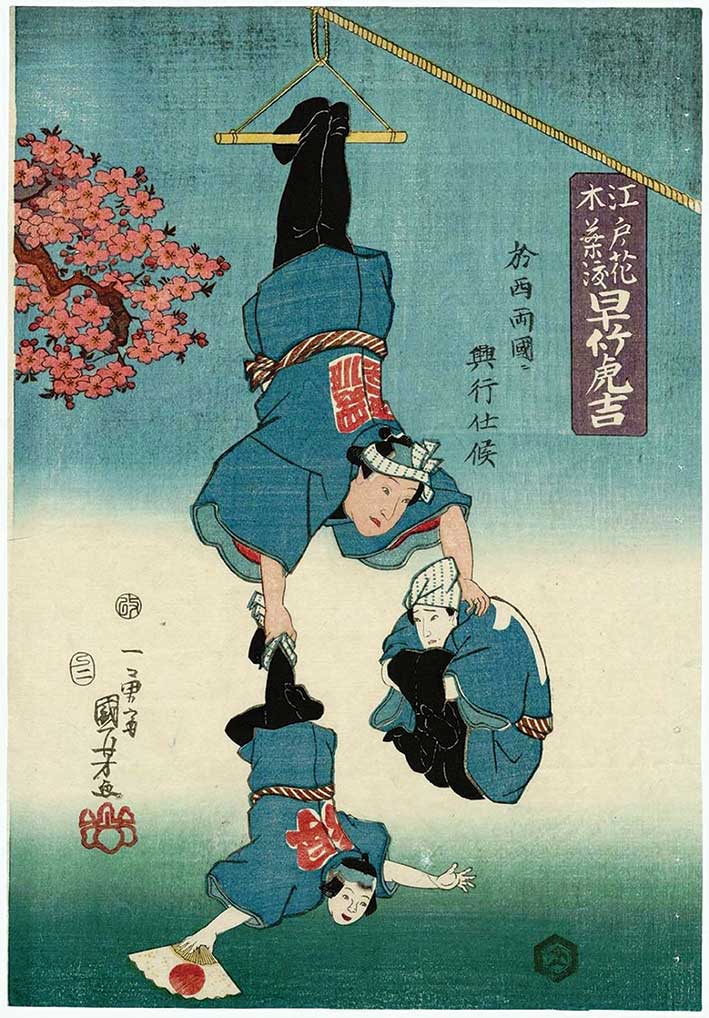
This special exhibition in Nice, France, invites us into the spectacular and colourful world of street artists. Dancers, storytellers, musicians, and acrobats, are all depicted as free spirits in a timeless world that traverses centuries. In the prints, these Japanese street performers transform the space into a stage and the everyday into a celebration, at a crossroads of the sacred, the popular, and the wondrous.
In Japan, street artists played an essential role in the transmission of stories, knowledge, and emotions to a public that was increasingly looking for entertainment. Their creativity continues to permeate Japanese culture today, from cinema and comics, to theatre and the public arts. This exhibition Saltimbanques au Japon (Street Performers/Circus Entertainers in Japan) invites us to explore this constellation of itinerant artists who entertained the Japanese during the Edo (1603-1868) and Meiji periods (1868-1912), through 70 prints from the collection of Jeanne-Yvonne and G Edard Borg.
Marginalised since ancient times, street performers occupy a unique place in the cultural and visual history of the country. During the Edo period (1603-1868), the ruling Tokugawa shoguns attempted to control public morals and provide personal security by creating entertainment districts in which prostitution was licensed. Jugglers, acrobats, tightrope walkers, animal trainers, illusionists were pushed into these areas. In the Tokugawa capital of Edo (modern-day Tokyo), the Yoshiwara district was the government-regulated pleasure quarter in which the courtesans conducted their business., and artisans traditionally performed in public squares, near shrines, and during seasonal festivals. Other cities such as Kyoto and Osaka also maintained entertainment areas, or pleasure quarters, for the public to frequent.
Acrobats and Dancers in Japanese Prints
Since at least the Heian period (794-1185), street performers entertained the public with a variety of activities, including music, dance, acrobatics, juggling, and magic tricks, in exchange for a few coins with their performances having their origins in traditional dances and rituals stemming from Shinto and Buddhist beliefs. These practices are often grouped under the term misemono, which literally means ‘things that are shown’ and encompasses all sorts of curiosities and astonishing phenomena designed to arouse wonder and curiosity in the public, including the display of wild animals. It was not uncommon to encounter these entertainers during festive periods throughout the year, particularly at the New Year, where their role was to purify and ward off evil spirits in order to begin the year with auspicious beginnings. These traditions continue to this day, so it is not uncommon to stumble upon a lion dance or other acrobatic performances while travelling around the archipelago during festivals.
During the Edo period, the urban population was growing and popular entertainment experienced an unprecedented growth in the city. The public, eager for images and stories, became captivated by street performances, and ukiyo-e artists strived to capture this atmosphere, excitement, and latest fashions, and this included the street performers appearing in Japanese prints.
After more than 250 years of isolation, Japan was forced to finally open itself to the world in 1854. During the Meiji era, the rapid modernisation of the country’s cities, encouraged even more people to move to urban centres and facilitated the burgeoning middle classes. These urban classes helped support the evolution of popular entertainment in their thirst for diversion and amusements. Some prints from this period retain iconography inherited from the Edo period, while others incorporate new influences and look to this modern and transforming world for inspiration. In the newly opened port cities, such as Yokohama, Kobe, Nagasaki, Hakodate, and Niigata (the Treaty Ports), newly introduced Western circus performances captivated a population torn between curiosity and reserve.
Professor Risley and the Arrival of the Circus
At this time, the American Richard Risley Carlisle (1814-1874), known as ‘Professor Risley’ and his circus troupe arrived in Yokohama, where they performed for the public. He was an acrobat and adventurer, hailing from New Jersey in the US. In 1858, after training and performing across Europe, he formed his own circus troupe in London and set off to tour Oceania and Asia, performing in Hawaii in 1860, and in Sydney in September of the same year. By 1861, his troupe was in Singapore and had progressed to Shanghai in 1863, from where they set off for Japan and their well-received performances in Yokohama. The original troupe comprised 10 acrobatic performers and eight horses.
Risley’s arrival in Japan had opened doors to other circuses, such as that of the Frenchman Louis Soullier in 1871, whose equestrian acrobatics performed by female riders particularly astonished the Japanese public. But the troupe that most fascinated the inhabitants of the archipelago, even performing before Emperor Meiji, was the circus of the Italian Giuseppe Chiarini, which arrived in Tokyo in 1886. It was the first time the Meiji emperor had seen a circus and he rewarded Chiarini with $5,000 in gold. The circus went on to tour throughout Japan, bringing with it clowns and a large menagerie of exotic animals, including a lion and an elephant. Prints depicting these circus performers are on show in the exhibition.
Less well-known was the Australian Woodyear Circus, which performed in Japan in 1888, demonstrating Japan’s continuing fascination with circus performers. This fascination was to go both ways – Risley’s encounter with local travelling entertainers inspired him to take a group back with him to perform in the US. In this reciprocal exchange, Japanese street performers aroused the admiration of Western audiences, and they were even captured on early ciné reels.
Circus Animals
Circus animals were also part of the main attractions. Japan has had a long fascination with wild animals and one animal that was often depicted is the monkey. Throughout history, and in many cultures, the monkey has embodied an ambivalent symbolism: it is both learned and comical. In Japan, during the Kamakura period (1185-1333), it was considered the messenger of the gods and the protector of horses, keeping them company in the stables. Due to its sacred and benevolent nature, it was displayed at the imperial court during the New Year, as part of the purification rites specific to this period. During the Edo period, in the late 17th and early 18th centuries, as samurai culture became established, the role of monkey training (sarumawashi) changed for a formal religious ritual into popular entertainment, relegated to the ranks of other street performers.
Other prints in the exhibition illustrate the great public displays of during the seasonal festivals in Japan. New Year, the changing seasons, the commemoration of the dead, and other religious festivals, are all occasions for celebration and a chance to give tributes to deities and ancestors. They also make wonderful subject matter for prints. Originally, festivals were held in two parts – the first called matsuri, a term still used today, was dedicated to the religious aspect of the festival and communion with the deity through prayers and ablutions. The second, called sairei, encompassed religious activities intended to entertain the deity and, more generally, the public.
And there is no better form of public entertainment to attract the crowds than acrobatics. This form of entertainment is believed to have arrived in Japan from China in the 7th century. Karuwaza is a general term covering what in the West would be called acrobatics – such as juggling, wire walking and balancing acts. Karu means light, or agile, waza is trick or business – and there is also a secondary meaning of ‘risky business’. During the Muromachi period (1392-1573) a form of acrobatics – largely wire walking and paper walking – called ‘spider dancing’ (kumomai) was sponsored by aristocrats and military leaders as a type of religious entertainment and incorporated into kabuki. When women (who were usually courtesans) were banned from performing in kabuki in the 17th century, these roles were taken over by young boys aged eleven to fifteen.
Street Performers in Japanese Prints
With growing urbanisation in the Edo period, these acrobats began to perform in cities and towns for the enjoyment of all classes of society. By the 15th century, various acrobatic, dance, and parade activities had taken precedence over the religious dimension of the great public festivals. Today, these celebrations continue to punctuate the daily life in Japan.
Another form of acrobatics features firefighters. In 1657, the Great Fire of Meireki, which claimed 100,000 lives, devastated 70% of the city of Edo. Built primarily of wood and bamboo, Edo was particularly vulnerable to fires, which were known as the ‘Flowers of Edo’. Nearly 2,000 fires broke out over two and a half centuries, 50 of them major. In this battle, firefighters played a vital role, perched on their ladders, watching for potential hotspots to protect the population. The Dezomeshiki, a ceremony traditionally held in early January to mark the start of the New Year, originated from the need to raise public awareness of fire risks. This festival features acrobatic displays, where firefighters, perched on 6-metre-high ladders (hashigo-nori), demonstrate their agility. There are also parades and demonstrations of brigade manoeuvres, processions of traditional costumes, depending on the region and era, as well as fireworks. Today, firefighters perpetuate this tradition, blending ancient gestures with modern practices. A print of firefighters performing at New Year by Hiroshige Utagawa III (1843-1894) is included in the exhibition.
Exotic Animals
Exotic animals were usually found at the fairground attractions on Ryogoku Bridge and in Asakusa in Edo, located in the capital’s most lively districts. Between 1770 and 1870, various animals were brought into the city, including a panther in 1860. An elephant had already been seen in Nagasaki in 1727, when a male and a female arrived from Cochin, India, to be exhibited in the city. More than a century later, in 1863, the elephant’s imposing stature and unusual trunk continued to amuse the Japanese crowds who came to see it in Edo. This appearance was widely documented in a print that year by such artists as Utagawa Yoshikazu (active 1850-70), Taguchi (Utagawa) Yoshimori (1830-1884), Yoshitoro Ichiryusai (1830-1866). It was widely believed that viewing these rare animals could cure a variety of ills, such as smallpox.
Circus troupes usually had animals performing tricks as part of their repertoire. Chiarini’s Circus had in their menagerie three tigers under the control of an animal trainer, as well as a lion and elephant, as can be seen in one of Yoshu Chikanobu’s prints of 1886. One celebrated feline, brought from the US and resembling a tiger almost exactly, amazed the inhabitants of Edo with its ferocity. Equestrian acts included acrobatics on horses and ponies, all adding the the mix of illustrations of street performers in Japanese prints.
The exhibition in Nice brings this colourful and exotic world to life, exploring how Japanese ancient traditions existed alongside the Western-style traditions of performance art introduced during the Meiji period. The skills and ingenuity of these street performers, acrobats, circus entertainers and animal trainers, colourfully brought to life in print, show how they continue to entertain the public today.
• Until 28 June, Street Performers in Japanese Prints, Musée des Arts Asiatiques, Nice, France, maa.departement06.fr
• Professor Risley and the Imperial Japanese Troupes by Frederik L Schodt, Stone Bridge Press, 2013


