

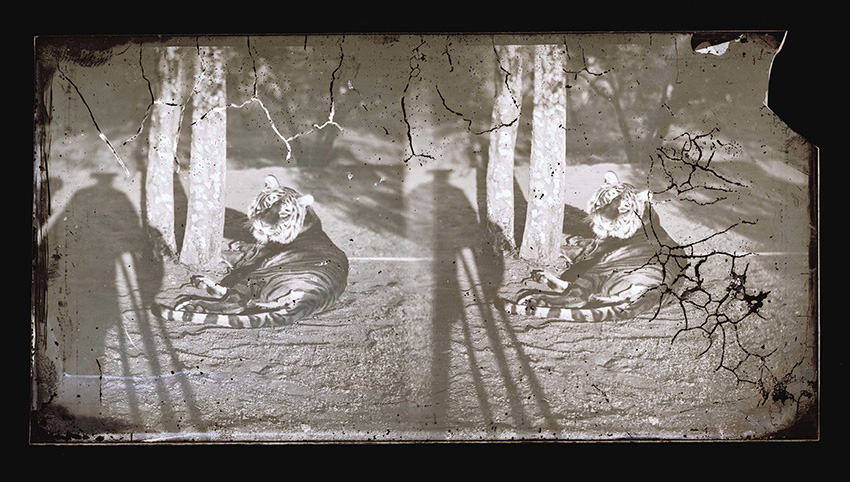
This is the first exhibition to focus on photographs and negatives in the Ashmolean, and as such features previously unseen photographs of India by Colonel Eugene Clutterbuck Impey (1830-1904) – documenting colonial photography in India. A member of the East India Company (EIC), Impey arrived in India in 1851 and also took part in military actions during the Indian uprising of 1857. In 1858, the EIC was disestablished after the First War of Independence and, when the British Crown took control, he worked as a political agent in the Indian government until returning to Britain on his retirement in 1878.
Impey served most of his career in Rajasthan, becoming the Assistant Agent to the Governor General in Rajputana in 1856 and the political agent in Alwar in 1858. He published 81 of his Indian photographs in a volume entitled Delhi, Agra, and Rajpootana, published in London in 1865, which included notes on the images. He was a prolific photographer and a frequent contributor to exhibitions organised by the Bengal Photographic Society. His photographs reflect British imperial interests, showcasing portraits of colonial officers and Indians, as well as staged scenes of daily life, clothing, religious sites, animals, and landscapes, subject matter that was covered by amateurs and the professional studios in India at the time.
The Invention of Photography
The invention of photography in the 1840s revolutionised the way in which the world was documented and interpreted, not only in Europe but also in Asia. As early as the mid-19th century, the British authorities in India launched an impressive photographic survey of architecture, helping to establish early photography in India. Enthusiastic amateur photographers soon followed suit with atmospheric images of life during the period, from high to low, including topics such as anthropology, archaeology, ethnography, flora and fauna, as well as capturing the beauty of the Taj Mahal and the Indian landscape. These photographs not only serviced the demands of intelligence and the need for scientific record by the EIC and later governments but also offered an eager and curious public in the West – a glimpse of the ‘exotic East’, a way to see the sites and cultures of a far-away land.
When photography was in its infancy, the technical challenges were immense – exposure times, for instance, were extremely long, so everything had to be planned to the smallest detail. Impey adopted the ‘wet collodion plates’ method for capturing his images, printing them on albumen paper, but he also used stereoscopic techniques where two images are printed side-by-side.
Julia AB Hegewald writes in the accompanying catalogue, ‘Impey’s work is less well known and has generally been neglected in photographic studies. While he took diverse pictures of palaces, bungalows, and other colonial buildings, such as churches and administrative buildings, Impey was particularly interested in Hindu and Jaina sacred sites with temples and cenotaphs, and he also made visual records of a surprisingly large number of water structures’.
Working in the Field
In this exhibition of early photography in India, there is a telling photograph documenting Impey working in the field and showing the amount of effort needed to set up a shoot, along with the large number of people involved in the process. Mallica Kumbera Landrus, the curator of the exhibition, writes in her entry in the catalogue, ‘Impey mainly photographed locations where he was assigned, as well as the Indian people he encountered, and, at times, his own professional activities, including his photographic work. No less than 247 of his wet collodion glass negatives have been preserved in the Ashmolean Museum, differing in size and including 142 stereoscopic negatives, as well as thirteen positive lantern slides. The Bodleian [Library] holds a complementary set of approximately 150 negatives, found in the New Bodleian Library’s basement in 1995, which might well have been part of the original group. Many photographs were taken in and around the hill-stations of Mount Abu and Shimla, featuring palaces, temples, people and landscapes, particularly from Rajasthan’.
In the 1850s, European photographers working for the EIC, and later government, gathered extensive materials detailing their experiences of India and used them to document the topographical and ethnographical information of the subcontinent. The beauty of Mughal India became a focus for the photographer’s lens and these images gained much attention within Indian society as well as abroad. Virtually all these photographers showed a fascination with Mughal architecture, whose monumental grandeur was often documented down to the smallest detail.
Photography of Indian Buildings
As a result go this colonial photography in India, buildings and architecture played a significant role in the development of architectural photography as its own genre. Mughal gardens received particular attention from Western photographers with an emphasis placed on the garden tombs of the Mughal empire. Undoubtedly, the Taj Mahal was one of the most important inspirations of this fascination, but other cultural sites were also photographed such as the Qutub Minar in Delhi, a victory tower and minaret built during the Delhi Sultanate (1206-1526).
Another part of this story of early Indian photography is the well-supported photographic societies that had begun to be formed in the 1850s – mainly in Bombay, Calcutta, and Madras, which significantly contributed to the body of work left today.
The government actively encouraged the use of photography as a means of documenting the land, not only for military purposes, but also for the burgeoning interest in archaeology and the lost civilisations of India. Such societies also published their own journals, which formed a valuable source of information – not only on the latest developments in photography – but also about new discoveries. These images were also used for propaganda by the government in British India at home and abroad to try to justify British rule and showcase ‘British achievements’ to the world.
Landscapes in Colonial Photography in India
Impey’s photographs offer a first-hand impression of Victorian India and the Raj, including Mughal palaces and mausolea, ruins, exotic landscapes, as well as the many different ethnic groups and cultures found in the country, offering a fantastic opportunity to create striking images. Princes, maharajas, ministers, and soldiers could all be recorded in detailed splendour. There was also a chance to document ordinary people and daily life: agricultural workers, bullock cart drivers, a groom with his camel, acrobats, dancing girls, as well as religious processions.
They also documented Impey’s own society by photographing British families in India, including, scenes from the hill stations such as Shimla and Mount Abu. Marwa Ahmed, writing in the catalogue notes, ‘Among the scenes of daily life, Impey captures images of the British pursuing stereotypical, ideal, “civilised” British leisure activities’. These included camping, taking tea, ladies sewing, and participating in fancy dress balls.
Apart from amateur photographers and those in government positions, there arose a group of professional or commercial photographers who set up studios in the most populated cities. Commercial photographers also went on excursions to photograph the cultural and historical sites to turn into postcards, supply domestic and international newspapers, and create souvenirs for the general public. There was also a great demand for photographs as illustrations in scientific journals, as well as trade and society directories.
Commercial Photographers in Victorian India
A few of these professional studios were established in the 1850s in the centres of Calcutta and Bombay, but it was not until the 1860s that professional photography was well established in India, with numerous commercial studios established in the larger cities such as Madras and in the hill stations like Shimla. One ofå the most famous of these studio photographers was Samuel Bourne, a British photographer known for his prolific work in India between 1863 and 1870. Together with Charles Shepherd, he set up Bourne & Shepherd, opening a studio first in Shimla in 1863 and later in Calcutta. The studio was responsible for some of the most iconic photographs of the time with their images distributed internationally.
The bulk of the photographers that made a name in India during this time were mainly Westerners. Working at the same time as Impey, they were a mixture of amateurs, military men, and commercial photographers, such as Felice Beato (1832-1909), Colonel Willoughby Wallace Hooper (1837-1912), Sir Donald Horne Macfarlane (1830-1904), and Captain Linnaeus Tripe (1822-1902).
The most famous Indian photographer of the era was Lala Deen Dayal (1844-1910), who began working in the mid-1870s as a commissioned photographer, eventually setting up his own studios in Indore, Mumbai, and Hyderabad. He also became the court photographer to the sixth Nizam of Hyderabad, Mahbub Ali Khan, Asif Jah VI, and was later appointed as the photographer to the Viceroy of India, Lord Dalhousie, in 1885. He went on to receive the Royal Warrant from Queen Victoria in 1897, after accompanying the Royal Tour of the Prince and Princess of Wales in India in 1875-76.
The collective efforts of these enthusiastic amateur and professional photographers provide a remarkable and invaluable resource for study and reflection in our contemporary world – and an exploration of colonial photography in India.
• Until 13 December, Colonial Photography in India, Ashmolean Museum, Oxford, ashmolean.org
• Catalogue available


