

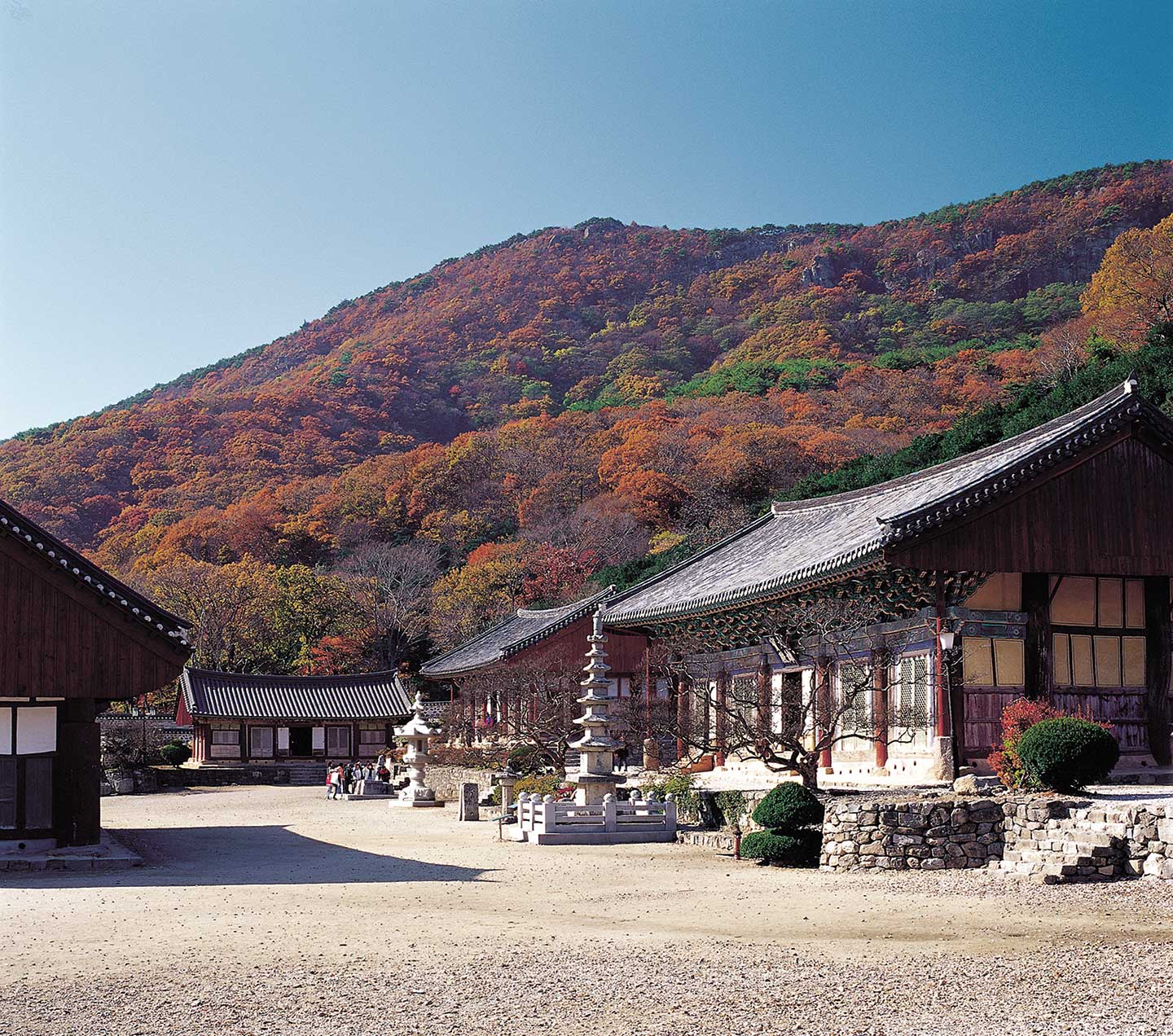
The area around Seonunsa Temple is known for its natural beauty and its mountain walking paths, including hiking to the Dosolam hermitage. Surrounding the temple is a forest of over 500-year-old red camellia forest (peak season for blooms is usually mid-April), which has been designated as a Natural Monument. There are also breathtaking views of autumn foliage surrounding the temple later in the year. Because of its natural beauty, thousands of people are drawn to walk in the mountains and along the streams behind the main temple. Scattered in the hills are shrines, artworks, stupas, memorials, meditation retreat centres and other historic locations over dozens of kilometres of trails that provide a peaceful environment for meditative walks, or more strenuous hikes.
History of Seonunsa Temple
The Seonunsa Temple is known to have been built in 577, in the 24th year of King Wideok of the Baekje dynasty, and is the second head temple of Jogye Order in Jeollabuk province. According to the temple’s historical records, it was originally much larger with 89 hermitages and 3,000 monks. Today, only four hermitages remain: Dosolam, Chamdangam, Dongunam, and Seoksangam. An important site near the temple is the Jinheunggul (cave), famous for being a location where the Silla King Jinheung (r 540-575) received spiritual training – it now also plays a regular role in contemporary historic television dramas. King Jinheung is widely regarded as one of the kingdom’s greatest leaders for vastly expanding its territory and setting the foundation for the unification of the Korean Peninsula at that time. In 551, he allied with King Seong of Baekje to take the Han River valley from the Goguryeo and also established the Hwarang warrior order.
Looming over the trail up to the Dosolam hermitage is a massive 13-metres high, Goryeo-dynasty (918-1392), figure engraved directly into the cliff face using the unique style for rock-carvings from this period – it is similar to the rock-carved seated Buddha found at Wolchulsan Mountain, Yeongam, South Jeolla province. A deep cut has been made around the head with the engraving getting progressively thicker from the head to the bottom of the statue. The rectangular, flat face has a somewhat stiff expression, but the upturned thin eyes, high nose, and straight, plump lips give a mystical smile to the face. There are also thin samdo (three wrinkles or lines) on the neck. These lines are a key iconographic feature, particularly in Silla and Goryeo dynasty statues, signifying the ‘three ways’ or ‘three paths’ a practitioner must pass through to attain enlightenment. The carving is slightly clumsy, with the head looking as if it has been just placed on top of the torso of the carving without much thought.
The area is a major site for pilgrims wishing to see the Maitreya Buddha, or the future Buddha of Salvation. A long stairway to the right of the giant Buddha leads up to a small shrine at the top of the rock, to bring you to the Dosolam Hermitage itself (the upper hermitage), considered one of the most important shrines of the Seonunsa temple complex.
The shrine is called Sangdolsalam (on top of stone man) and contains the Jijang Bodhisattva (Ksitigarbha), believed to rescue people from suffering. Known in Korean as Jijang and in Sanskrit as Ksitigarbha, this bodhisattva is famously depicted as a Buddhist monk with a shaved head who vows to assist all beings, particularly those in hell. Unlike the typical depictions of the Jijang Bodhisattva, the saint wears a hood, which was fashionable during the Goryeo dynasty. The shrine’s significance is reflected in a steady stream of believers who come here and climb the mountain to pay their respects. Though the shrine is said to have existed since the Tongil-Silla period, the present building was rebuilt at the beginning of the Joseon dynasty and has been repaired several times.
The highest of the four remaining hermitages, Naewongung Hall is in the Dosolam Hermitage and is one of three major Ksitigarbha Bodhisattva prayer sites in Korea. Perched on top of a steep rock cliff, it attracts numerous pilgrims year-round to visit a gilt-bronze seated Ksitigarbha Bodhisattva, which is a state-designated Treasure. Finally, behind Sangdolsalam, near the Naewongung (inner palace) is a shrine to the traditional Korean mountain god, Sansin. This type of shrine is fairly easy to identify because of its high position and the presence of two shamans and a tiger. It represents the traditional, earlier indigenous belief system integrated into Korean Buddhism, which often includes a shrine to the mountain spirit to protect the temple site.
To discover more about Seonunsa Temple without walking in the mountains, there is a rare chance to view artefacts from the temple in Seoul. An important exhibition on temple and its sacred objects is currently on show at the Central Buddhist Museum until the end of July. Among the 157 items on display are one National Treasure and 11 Treasures. A major highlight is the gilt-bronze seated Ksitigarbha Bodhisattva statue belonging to Seonunsa, which was stolen in 1936 and taken to Hiroshima in Japan. In 1938, the thieves confessed to police in Gochang after suffering misfortunes and being rebuked by the deity in their dreams for its theft. Monks from the temple personally travelled to Japan to reclaim and repatriate it. The statue is now displayed together with a 14th-century counterpart from Dosolam Hermitage (a small Buddhist retreat perched on the steep rocky ridges of Dalmasan Mountain in Haena, Jeollanam province), and a 15th-century stone version from Chamdangam. The exhibition marks the first time all three Ksitigarbha Bodhisattva statues have been brought together in one space.
The Seoul exhibition also explores the history, and describes the architecture and decoration of the main Daeungjeon Hall of the Seonunsa Temple in Gochang. The current building is a late Joseon-period Buddha hall designated as Treasure 290 by the South Korean government. Originally built during the years of King Jinheung of Silla (533-576), it was rebuilt in 1472, in the 3rd year of the reign of King Sejong of Joseon (1418-1450). The hall has since been rebuilt again over the centuries – fire destroyed it during the Imjin Wars in 1592, and it was rebuilt again in 1613 (5th year of King Gwanghaegun (1575-1641)). Measuring five kan (a unit of measurement referring to the distance between two columns measuring roughly six feet or 1.8 metres) by three kan, the hall was built in the dapo (multiple column-heads) style in which gongpos (column-heads) support the weight of the roof. The refined and highly decorative dapo, as well as floral lattice detachable doors, are typical of the architectural style of the mid-Joseon dynasty (1392-1910). The column-heads on the rear side of the building are simpler in design with the shape of the rear eaves different from those at the front.
South Korea has a vast number of Buddhist sites, with over 900 traditional Buddhist temples and thousands of hermitages, many of which are nestled in mountainous areas. To explore Korean Buddhism and the network of temples, a special programme was initiated in 2022 that allows visitors to stay for a couple of hours, days, or weeks, in certain temples across the country – in cities and in the countryside. The temple stay information centre is located opposite Jogyesa Temple in Seoul and has comprehensive information on all the programmes and participating temples. Information can also be found on their website, along with a reservation system.
• Exhibition until 31 July, Central Buddhist Museum, Seoul, museum.buddhism.or.kr
• Temple stays information, templestay.com


