

Tokyo National Museum loaned over 80 objects to a travelling exhibition devoted to the art of the samurai in 2009, which explored the art and aesthetics of samurai culture in Japan. The collection in focus dates primarily to the Edo period (1603-1868) with many pieces classified as Important Cultural Property and National Treasures and shows the accomplished level of society, education, and skills developed by the samurai from the 10th to 19th centuries. The exhibition illustrated how multiple aspects of samurai life, including battle regalia, such as their complex armour and swords, were an integral part of samurai culture and life.
For nearly 700 years, from the latter half of the 12th century until the Meiji Restoration in 1868, the military bushi (warrior class) were at the helm of government in Japan. During the mid-Heian period (10th century), groups of bushi warriors formed throughout the country. As some of the warriors served the noble families in Kyoto, they were called samurai or, literally, ‘those who serve in close attendance to nobility’.
Originally, their social position was low, and they were considered assistants or attendants; however, by the Edo period, the samurai began using grouped armed force to become more powerful. By doing so, they created a culture of their own based on the lifestyles of the nobles, which was at that time marked by strength and simplicity. The life of these warriors was simple, and their philosophy stressed the importance of bravery and dedication to their overlords (daimyo), as well as to their clans and houses. This way of life became the basis of bushido (way of the warrior) that eventually elevated the samurai into a refined, distinct social class.
The new class of warriors, originally armed to serve the nobility, began to be noticeable around the late Heian period (beginning of the 12th century) – with the most prominent being the Taira and Minamoto clans, descendants of Emperor Kanmu and Emperor Seiwa, respectively. Both families gradually came to prominence by guarding noble families. In 1156, after the death of Emperor Konoe, (1139-1155), an intense dispute over imperial succession began (the Hogen Rebellion) between Emperor Go-Shirakawa and the retired Emperor Sutoku, with the Fujiwara regents, who held real power at court, also becoming involved. Emperor Go-Shirakawa won this divisive political conflict with the backing of Taira no Kiyomori and Minamoto no Yoshitomo clans.
This allowed the Taira and the Minamoto families to gain further power. By 1159, Kiyomori and Yoshitomo were equal rivals, but Kiyomori’s eventual victory over Yoshitomo enabled the dominance of the Taira clan. This allowed the clan to amass great wealth by monopolising fief collection in the provinces and allowed them to expand their territories and become politically powerful. With control over the economy, their military status grew, which ultimately brought the control of the central government into their hands.
This warrior class was becoming established, but it was at a turbulent time – political and economic conflicts had also emerged among the aristocratic class in Kyoto, as well as in the nobility in the provinces. However, it did give an opportunity to Yoshitomo’s son, Yoritomo (1147-1199), to lead a revolt against the Taira clan. This rebellion engulfed the entire nation, and in 1185, the Taira clan and its influence were eventually destroyed.
Territorial control of Japan during the Heian period was run by the aristocratic families, who owned the land in the provinces, and by default controlled the associated commercial activities such as rice cultivation and fabric manufacture, which formed the basis of their economic power. These powerful families did not directly manage their lands and businesses; rather, they relied on lower-ranking clan members, whom they eventually replaced with the samurai to oversee their estates as fief holders. With the backing of a noble family, these warriors were able to quickly take control of the provincial areas and gain power themselves by participating in business and protecting noble families’ interests whilst also looking after their own.
This allowed them to build up their own economic and military power locally, gradually shifting from hired local protectors into independent military administrators. Their domains provided a powerful economic base, and with the recognition of ownership by the government, the Kamakura shogunate and provincial nobility were able to maintain a mutually trustful relationship.
After the defeat of the Taira clan, Minamoto no Yoritomo was able to establish a new government in Kamakura, becoming the first shogun of the Kamakura shogunate, with government affairs administered by the warrior class. The clan differentiated itself from the Taira family by becoming more aristocratic and interested in cultural pursuits, which in the past had beeen mainly restricted to the royal court. Governing from Kamakura, however, was not his only consideration – in Kyoto, there was also the powerful Fujiwara clan who were traditionally connected to the court and served the imperial family.
Although this dual government system continued to exist until the Edo period, financial power and control were overwhelmingly greater for the samurai. When Yoritomo was ordered to command the campaign against the Taira clan by the emperor, he was appointed to the rank of Seii-tai-shogun, the commander of the entire military force to defeat enemies and, as the head of this unified warrior class, the Ashikaga and Tokugawa families also received the title of shogun.
While the Kamakura period (1185-1333) began and ended with major civil wars, the decades in between were relatively stable under the administration of the Kamakura Shogunate and the Hojo (the ancestral family of Yoritomo’s wife). It was also a time when Zen Buddhism was on the rise, and personal discipline was greatly admired. A new style of sculpture was introduced by the Nara-based Kei School, whose work was characterised by intense realism, emotional intensity, and dynamic movement. After the Kamakura shogunate fell in 1333, Ashikaga Takauji defeated Emperor Go-Daigo and, in 1336, established the new Muromachi shogunate (1336-1573) in Kyoto. The arts continued to flourish during Muromachi period, heavily influenced by Zen Buddhism and by Song, Yuan, and Ming dynasty aesthetics from China, commissioned under the patronage of the Ashikaga shogunate.
One of the notable daimyo of the Sengoku period (1467-1615) was Oda Nobunaga of Owari (present-day Aichi Prefecture). He expelled the Ashikaga 15th shogun, Yoshiaki, in 1573, and attempted national unification with his powerful army, but he was forced to end his life by the treachery of his own general, Akechi Mitsuhide, in 1582. This conquest, aimed at unification, first started by Nobunaga was carried on by Toyotomi Hideyoshi (1537-1598), who finally unified Japan in 1590. Hideyoshi implemented policy of separating peasants and samurai (Heino Bunri) by banning the use and possession of weapons by peasants, which led the way for the establishment of a class system in the Edo period.
When Toyotomi Hideyoshi died in 1598, a fight began between the supporters of the Hideyoshi’s son, Hideyori, and Tokugawa Ieyasu, which ultimately evolved into the biggest battle in the history of Japan, the Battle of Sekigahara. After the victory at the battle, Ieyasu was appointed as Seii-tai-shogun, and established the Edo shogunate that went on to rule Japan for over 260 years. He reinforced the purpose of life for samurai by emphasising Confucianism and applying its philosophy to the standards that samurai should uphold.
It was the Tokugawa shogunate that instituted bushido, the code of the samurai, which stressed the need for loyalty to superiors and the importance of upholding the morality of the ruler. Bushido deeply penetrated society as the code to live by for an individual samurai, with the principles of honour, not bringing shame and disgrace to their family name, as well as the need to dutifully accept death. The adoption of Zen Buddhism also provided psychological and spiritual tools for mental clarity and helped manage the fear of death on the battlefield.
This martial legacy of the samurai lives on most vividly through their distinctive arms and armour, which represented far more than mere military equipment, particularly during peacetime. For the samurai, the battlefield was a place to display their courage and feat of arms, and their own battle attire was s moment of pride. This pride and desire to be uniquely identified is one of the major characteristics of Japanese armour. These styles are generally categorised into four types: O-yoroi (great armour), Do-maru, Haramaki, and Tosei Gusoku, with the difference being the way each is worn. O-yoroi is a formal type of armour with the right torso section made separately and laced with a larger body piece shielding the front, left torso, and back.
Tassets (skirt-like armour panels) suspended from the torso called kusazuri were divided into front, back, left, and right sections to improve mobility of the legs. The armour was also decorated with motifs such as flowers or animals and used dyed leather for further protection on the chest of the armour. Do-maru-style armour was put on and taken off using the opening under the right arm, whilst Haramaki opened at the back. Since the latter two armours were much lighter and allowed greater agility, after the Nanbokucho period, high-ranking warlords wore Do-maru and Haramaki rather than O-yoroi.
Basic armour construction starts with the production of leather and iron plates called kozane, 5-7 cm vertically and 2-4 cm horizontally. After small holes are drilled in each plate, kozane is lacquered in black, overlapped for half of its width, and laced together in rows with leather cords, finally laced again top and bottom with red, white, dark blue, or green braided cords. When worn, the armour provided coverage over critical areas of the body, and while not in use, it was folded up and placed inside a box to be easily portable.
The essential battle weapon of a samurai was his sword – called ‘the souls of samurai’ – these objects were the most important possessions for a warrior. Upon departing for battle, samurai prayed at shrines and dedicated their armours and swords for victory, and when returning victorious, they rededicated them to show their appreciation. Warriors acknowledged for great battle achievements were often granted land and swords for their valour by their overlord. Such granting of swords was especially frequent in the latter part of the 16th century during the turbulent Sengoku period, as it enabled a strong bond and trust between the lord and his vassals to be established.
Japanese swords are usually characterised by curved blades, but from the Kofun period in the 3rd century through the early Heian period, and up until the 9th century, owing to influences from China and the Korean Peninsula, swords had straight blades. Swords with the distinctive style of blade curvature are considered to have appeared during the mid-Heian period, around the beginning of the 11th century.
The most famous swordsmiths known from the earliest period of production were Munechika of Kyoto and Yasutsuna of Houki (present-day Tottori Prefecture) from the 10th to 12th centuries. From this time onwards, sword makers inscribed their names on the blades, and the number of known swordsmiths, including the active artisans, is said to be close to 23,000 – there are approximately 150-200 licensed swordsmiths in Japan today. The greatest swordsmiths are credited with having worked during the Kamakura period, as seen in the surviving swords of Awataguchi Yoshimitsu in Kyoto and Masamune.
By the Edo period, sword giving between the shogun and daimyo had become ceremonial and swords, given on celebratory occasions such as the birth of a son, a coming-of-age ceremony, or marriage. For the daimyo, the shogun gave swords when a son took over as the head of the family, as well as upon the first face-to-face meeting with the shogun, and at marriage. These swords were kept as family heirlooms for generations.
The katana sword, which was paired with a shorter wakizashi to form the daisho during the Edo period, embodied both technical mastery and profound symbolic meaning. The swords were not only weapons, but markers of status and identity, with master swordsmiths forging blades of exceptional durability, while skilled metalworkers embellished them with elegant accessories.
Prior to the Muromachi period, major importance was not placed on the selection of swordsmith for these gifts, but by the mid-Muromachi period, the professionals in charge of overseeing the art collection and weapons of the Ashikaga shogun family began to specifically choose swordsmiths who could produce swords appropriate for the shogun. Secret books about judging swords with stylistic features of sword makers began to be produced, and professional appraisers began to appear.
One of the main appraisal houses was run by the Honami family, and although they had a traditional business of sword polishing (togishi), they also repaired daimyo swords and handled appraisals for centuries. For swords exchanged as gifts between the shogun family and daimyo, or between the daimyo families, certificates with proof of authenticity and price issued by the Honami family were always included. For both the shogun and the daimyo, swords were the proof of ancestors’ battle achievements passed down in the families and, from a practical point of view, they were valuable properties as weapons, at the same time used as gift items for diplomacy.
In 1719, a catalogue of master swords found across Japan called Meibutsu-cho was created on the order of the 8th shogun Yoshimune, which included the selection of swords used by the Heian warlords and historic swords up to the Nanbokucho period, with Masamune, Awataguchi Toshiro, and Go Yoshihiro heading the list as the three greatest sword makers.
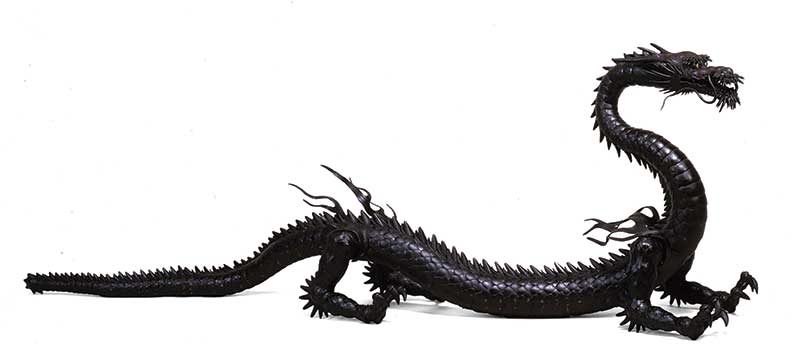
In the decorative arts, Japanese swordsmiths and armourers began creating articulated dragons, known as jizai okimono (move-freely decorative objects), primarily due to a severe decline in the demand for weapons during the peaceful Edo period. To maintain their highly specialised metalworking techniques and secure patronage from wealthy daimyo, smiths began creating these complex creatures as proof-of-skill advertisements and luxury souvenirs. The earliest dated jizai okimono known is an iron dragon made by Myochin Muneakira in 1713, now part of Tokyo National Museum’s collection.
Through the centuries, the samurai class emphasised the importance of arts, patronage, and refinement alongside their martial careers, adopting Zen, the refinement of the tea ceremony, and practising painting and calligraphy. They also encouraged the arts of poetry and theatre – producing the bunbu ryodo – the dual path of pen and sword.
They remained an important warrior class until the Emperor Meiji abolished the feudal class and ended the samurai monopoly to be the only armed force in favour of a modern army. They later lost their right to wear their sword or katana in public, as well as their right to execute commoners who insulted them. This forced the samurai to reinvent themselves – as political leaders, industrialists, or they enrolled in the Imperial Japanese Army created by the Meiji government in 1871.


