

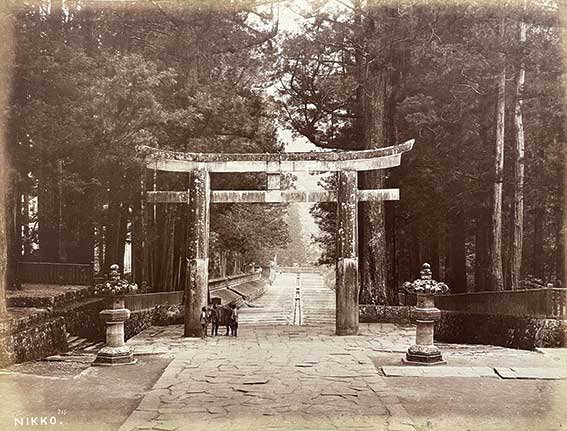
Two exhibitions, one in the US and one in the Netherlands, explore how Japan was documented with photography in the 19th century. Looking for Japan at the Dayton Art Institute shows how photography recorded and shaped perceptions of Japan during the transformative Meiji period (1868-1912), a time of great political, social, and cultural change.
As traditional institutions gave way to new political and social structures and many aspects of Japanese culture underwent modernisation, photography emerged as a powerful means of documenting and shaping perceptions of Japan. The Dayton exhibition brings together photographs and photographic objects, including highly personal images and photographs created for a newly established tourist trade, which offer viewers an opportunity to consider how Japan was represented both within the country and for Western audiences.
On show are a range of photographic formats, including albumen photographs and collotypes, as well as complementary objects such as woodblock prints and textiles. Particularly striking are the hand-coloured photographs depicting a kaleidoscope of landscapes, cities, and portraits, as well as images of Japanese architecture, women’s hairstyles, clothing, weapons, and tattoos. Many of the works were produced by prominent photographic studios and photographers, including Ogawa Kazumasa, Kusakabe Kimbei, Uchida Kuichi, Suzuki Shinichi II, Felice Beato, and Baron Raimund von Stillfried-Ratenicz. Together, these photographs illuminate both everyday life and the ways Japan was presented to audiences during a period when international interest in the country was rapidly expanding.
The exhibition also explores the beliefs, traditions, and daily life in Japan alongside the ways these subjects were packaged for, and influenced by, Western audiences. Some of the photographs are deeply personal, while others reflect the commercial demands of the emerging tourism industry. They reveal the history of Japanese photographers and their relationship to the pioneering Western photographers, who had arrived in Japan in 1853, when the country reopened to foreigners.
Ogawa Kazumasa (1860-1929) was a pivotal figure in early Japanese photography. He adapted cutting-edge Western technology in photo-printing processes to produce numerous half-tone and collotype publication which transformed a market that had previously concentrated on the more expensive souvenir albums. Ogawa’s publications were also instrumental in introducing Japanese art and culture to a mass international audience and consequently built one of the most successful photographic businesses in late-Meiji Japan. He opened his first portrait studio in Tomioka, Gunma Prefecture in 1877.
Kusakabe Kimbei (1841-1932) was born into a family of textile merchants and left home at eighteen to move to Yokohama to further his ambition of becoming an artist. Although not much is known of his early life, at some point in the early 1850s he joined Felice Beato (1834-1909) as a photo-colourist. He went on to become an assistant and accompanied Beato on a trip to Shanghai in 1867. In the 1870s, he joined Baron von Stillfried-Ratenicz at his commercial photography studios in Yokohama, but little is known of his time there. By 1880, he had opened his own Yokohama studio to target the foreign community to sell souvenir albums and, over the years, amassed a portfolio of over 2,000 images, making his studio the largest in Japan by the early 1900s.
Uchida Kuichi (circa 1844-1875) is considered to be one of Japan’s greatest landscape photographers – taught by Dr Pompe van Meerdervoort from the Dutch Medical School in Nagasaki. He also set up a successful photographic equipment import business in 1863 before moving to Kobe in 1865, where he opened a studio with Ueno Sachima, the younger brother of the celebrated Ueno Hikoma (1838-1904), another commercially successful photographer who also taught photography in Nagasaki. Ueno senior was to go on to capture the transit of Venus in 1874, as well as becoming famous for his battlefield scenes during the Satsuma Rebellion in 1877.
Uchida Kuichi opened the first studio in Osaka in 1865, the following year he moved to Yokohama, and moved once again in 1869 to Tokyo. He also expanded his business by opening overseas studio branches in Vladivostok in 1890, with Shanghai and Hong Kong opening in 1891. His reputation was sealed when he was asked to photograph the Royal Family in 1872 – the same year he accompanied the Emperor on visits to central Japan and Kyushu as the official photographer. Sadly, he died aged thirty-two of tuberculosis, just as his international reputation was gaining traction.
Suzuki Shinichi II (1855-1912) was the son-in-law of Suzuki Shinichi I, whose family he had met when he was a photographic apprentice to Shimooka Renjo. On marriage he adopted his wife’s family name. His father-in-law was a master photographer operating a portrait studio in Yokohama – and a pioneer of the technique of printing photographs onto porcelain. He was known for his photography depicting natural rural landscapes with attention to scenes of daily life, published as photographic series in The Far East, an illustrated news magazine owned by JR Black.
Suzuki Shinichi II was a student of Shimooka Renjo in Yokohama, but in 1876, he left and opened his first studio in Nagoya. To improve his developing techniques, he left to study in San Francisco. On his return he continued with his studio work and, in 1888, was asked to photograph the Emperor and Empress. The same year, he was commissioned by the Japanese government to produce photographic albums as diplomatic gifts. After the Russo-Japanese War (1904-05), at the height of his success, he lost his business and fortune by speculating in a shipping business and the family was ruined.
Probably the best-known foreign photographers working in Japan were Felice Beato and Baron Raimund von Stillfried-Ratenicz (1839-1911). Beato is the most famous Western photographer to have worked in Japan, with a reputation for producing the best quality landscape and portrait photography, and was one of the first Western photographers to enter Japan when the country opened its borders. Before moving there, he had been a war photographer documenting events in Greece, Malta, and the Middle East, reported on the Crimean War and the Indian Rebellion (1857), as well as photographing the events of the Opium Wars in China (1860s).
Beato arrived in Yokohama in 1863 and operated a studio until 1877, after which it was eventually sold to Stillfried and Andersen. His style of using Western photography techniques to portray Japanese culture and society became enormously popular – he became the pioneer of ‘Yokohama photographs’ in which he used the refined skills of local Japanese watercolourists and woodblock printmakers to produce vibrant, hand-coloured, albumen prints. These works included subjects such as samurai portraits and traditional bijin-ga, the beauties depicted in 18th- and 19th-century ukiyo-e. These photographs attracted both foreign visitors visiting Japan for the first time, as well as curious buyers who had never visited Japan but wanted to glimpse and ‘experience’ the Far East from the comfort of their homes in the West. Among the assistants who worked in Beato’s atelier, first as a painter of photographs, was Kusakabe Kimbei, whose hand-coloured albumen prints became appreciated for their beauty and vivacity of their colours that were presented in lacquered albums which, in themselves, were appreciated for their artisanship. Beato was also the first Westerner to photograph landmarks like the monumental Great Buddha (Daibutsu) at Kamakura, despite strict travel limits on foreigners, becoming rare visual documentation of the period. By 1868, he had published two celebrated volumes: Views of Japan and Native Types.
Beato and Ueno Hikoma shared a working relationship, for a time sharing a studio in Nagasaki, with Beato photographing Hikoma’s younger sister and Hikoma himself at Daion-ji in Nagasaki in 1865. Ueno Hikoma was able to refine his wet-collodion chemistry and composition techniques through his interactions with the highly experienced Beato, while Beato was influenced to include elements of Japanese aesthetics into his own portfolios. In 1887, Beato moved to Burma to cover the Anglo-Burmese Wars (1825-85), where he was believed to have died – until his death certificate was discovered in 2009 which stated he died in Florence in January 1909.
Baron von Stillfried-Ratenicz was an Austrian aristocrat, painter, entrepreneur, world traveller, soldier, and diplomat, who presented a colourful and influential persona in the late 19th-century in Japan. On his first visit to the country, he worked for a Dutch silk merchant in Nagasaki moving to a position at the French consul in the treaty port of Hakodate. He then left to support Emperor Maximilian I and the Austrian regime in Mexico (Maximilian had become Emperor of Mexico in 1864 until his assassination in 1867). The Baron then returned to Japan to open a Yokohama photography studio in 1871, joining with Hermann Andersen in 1877 to purchase Felice Beato’s business. In 1885, Stillfried & Andersen sold the commercial studio, along with its massive inventory of remaining negatives (comprising both Stillfried’s and Beato’s work), to the Italian photographer Adolfo Farsari and the photographer Kusakabe Kimbei.
These relationships between Western and Japanese photographers served as a catalyst at the dawn of Japanese photography, combining imported Western technology and commercial ventures with local artistic skills, to establish a thriving global market. The results of these interactions and resulting creativity can be seen in private collections and museums around the world today.
Light Over Desjima is second exhibition of early Japanese photography highlights the unique exchange of knowledge between the Netherlands and Japan in the 19th century. The exhibition was developed in collaboration with Leiden University Libraries, Nagasaki University Library, and various museums and photographic collections in the Netherlands and Japan. Dejima, the artificial fan-shaped trading island in Nagasaki Bay, played a pivotal role in the arrival of photography in Japan. At the time, the island was Japan’s only point of contact with the outside world. Under the strict supervision of the Japanese government, it was the place where the Dutch could exchange goods, knowledge, and technology.
Dejima came into existence in 1634 (Kan’ei 11), when Japanese shogunate had become increasingly worried about Catholic missionary activity promoted by the Portuguese in Japan – and the political consequences of large numbers of Catholic converts. To keep the Portuguese in check, that year Tokugawa Iemitsu (1604-51) ordered the construction of a heavily guarded small artificial island in Nagasaki Bay where the Portuguese traders could be isolated from their surroundings. This restriction of their freedom of movement, however, did not lead to the suppression of Christianity that the shogunate had hoped for. This resulted in 1638, after a rebellion by Catholic converts, in the shogunate ending the Portuguese trade altogether. A year later, it prohibited the entry of Portuguese vessels into Japanese waters. This meant that the artificial island of Dejima, built at great expense, lay empty with no obvious use.
When the Portuguese were expelled from Japan, the Dutch were allowed to stay, as they had limited their activities solely to trading and showed no interest in winning souls for the Christian church. Even so, in 1641, they were forced to tear down their brand-new brick trading post in Hirado and were moved to Dejima, where they were under stricter supervision of the shogunate and their movements could be severely restricted. Between 1641 and 1856, the Dutch traders were the only Westerners allowed in Japan, creating a unique and exclusive relationship between the Netherlands and the shogunate.
It was during this isolationist period that Dejima became a crucial window onto the West and a place through which Western medicine, science, and technology (including military technology) was introduced into Japan. In 1856, the strict rules that had confined the Dutch on Dejima for over two centuries were ended, resulting in the Dutch-Japanese Friendship Treaty that encoded a new freedom and rights. Naturally, when photography emerged in Europe in the mid-19th century, this invention reached Japan via Dejima.
This exhibition proves that the island was not merely a trading hub, but also a crucial link in the transfer of knowledge between the Netherlands and Japan. Dutch physicians stationed on Dejima played a major role in disseminating photographic knowledge among Japanese students. When the first cameras arrived in the mid-19th century, manuals and photographic materials were also brought via Dejima for the benefit of Western and Japanese amateur and professional photographers. Physicians such as Jan Karel van den Broek, Johan Pompe van Meerdervoort, and Antoon Bauduin instructed Japanese students in European science and technology, including photography. One of the best students and beneficiaries of this system was Ueno Hikoma. In 1862, he had established Japan’s first professional photography studio in Nagasaki, with his work marking the beginning of a rich tradition of local photography in the country.
At the heart of the exhibition are photographs made before 1870, a time when Japan was gradually opening to the outside world. Portraits, family scenes, street views, and landscapes not only show the development of photography, but also reveal what everyday life in Japan was like during this period of great change. These photographs are extremely fragile, therefore the images on show are new prints especially created for the exhibition. This brings some advantages, as almost all early photographs are contained in albums, the new prints allow many more images from each album to be exhibited. Also, some 19th-century photographs are very small and benefit from having been enlarged to show greater detail.
On show are approximately 200 photographs from Dutch and Japanese collections, including early portraits, landscapes, street scenes, and domestic scenes showing a Japan in transition, moving from the medieval past to a modern, industrialised future. Also on display are historical cameras and photographic equipment to explain 19th-century photographic processes. The exhibition further highlights discoveries from recent research, including one of the oldest known photographs taken by a Dutch person in Japan.
Looking for Japan: Early Japanese Photography, runs at the Dayton Art Institute, Ohio, until 29 November, daytonartinstitute.org
Light Over Dejima is at SieboldHuis, Leiden, until 28 February 2027, sieboldhuis.org


