

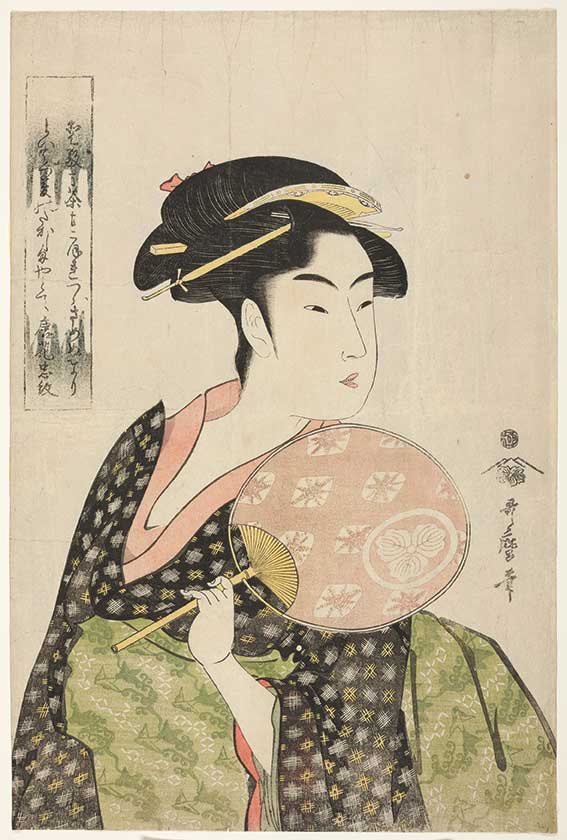
This exhibition brings together more than 40 of Kitagawa Utamaro’s (circa 1753-1806) most celebrated works, all drawn from the Art Institute of Chicago’s collection. While his subject, beautiful women, had been a mainstay in ukiyo-e from its beginning, Utamaro invested his subjects with a fresh vibrancy, experimenting with dramatic close-ups that hint at the women’s complex inner lives.
The ukiyo-e artists provided an opportunity to see into everyday life in Edo through their prints, by portraying how people lived – exploring ideas of beauty, festivals, travel, food, entertainment, as well as their favourite beauty spots. Bursting with life, the pleasure quarter, or ‘floating world’, seen in these prints are an expression of the new economic and social ambitions of the Japanese nation as the country became increasingly urbanised. Utamaro was one of these ukiyo-e artists and one of the most highly esteemed of his generation. Like other artists of his time, he did not work independently but was employed by publishers and patrons as a ‘brush for hire’. Utamaro was already well known in his own day as a master of the bijin (beauty) genre, brilliantly capturing sensuous females both in painting and in print.
Early bijin-ga, with their full-length upright figures in colourful kimonos, has its roots in the Kaigetsudo school (founded by Kaigetsudo Ando around 1700), which was known for depicting the courtesans of the Yoshiwara, Edo’s pleasure quarter. The full-length portraits of these barefoot women (they were forbidden to wear socks) were symbols of a feminine ideal, showing imposing proportions and wrapped in the latest patterned kimonos, depicted by thick, fluid, black lines to emphasise their elegance. Hishikawa Moronobu (d 1694) had painted this floating world earlier, but he rarely painted single beauties. It was Utamaro’s prints and paintings that portrayed these beauties best – the most beautiful courtesans of the most famous houses in Edo – by exploring their characters rather than using formalised lines to depict them.
Utamaro popularised the okubi-e form (bust portraits) of figures in moments of quiet intimacy, such as posing in front of a mirror, or the moment after taking a bath. His prints also reveal these beauties in various activities throughout the day to show moments of their inner worlds. These portraits were not idealised but observed – they were of real beauties of the day with individualised, expressive faces, which portrayed their emotions by using fine, delicate, and micro-detailed line work, such as can be seen in kewari (hair carving).
The Ten Classes of Physiognomic Studies of Women and Ten Classes of Physiognomies of Women are prime examples of his attention to subtle differences. Although the physical features look similar, the mood and atmosphere are expressed through gestures and small details such as costume, hairstyle, and accoutrements. The prints focus on the expressions of the women, often caught in a relaxed moment in okubi-e, bust-length form. The use of this print style adapted conventions to move outside traditional print forms, making the face the major focus of the work.
The women portrayed by Utamaro are often depicted engaging in artistic pursuits such as painting, calligraphy, strategy board games, poetry, and music – all considered key and desirable skills for the educated elite (or those aspiring to be top-class courtesans). He portrayed famous courtesans and geisha, as well as ordinary women, but it was the women of the Yoshiwara who particularly inspired his creativity. In these works, Utamaro showcases the period’s latest elaborate fashions in hairstyles and clothing, including the diaphanous or patterned fabrics used in the multiple layers of garments worn.
The Yoshiwara was the most famous pleasure quarter, located in Edo’s northern quadrant. Surrounded by a moat and with a single main gate, the Yoshiwara was a self-sustaining village, equipped with its own firefighting force servicing the brothels and assignation houses. The district’s cherry blossom festival was among its most anticipated annual events. Prints, books, and paintings promoted the idea of the Yoshiwara as a fantasy space where a man of means could meet elegant, accomplished women, establishing relationships that extended beyond physical intimacy into romance. In his images of fashionable courtesans, Utamaro treated the Yoshiwara’s top-ranking women as visions of beauty, clad in silks and brocades, with chic coiffures and refined make-up, who were accomplished in the arts of dance, music, poetry, and conversation.
A print in the exhibition portrays a worker in Yoshiwara during the Hour of the Ox (1am to 3am), capturing a quiet, late-night moment when the heavy work of the evening is finally done. The print comes from the series The Twelve Hours in Yoshiwara, circa 1794, using the traditional Japanese method of telling the time linked to the zodiac as its title. Another famous print is Ohisa of the Takashima Tea Shop (circa 1793). Two of the most celebrated town beauties of the day were the teahouse waitress Naniwaya Okita and the rice-cracker shop girl Takashimaya Ohisa, documented in memoirs as being so famous that people would make special trips to their shops in Edo just to see them. Utamaro made several prints of both women.
By the 1790s, Utamaro’s name and prints had become synonymous with the floating world and bijin-ga, but he increasingly turned his attention to women and their roles in everyday life. In addition to portraying pleasure-quarter beauties, Utamaro also completed prints that focused on their lives at work or at home. In the exhibition, one print shows a kitchen scene where a woman wearing a head covering blows through a bamboo tube to stoke the flames of the clay stove at centre. Here, Utamaro highlights the beauty of women engaged in household chores, idealising their features while elevating an ordinary domestic moment.
In Edo Japan, there was a separation of rank and gender, which influenced the roles women could play in Japanese society and the responsibilities they had within their communities. The cultivation of leisure was key to raising social status as a woman. Courtesans, who worked in the pleasure quarter, were influential in setting standards in dress, hairstyles, and personal cultivation regarding literature and the performing arts. The sophisticated art of hairdressing reached its peak during the Edo period and the elaborate styles changed so rapidly that there were eventually hundreds of different ways for women to dress their hair, which, in turn, brought an enthusiasm for hair ornaments. Like make-up, hairstyles were indicators of age, social class, marital status, or even profession. In the hierarchical, class-conscious society of the Edo era, women could not freely choose their make-up or hairstyle.
Apart from his celebrated prints and paintings, Utamaro illustrated several extraordinary printed books, many of which are considered the pinnacle of woodblock printing. His work with publishers was prolific, and he created at least 2,000 designs that were transformed by the emerging print medium into multiples of thousands on paper to create ukiyo-e. He also produced the illustrations for up to 90 books, including novellas, poetry albums, and shunga (erotica), yet fewer than 50 extant paintings might be attributed to the artist.
Elements of Beauty, until 21 December, Art Institute of Chicago, artic.org


