

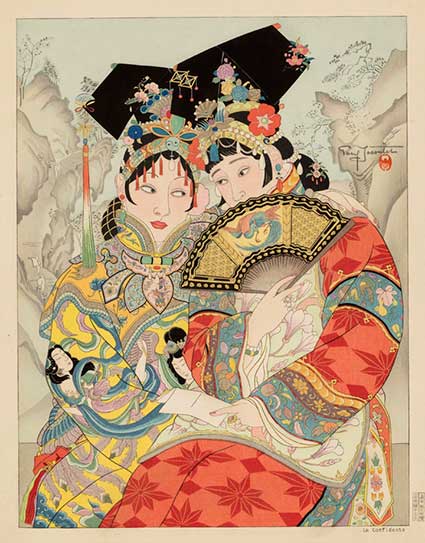
Paul Jacoulet (1896-1960) was born in Paris, but spent most of his life in Japan. There is confusion around his birthdate as official public records state 1896, but it is recorded on his tombstone as 1902. He moved to Japan at a young age, following the appointment of his father as a French professor at the University of Foreign Studies in Tokyo. The artist is particularly known for his sensitive and colourful portrayal of the people of Asia and the South Pacific islands that he created during the first half of the 20th century. During his life, he produced a total of 166 woodblock prints with most of the works being figurative.
These prints are influenced by the ukiyo-e tradition, which he studied with the Nihonga masters, Ikeda Terukata (1883-1921) and his wife, Shoen (1886-1917). His artistic training began when he was a young boy, studying both Western-style and traditional Japanese-style painting with Japanese and English tutors. It was at the house of his English tutor that he first discovered the prints of Kitagawa Utamaro (circa 1753-1806), in whose work he developed a keen interest, studying and copying the prints of the celebrated ukiyo-e master. His interest in woodblock technique was also stimulated by the revival of, and a renewed interest in, this traditional art form in Japan in the 1930s, when the Shin Hanga (New Print) movement, which stressed the collaborative work of the artist, carver, and printer, became established.
Jacoulet was an eccentric character, prone to embellishing the events of his life – as mentioned earlier – his birth year is still uncertain. From a young age, he collected and reproduced ukiyo-e prints, immersing himself in their artistry. He was also known to have been fascinated by traditional Japanese performing arts and enjoyed performing the joruri (chanted narrative storytelling) and Bunraku puppet performances. Kabuki was another interest and he regularly visited kabuki theatres.
These activities, closely associated with the entertainments of the floating world, would have a lasting influence on Jacoulet’s choice of subject matter and how he rendered the figures that appeared in his prints. He particularly excelled in depicting scenes from people’s everyday life, showing them in their natural surroundings and environment, as well as conveying the emotional state of the characters. Often depicted in close-up and in the conventional three-quarter forms used in ukiyo-e (forms pioneered by Utamaro), each portrait brings a sense of closeness and immediacy to the viewer.
Jacoulet’s depiction of now- vanished professions, such as the itinerant salt merchants of Korea, has also brought these prints an anthropological interest and value. Fascinated by the local culture, he produced more than 35 distinct woodblock prints depicting Korean subjects. His work captured a wide cross-section of early 20th-century Korean life, including scholars, traditional brides and bridegrooms, religious ascetics, and everyday workers like pastry cooks and ceramic potters.
To achieve the numerous complex steps leading to the creation of a woodblock print, Jacoulet collaborated with various carvers and printers – something he never failed to mention on his prints. Up to 60 woodblocks were used to produce a single print, as in his 1942 series of Chinese women, whose intricate and colourful brocades required a high number of blocks to recreate the sumptuous fabric patterns. Mica, crushed pearl, and metallic powder were used to enrich the print’s background, as in traditional Japanese prints.
Surprisingly, Jacoulet’s prints were originally only available through a monthly subscription. They were published in series that were each distinguishable by a different seal that the artist had specially created, such as the fan seal or the mandarin duck seal that was used in his earliest prints (mid-1930s), and the peony seal for his later prints (1950s).
Throughout the 1930s, Jacoulet visited Korea where his mother, who had remarried a Japanese doctor, was living. In 1941, Jacoulet, like many foreigners living in Japan, was forced to leave Tokyo and was evacuated to rural Karuizawa, where he continued to live with the family of his Korean assistant, who helped him in his artistic production throughout his life. Jacoulet’s mother supported his artistic endeavours all her life too. She believed that if French Polynesia was a creative place for Paul Gauguin, then Jacoulet should also go there to seek inspiration.
This resulted in the artist spending many winters away from Japan, visiting various islands in Micronesia, Indonesia, and the Philippines. Although his most valued works are from this part of the world, perhaps because of their novelty, his works featuring China, Korea, Japan, and Mongolia are also greatly appreciated by a modern audience.
In 1949, Jacoulet, who was childless, adopted the eldest daughter of his assistant (Seongsoon Rah, also known as Thérèse Inagaki), who would later make a donation of the works of her adoptive father to the National Museum of Korea in 2005. The museum held a landmark exhibition in 2006 of Jacoulet’s prints, Colours of Asia, Prints of Paul Jacoulet. Works from his portfolio are periodically rotated into the museum’s modern art and print galleries to showcase how foreign artists documented the clothing, hairstyles, and everyday rituals of the late Joseon and colonial eras.Jacoulet’s last print was of a Korean dancer, which he made in January 1960, shortly before his death at the age of 64, in March of the same year.
He had been working on a major new project, a series of 120 subjects which he never completed. Jacoulet was among a handful of Western artists in the first half of the 20th century who created a body of work inspired by traditional Japanese printmaking techniques. He was, however, unique in transposing the world of ukiyo-e beyond Japan, also imaginatively creating subject matter from China, Korea, Mongolia, and the Pacific Islands.


