

Built and used as the official imperial residence for China’s emperors during both the Ming (1368-1644) and Qing (1644-1911) dynasties, the Imperial Palace, or the Forbidden City, was strictly off-limits to all but the emperor, his family, and thousands of his servants. Made up of more than 90 architectural complexes, the Imperial Palace comprised about 980 buildings and approximately 8,700 rooms.
The palatial city became the Palace Museum in 1925, after Puyi, the last emperor, had abdicated in 1912, eventually going into exile at the end of 1924. Located in the heart of Beijing, the site is a sprawling complex spanning approximately 727,000 square metres. It also houses the largest collection of China’s imperial collections of paintings, ceramics, and decorative objects. Designated as one of that country’s most important protected cultural heritage sites in 1961 by China’s State Council, the Forbidden City became a UNESCO World Heritage site in 1987. Today, it is still considered one of the world’s most important museums.
This exhibition at the Hong Kong Palace Museum (HKPM) positions the Forbidden City and its emperors and courts within a global context, showing it as a vital platform for dialogue between China, other parts of Asia, and Europe. Spanning more than 600 years of history, the Yuan (1271-1368), Ming (1368-1644), and Qing (1644-1911) dynasties, the show explores the rich tapestry of interactions in diplomacy, trade, science and technology, philosophy, and craftsmanship.
On view over the period of the exhibition are 130 artefacts on loan from three institutions: the Palace Museum in Beijing, the HKPM, and the Museum of Islamic Art in Doha. Anchored by the Palace Museum’s collection, including 18 grade-one national treasures, the display is further enriched by significant objects from the HKPM, the Chris Hall Collection at the HKPM, and the Museum of Islamic Art in Doha, with objects ranging from paintings and calligraphic works to jewellery, timepieces, ceramics, glassware, furniture, textiles, and scholar’s objects.
Forbidden City as a Cultural Exchange Hub
Through these objects, the show aims to give a deeper understanding of the enduring and far-reaching exchanges and mutual influences between China and the wider world, while encouraging appreciation of Chinese art and culture using diverse perspectives. They reflect the Forbidden City’s historical role as a hub of cultural exchange between China and the world during the Ming and Qing dynasties. As the imperial palace during the Ming and Qing dynasties, the Forbidden City served not only as the centre of political power but also as a stage for interactions between China and the wider world.
The first section, Routes of Exchange: Marco Polo and Zheng He, charts China’s flourishing cultural encounters with other regions during the Yuan and Ming dynasties. Taking as examples the trade, ideas, and technologies, as well as the movements of people that travelled the Silk Roads and maritime trade routes, it paints a picture of China’s growing contact with the wider world. The Yongle emperor (r 1403-1424), who presided over early Ming China, initiated encounters with the outside world on a scale never experienced before. To illustrate these connections is a textile with patterns of cranes, deer, and persimmon pedicels from the Hongwu period (1368-1398), Ming dynasty.
Admiral Zheng He
Beginning with his first mission abroad for the Ming dynasty, diplomat and Admiral Zheng He (d 1433) brought such patterned textiles woven with gold and silk threads as gifts and was prepared to speak the language of prestige and alliance. Almost a century before Columbus sailed his Santa Maria to America, the Chinese Admiral Zheng He navigated his fleet from China to as far west as Mogadishu on the eastern shores of Africa, taking in Southeast Asia, the Indian subcontinent, Ceylon, West Asia, and the Arabian Peninsula. The fleet contained up to 62 gigantic ships and a crew of 30,000 sailors.
Zheng He brought back for his emperor tribute, maps, and foreign beasts, including an African giraffe and ostriches, creatures never before seen in China. For a brief period at the start of the Ming dynasty, China was to rule the seas, until the government closed the door on any travel outside China. In his career, Admiral He made seven extraordinary voyages, and was an unusual combination of conquering admiral, devout Muslim, and imperial eunuch. Born into a Muslim family in 1371, with both a father and grandfather who had completed the Hajj to Mecca, he must always have been aware of a world outside China. His triple persona was to have a profound influence on his explorations and discoveries.
The same section also includes one of the exhibition’s oldest works – a Mosque lamp with a verse from the Qur’an, dating to the late Yuan or early Ming period. There is a long history of interactions between China and West Asia. The origin of glassmaking can be traced to West Asia and North Africa. Glass objects were already introduced into China by 221 BC, with China beginning to make glass at this period. This oil lamp was made in the Mamluk Sultanate (in the area around modern-day Egypt and Saudi Arabia) and used to light the interiors of mosques or public buildings.
It serves as a testament to the long-standing exchange of objects and ideas between China and West Asia, as foreign delegations and merchants would have routinely presented exotic luxury goods, specialised glassware, and metalwork to the Chinese imperial court as diplomatic gifts. Early Ming imperial porcelain often adopted Islamic glass or metal forms, which were often made for diplomatic or trade purposes. This type of jug, originally used as a wine container, was mostly produced in Khorasan (in modern-day northeastern Iran and northwestern Afghanistan) controlled by the Timurid (1370-1507). After it was introduced into China, it surprisingly became known as a watering can for plants.
Sandalwood and Incense
Other such imports through international trade at this time included the rare timber, sandalwood, which was used to craft objects as well as being an important ingredient in the creation of incense. Native to Southeast Asia, its rich and enduring fragrance made it a highly favoured aromatic material at court. Before the late 16th century, the court primarily received sandalwood as diplomatic gifts from Southeast Asian countries, including Siam (modern-day Thailand) and Champa (modern-day Central Vietnam).
In imperial rites, sandalwood was not only burnt as incense, but also used to craft seals and tablets, such as one commemorating Empress Xiaoci (1332-1382) of the Ming dynasty in 1384. After the late 16th century, sandalwood became more accessible through the extensive maritime trade routes, which allowed it to become part of everyday life in the home. Censers (xianglu) were also associated with scholars’ lives, for example, used to mark a passage of time, as well as showing the owner’s taste and appreciation of antiquity.
Imported Treasures at the Ming Court
The second section, Imported Treasures: the Ming Court Art and New Knowledge of the World, discovers the historical context of rare commodities imported to China from South and Southeast Asia during the late Ming period, and their significant impact on imperial art and craftsmanship in the Ming and Qing dynasties, reflecting 15th-century Chinese culture’s inclusiveness and inventiveness. Among the highlights of this section are two grade-one national treasures: a ruyi sceptre in the form of lingzhi fungus and a sapphire pendant. Intricately shaped from a single piece of Burmese jadeite, the ruyi sceptre is one of the few surviving examples of its kind. Precious jewels were also highly prized at court, and rubies and sapphires from Southeast and South Asia entered the imperial court in great quantities. As artisans grew to understand and develop gemstone inlay techniques, imported jewels were increasingly used in making jewellery and decorating court vessels.
The early Qing dynasty continued to increase contact with other worlds outside the kingdom, and this outreach is explored in East Meets West: Artistic and Scientific Exchanges in the Qing Dynasty that looks at the spirit of artisanal innovation and the integration of knowledge during the Kangxi (r 1662-1722), Yongzheng (r 1723-1735), and Qianlong (r 1735-1796) reigns of the Qing dynasty. A geometric polyhedron model shows the Kangxi Emperor’s keen interest in mathematics and his open-minded engagement with foreign knowledge.
Foreigners who highly influenced the Qing court were the Jesuits, who assembled at the Qixiang gong or Taijidian, ‘Hall of Supremacy’ in the Forbidden City, using it as a conduit to impart Western scientific and technical knowledge. The Flemish Jesuit priest, Ferdinand Verbiest (1623-1688) was appointed head of the Imperial Board of Astronomy so that new precision instruments might be added to the imperial observatory. Likewise, Kangxi’s interest in mathematics surfaced in a 12-digit calculator reproduced after French scientist Blaise Pascal’s 1642 model.
Western Clocks in the Forbidden City
In the 1580s, Western clocks had entered China’s interior from its southern coast. The rich collection of clocks and automata in the Forbidden City serves not only as a medium of contact between China and the Western world, but also as a vehicle of cultural diversity: through a unique historical angle, it documents over three centuries of communication, exchange, and integration between China and the wider world. Some of the first works to enter the Forbidden City were brought by missionaries in the early 1600s, seeking to ingratiate themselves into Chinese society by presenting beautiful automata to the emperor.
Decades later, the Kangxi emperor began collecting automata, which he christened zimingzhong, displaying them as ‘foreign curiosities’ and demonstrating this mastery of time, the heavens, and his divine right to rule. Lord Macartney, the first British ambassador to the court noted in 1793, when he visited the Qianlong Emperor in the imperial audience hall at Yuanming Yuan, ‘At the end I observed a musical clock that played 12 old English tunes … On the dial appeared in large characters, “George Clarke, Clock and Watchmaker of Leadenhall Street, London”’.
The Qing court amassed an extraordinary number of timepieces produced in Europe, primarily from England, as well as models produced in Guangzhou and the Imperial Workshops in the Forbidden City. The fascination with timepieces continued under the Qianlong Emperor and one of his timepieces, from a celebrated London clockmaker, is included in the exhibition. This popular London clockmaker at the Qing court was James Cox (died circa 1791). He is also the best-documented of British clockmakers who participated in the Chinese market in the late 18th century. Cox’s association with the court began in 1766, when he was commissioned by the East India Company to construct an elaborate pair of clockwork automata in the form of chariots that were to be given as a gift for the Qianlong Emperor.
Giuseppe Castiglione and Painting at the Qing Court
Painting during Kangxi’s 61-year reign, the longest in China, also incorporated foreign influences. These cultural exchanges saw the Italian missionary, Giuseppe Castiglione (1688-1766), who was also known as Lang Shining, become one of the earliest appointments to the imperial court. He enjoyed the rare distinction of having served three consecutive Qing emperors: Kangxi; his son, Yongzheng; and grandson Qianlong. Castiglione had arrived in China to preach in 1715, and was soon called to serve in the Qing court, as his skills as a painter with knowledge of Western perspective and mural painting were in demand.
An album leaf by Castiglione in the exhibition has the traditional composition of a flower-and-bird painting, yet subtle variations of light and shadow make numerous details clearly visible. The technique of using white paint to highlight areas of brightness and enhance the three-dimensionality of objects is frequently employed throughout the work. These features exemplify the integration of European chiaroscuro methods into traditional Chinese painting, resulting in an artwork that blends Eastern and Western artistic practices within the context of Qing court painting.
Traditional Chinese painting was also influenced by these trends and new techniques from the West. Emperor Yongzheng was fascinated by the new-fangled elements of European culture. He also commissioned the memorable Castiglione painting, Pine, Hawk and Fungus of Immortality of 1724 – the white hawk (a symbol of imperial power) portrayed in a Chinese landscape but executed in the European realist style. Castiglione was eager to convey fixed-point perspective to Chinese painters, and wrote Shixue, ‘Study of Perspective’, with court official Nian Xiyao, in 1729.
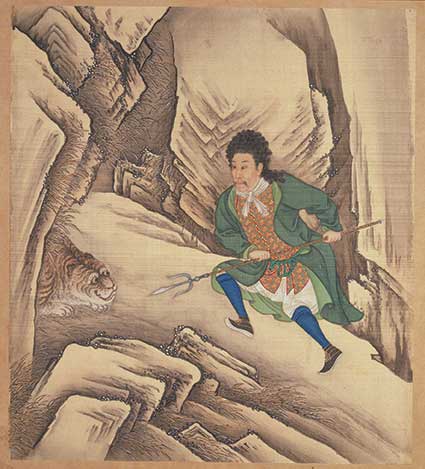
In the Kangxi period, a painting entitled Fighting Tiger, from Yinzhen’s Amusements, depicting Prince Yinzhen (the future Yongzheng Emperor) hunting a tiger, was commissioned. In this scene, the prince wears European-style attire and a peruke (wig), revealing Yinzhen’s fascination with the novel and the exotic. Kangxi also commissioned albums on the natural world. The Imperial Manual of Birds, by the court painter Jiang Tingxi (1669-1732) adopted Western techniques, taking the form of a richly illustrated encyclopaedia documenting exotic species with unprecedented precision. On display for only three months is a painting featuring a kingfisher from Siam (modern-day Thailand) from the album. Birds of this species were among the gifts presented to the Qing court from Siam and Champa (modern-day Central Vietnam).
The Qianglong Emperor
As the Qianlong Emperor reigned as an absolute monarch, under whose rule China reached the fullest extent of its power, the ‘Son of Heaven’ was determined to promote the arts with the same vigour as his far-flung military ‘Ten Great Campaigns’ to Central Asia and beyond. Known as a connoisseur and collector, he appointed many European artists to his court, including the French Jesuit painter, Jean-Denis Attiret (1702-1768), known as Wang Zhicheng. Attiret’s many portraits of the imperial family were depicted – on orders from the emperor – in a conspicuously Chinese style. He was commissioned, along with other European artists, to document Qianlong’s military victories, which resulted in 16 monumental battle tableaux depicting the Qing victories in Central Asia.
Apart from landscape and military paintings, there is also the fascination with previously unknown animals and a desire to document them. In the exhibition, there is a leaf from the six-volume Shoupu (Album of Beasts) by Yu Sheng (1692-1767) and Zhang Weibang (active 18th century) commissioned by Qianlong that follows the style of Niaopu (Album of Birds) by the same artists and commissioned in 1750. The creature depicted on one of the leaves is labelled as a bandi gou, which denotes the kind of beaver (Castor fibre) now found in the Brenta River region in Italy. The work echoes scientific albums such as the 16th-century Historia Animalium (History of Animals) by Conrad Gessner, Bengcao Gangmu (Compendium of Materia Medica) by Li Shizhen, and Kunyu Quantu (Complete Map of the World) produced by Ferdinand Verbiest in 1674 with the help of Chinese collaborators.
The growing numbers of foreigners associated with the Qing court can be seen in the choice of subject matter for decoration on a luohan bed that features scenes of merchants and envoys carrying foreign treasures, offering a window onto how Europeans were perceived in China during the Qing period. The bed is decorated with figures of merchants and envoys carrying clocks and other luxurious goods. Western clocks have a long history at the Chinese court. When the Jesuit Matteo Ricci (1552–1610) arrived in Beijing in the early 17th century, the first Jesuit to enter the Forbidden City in 1601, he presented mechanical clocks and a European-style world map to the Wanli Emperor (r 1572-1620) as gifts.
The Canton Trade
The final section looks at the Forbidden City and the Canton trade – The Emperor’s Southern Treasury: Canton Customs and the World. It examines how the Canton System (1757-1842) shaped court culture from the mid- to-late Qing dynasty. By the mid-18th century, the new system had been designed as a means for China to control trade with the West and manage its growing fear of foreigners by focusing all trade on the southern port of Canton. Implemented through several imperial edicts, it was finally firmly established when the Qianlong Emperor responded to perceived threats from abroad and confined all maritime trade to Canton. This allowed for a concentration of export workshops and shops to be established on China’s south coast to service the 13 ‘factories’ (trading posts), or hongs. From the late 17th century onwards, Chinese merchants, collectively known as the cohong, had been managing all foreign trade in the port. Once the Canton System had been implemented, the cohong was organised into a monopoly, or guild, to supervise, manage, and control foreign merchants.
Among the most important commodities of exchange during the 18th century was tea, which helped spark a taste for tea drinking across Europe and even inspired the development of European tea services. This craze for tea in the West also developed a demand for Chinese porcelains, including the creation of armorial porcelains (specially commissioned porcelains with family crests) related to tableware along with the demand for luxurious Chinese goods in general, such as lacquerware. Merchants in the factories focused on shipping these desired goods to the West, as well as filling their ships’ holds with European goods to bring back to China. It was the insatiable Western demand for Chinese tea that drove the creation of the Canton System, which accelerated global trade, shaped financial networks, and – due to severe trade imbalances – provoked the illegal opium trade (controlled by the EIC in India) that eventually forced the modern treaty ports to open through gunboat diplomacy. Then Chinese crackdowns on the narcotics trade sparked the Opium Wars (1839-42 and 1856-1860), shattering the restricted Canton paradigm and replacing it with a wider network of imperial treaty ports that has redefined modern international trade laws and China’s role in the 21st century – the Belt and Road Initiative.
Until 6 March 2028, Hong Kong Palace Museum hkpm.org.hk


