

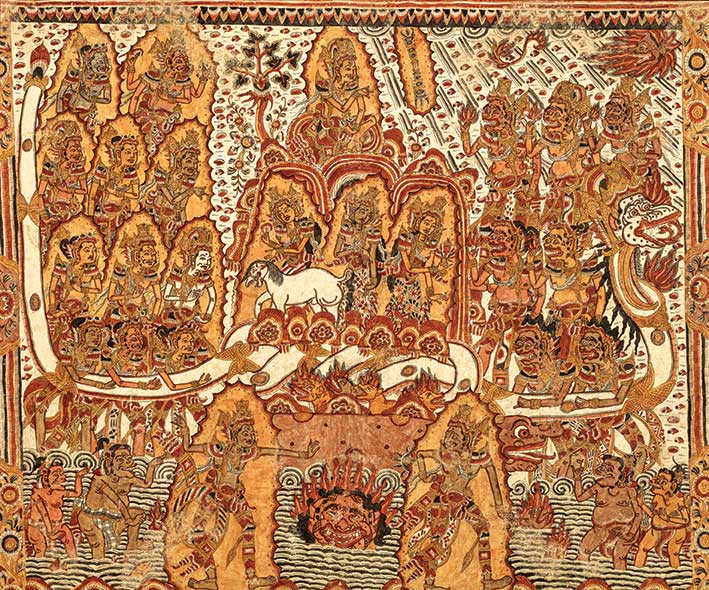
In Australia, the remarkable story of the artistic exchange that occurred between two very different Indonesian societies, Hindu Bali and Muslim Lombok, is being told at the Art Gallery of South Australia. The exhibition highlights the diversity of art, including the woven, embroidered, painted and tie-dyed textiles created by the Sasak people of Lombok and the Balinese as an expression of their spiritual beliefs, community values and reverence for the ancestors.
Through rarely seen Indonesian textiles from Bali and Lombok, drawings, paintings, and objects, the show reveals how centuries of maritime contact, trade, and migration across the Lombok Strait have shaped both islands’ artistic traditions while preserving their unique cultural identities. It also celebrates both the history and continuing ingenuity of artists on both islands through the shared heritage of cloth.
At the heart of the exhibition are Indonesian textiles from Bali and Lombok – woven, embroidered, painted and tie-dyed – created by the indigenous Sasak people of Lombok and the Balinese. For local communities, these works are profound expressions of spiritual belief, identity and reverence for ancestors. For Lombok, intricate songket (brocade) cloths shimmering with metallic thread, and hand-woven fabrics featuring Lombok’s renowned ikat technique reveal the island as a place where textiles are deeply intertwined with everyday life. Elsewhere in the exhibition of Indonesian textiles from Bali and Lombok, the lavish patterns of the Balinese textiles reflect the belief that the garments imitate divinely beautiful textiles woven by the Hindu gods.
The Connections Between Bali and Lombok
The Art Gallery of South Australia (AGSA) Curator of Asian Art, Russell Kelty, said the exhibition of Indonesian textiles from Bali and Lombok highlights an often-overlooked cultural relationship. ‘Two Islands, One Thread brings to light a remarkable history of connection between Bali and Lombok. While these islands are often understood as culturally distinct, their artistic traditions reveal a long history of exchange, adaptation and shared creativity. Textiles from both regions carry deep cultural meaning – used in ceremony, daily life and as conduits between the physical and spiritual worlds. This exhibition offers audiences a rare opportunity to see how these traditions intersect and diverge’.
Bali has been a major source of fascination for the West since the late 19th century. Balinese textiles first became known in the West during the late 19th and early 20th centuries, expanding through Dutch colonial expansion, international expositions, and early Western travellers. While Javanese batik gained broader Western exposure earlier, distinct Balinese weaving traditions – such as double-ikat geringsing and royal endek – began entering Western museum collections and colonial records around this period. Their textiles are culturally distinct, and it is the only island in the Indonesian archipelago to have resisted the forces of Islam which overran the Hindu-Buddhist kingdoms of neighbouring Java from the 15th century onwards. Bali remained independent and went on to practise a composite belief system based on a dominant Hindu cosmology and its views of the world. The religion, which integrates ancestor worship, animism and magic, has had a deep influence on Balinese culture and traditions, and is reflected in the island’s unique textile traditions.
In Bali, high spiritual value is attached to cloth. It is an activity invested with power since the textiles produced demarcate key stages in the human life cycle. Their making is not taken lightly. When, how, where and by whom cloth is made are critical considerations. An auspicious day is usually chosen for the actual weaving; the new moon and the full moon, for instance, are not considered auspicious times. Weaving is a ritualised activity, and those making items associated with deities undergo a purification ceremony called mawinten.
Balinese society makes a fine distinction between male and female activity. The use of weapons such as the keris, or dagger, is identified with men. Textiles are the preserve of women and when the circumstances are right, sakti or ‘spiritual power’ is conferred on the weaver. Cloth appears frequently in Balinese mythology and legend, and it is customary for weavers to make daily offerings to gods and deities. The lunar goddess Dewi Ratih, who lives on the moon, is often depicted spinning because she is believed to have given the knowledge of weaving to humanity.
Backstrap Looms
Women traditionally use the cag cag, to weave Indonesian textiles, a body tension or backstrap loom for weaving. It may be a continuous or discontinuous warp setup with a backstrap or harness, breast and cloth beam, beater/blade, reed, lease bar, heddle rod, and heddle strings, and a shuttle that carries the bobbin. The wooden harness which rests on the weaver’s lower back, is attached to the loom with cords. The cag cag integrates the weaver’s body with the loom, providing the force needed to keep the warp as taut or relaxed as required. Weaving in Bali today remains a skill that is passed down through the generations, usually from mother to daughter who has probably inherited a cag.
Many Balinese cloths fulfil religious purposes and are said to possess protective properties. Kain tenunan, ‘woven cloths’, are simple utilitarian textiles in lines and checks, some of which are sacred cloths for men. The poleng, a sarong in large black-and-white checks, is associated with spiritual power, protection, and masculine virtues. It is today a ‘uniform’ for the mandatory pacalang or ‘security guards’ present at ceremonial events. In Bali, shrines are considered physical embodiments of deities and spirits; they too need to be protected and have poleng draped over them as well as over guardian figures in temples.
Sacred Balinese Textiles
Geringsing cloths are perhaps the most sacred of all Balinese textiles. They are identified with the Hindu goddess Indra and are exclusive to the Tenganan Pageringsingan area of Bali. Worn as waist or hip wrappers by men and women during special rituals, they are said to possess healing properties and offer protection from disease and evil spirits. They are therefore used until they disintegrate.
A continuous circular warp, which is ritually appropriate, they symbolise the role of creation and are taken off uncut from the loom. They usually sport magnolia flower patterns and involve a complex dyeing method lasting well over a month to allow the yarns to be soaked and dried. It prepares them for their reddish-purple colour when they are immersed and repeatedly dyed again thereafter.
Special occasions call for elaborate and expensive cloths worn by royalty and the elite. Prominent among them is the kain songket, luxurious brocades that symbolise privilege and power. They carry geometric or floral patterns, embellished by sheer gold and silver yarns shimmering on brightly coloured silk. Because of their extravagant nature, they are said to be an aristocratic art and the handiwork of women from the highest castes.
The Textiles of Lombok
The island of Lombok’s textiles are mainly created by the indigenous Sasak people and first gained wider outside popularity during the 1970s and 1980s. While the hand-weaving of traditional songket and ikat fabrics has ancient roots tied to Sasak culture, they remained largely underrepresented in major colonial and international collections until a broader surge of interest in Indonesian arts emerged in the late 20th century.
They seem to be the least studied of Indonesian textiles and less represented in museum collections. Robyn Maxwell wrote, in the encyclopaedic Textiles of Indonesia: The Thomas Murray Collection, ‘Until relatively recently, there has been little interest in collecting the more visually sombre material culture of the Sasak, Lombok’s predominant ethnic group. Only a small number of Sasak textiles of any historical value survive – and then more in private collections than public museums’. Apart from those at AGSA, the Metropolitan Museum of Art in New York shows five objects online in their collection, three of which are textiles. Maxwell continues, ‘The best documented Sasak textiles are small, narrow, striped fabrics woven on the simplest back-tension looms. Their beauty lies in their eclectic colour combinations of the cotton warp threads’.
Medieval Hindu-Buddhist Indonesia
Maxwell explains that Lombok is located at the eastern margin of medieval Hindu-Buddhist Indonesia that stretched west across Bali, through Java and across Sumatra and although little archaeological evidence remains of their Hindu-Buddhist past, numerous features of surviving textiles suggest that other Buddhist arts, including textiles and paintings, were traded and used by the island’s inhabitants. The Java-based Majapahit empire (1293-1527), considered the last great Hindu-Buddhist maritime power in Southeast Asia, had conquered Bali in 1343 and claimed suzerainty over parts of Lombok during its 14th-century peak. The Mahapajit rulers acted as a dominant power and vital policing force along the southern corridor of the Maritime Silk Road, controlling key shipping lanes through the Java Sea, the Strait of Malacca, and the Indonesian archipelago. Later, independent Balinese kingdoms (specifically Karangasem) also ruled parts of Lombok in the 17th and 18th centuries, reinforcing Buddhist-Hindu motifs that influenced textile designs.
Muslim influence in Lombok first began during the first half of the 16th century (around 1545), driven by early Islamic preaching from Java, though broader trade links and institutional conversion expanded significantly into the 17th century and the indigenous Sasak population gradually integrated Islamic teachings with pre-existing local beliefs. This included the establishment of the Islamic Kingdom of Selaparang and the gradual conversion of the indigenous Sasak people. As Islam took root, traditional weavers shifted their aesthetic away from animist and Hindu-Buddhist depictions of living creatures toward abstract, geometric, and plant-based motifs.
The Adoption of Islam on Lombok
Over centuries, the adoption of Islam within the community on the island saw weavers modifying their designs and incorporating new ideas into their work from contact with Islamic merchants. This reinforcement of Islamic ideas and motifs was underpinned by the Dutch administrative approach which further strengthened orthodox Islamic networks on the island and local religious leaders (Tuan Guru), marginalising syncretic or hybrid local belief systems (Wetu Telu) in favour of standardised Sunni Islam (Waktu Lima), although the island of Lombok was not fully colonised by the Dutch until the end of the Lombok War (1891-94).
Alongside these Indonesia textiles from Bali and Lombok, Two Islands, One Thread features a collection of objects from Lombok and Bali, including gold ancestral shrine plaques, Balinese temple doors dating from the 18th century, and large-scale paintings, showcasing the architecture, ceremonial life, and artistic traditions of both islands.
Two Islands, One Thread, Indonesian textiles from Bali and Lombok, until 11 October 2026, Art Gallery of South Australia, agsa.sa.gov.au


