

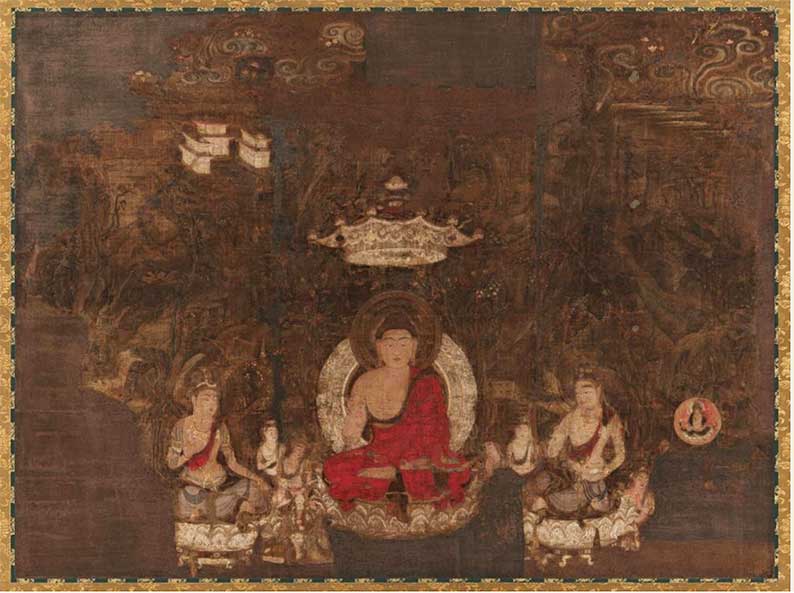
Buddhist paintings from Nara, known in Japanese as Nanto butsuga, represent a foundational tradition of sacred Japanese art. Rooted in the cosmopolitan Tenpyo style of the Nara period (710-794), these works feature rich iconography, detailed mandalas, and classical Buddhist imagery preserved across Nara’s ancient temples and at the Nara National Museum. A selection of these works on loan from the Museum of Fine Arts in Boston is currently on display at Nara National Museum.
Nara is the eastern terminus of the Silk Roads that brought trade and continental Asian culture, including Buddhism, to Japan in the period from the 500s to the 700s, transforming indigenous society. Buddhism was championed by Prince Shotoku Taishi (574-622) at what became the religious complex of Horyuji Temple, near Nara. In 752, Emperor Shomu (701-756) dedicated the great bronze Vairocana Buddha at Todaiji Temple, destroyed and reconstructed twice during its long history and still the symbol of Nara today.
Buddhism and Shinto
Notwithstanding partial destruction in the 1180s, 1560s and 1870s, Nara has each time revived and sustained its ancient religious traditions, in which Buddhism has generally coexisted peacefully with worship of native deities known as kami (modern Shinto). The great temples and shrines of Nara are on this occasion loaning a range of significant sacred images traversing some eight centuries of Japanese history.
Nara, once known as Nanto (Southern Capital), has a rich tradition of Buddhist painting that has been continuously passed down since ancient times. During the Nara period major temples were adorned with richly cosmopolitan Tenpyo-style paintings that would serve as a model for generations to come. By the Heian period (794-1185), elegant Buddhist paintings suited to aristocratic tastes were widely venerated. From the Kamakura period (1192-1333) onwards, which marked the revival of these Buddhist paintings, artists began producing revivalist works based on Tenpyo iconography. At the same time, Buddhist painters affiliated with the Nara-based painting atelier known as Nanto-edokoro became actively involved not only in the production of Buddhist paintings and illustrated handscrolls, but also in the decorative colouring of Buddhist sculptures.
The Tenpyo period (724-729) itself can be considered the finest part of the Nara period (710-784), the golden age of Japanese antiquity. The new permanent capital, Nara, was embellished with great temples and palaces and, under the Emperor’s impetus, Buddhist temples sprang up throughout the land. Sculpture reached great heights as the temples were filled with sacred images. It was a time of great artistic, religious and cultural activity, coupled with eager borrowing from China’s flourishing Tang dynasty, both in the administrative and artistic fields. Japanese embassies and students bore exotic gifts back from China and the Silk Roads – from Persian glass to carpets – and many were donated to Todai-ji’s treasure house, the Shoso-in, where they remained largely undisturbed until this century.
This exhibition is an international collaborative project realised after nearly two decades of planning between the Museum of Fine Arts, Boston in the US and the Nara National Museum in Japan. It marks the first attempt to trace the history of Buddhist paintings of Nara through an exceptional gathering of works, featuring the long-awaited homecoming of outstanding Buddhist paintings associated with Nara from the collection of the Museum of Fine Arts, Boston, alongside a careful selection of Buddhist paintings and sculpture from Japan, including works from the collection of the Nara National Museum. It also offers a rare chance to see the paintings and sculptures that once adorned the halls of the now-lost great temple Uchiyama Eikyuji, a legendary site of Nara. We invite you to fully immerse yourself in the rich and distinctive appeal of Buddhist paintings of Nara, an experience available only in this exhibition.
Until 13 September, Nara National Museum, narahaku.go.jp


