

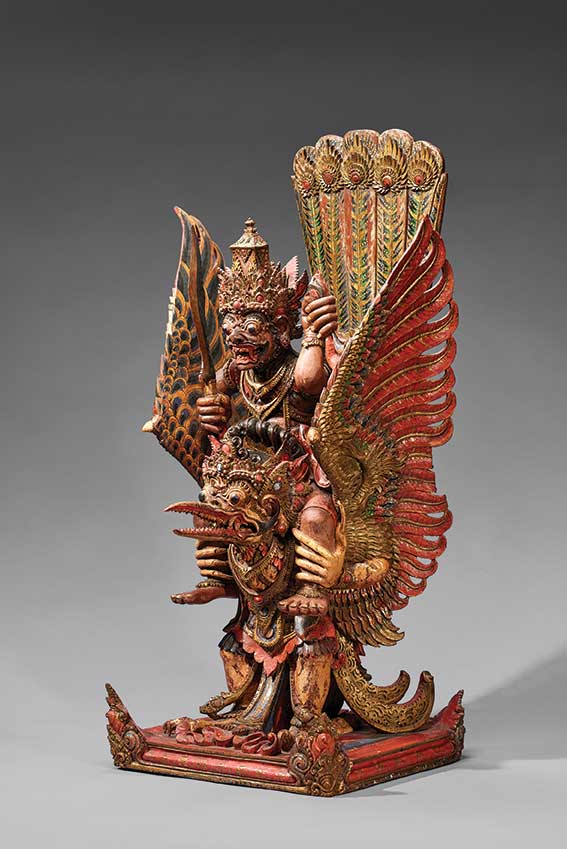
A bird with the body of a man, the wings of an eagle and the power to defeat the gods, Garuda is one of the most recognisable figures in Indonesian culture. His adventures have been told and retold through painting, sculpture, dance and shadow puppetry, with each storyteller bringing a distinctive emphasis to the mythical bird’s exploits. The Garuda originates in ancient India as a divine bird and the mount of Lord Vishnu, with tales of the Garuda then spreading across South and Southeast Asia through the diffusion of Hindu and Buddhist traditions.
The Garuda exhibition currently on show at the Asian Art Museum celebrates this legendary bird. The celestial bird is also the national emblem of Indonesia, Garuda Pancasila, representing freedom, strength, and the national philosophy. Another country also claims it as their national symbol – Thailand. Here it represents the royal family and divine authority. While both represent the same mythical bird, the Thai Garuda (Krut) and the Balinese Garuda differ significantly in their visual style, religious meaning, and modern political usage. The Thai version being a standardised, highly stylised, royal emblem with distinct human-like features.
The Myth of Garuda
The myth of Garuda has been woven into stories and depicted physically in many ways – in temple carvings, motifs in textiles, and in illustrations from Nepal, Sri Lanka, Thailand, Cambodia, Myanmar, and Tibet. In Buddhist lands, the Garuda appears in the Jataka Tales, where the bird is often shown in battle against the serpentine Nagas. Garuda also appears in dance performances, especially in Bali, in works such as the Kecak Wisnu Garuda dance and Barong and Ramayana performances. Performance styles vary from country to country – in Thailand, Garuda appears in Khon masked-dance drama and also appears in Cham dance in Bhutan and Nepal, and is present in Khmer classical dance in Cambodia.
India also retains a Garuda tradition where it is preserved in Kerala in the Garuda Thookkam and Garuda Parava dances in which performers wear large wings, headgear, and vibrant make-up to mimic the divine bird, moving in rhythm to traditional drums to reenact Garuda appeasing Goddess Kali after her battle with the demon Darika. In classical Hindu dance form, the bird appears in re-enactments of the epics Mahabharata and Ramayana.
Garuda in Tibet
To the north, in Tibet, Garuda became assimilated with the Bon khading (Tibetan mkha’ lding), the golden ‘horned eagle’, king of birds, and the Bon bird of fire. In Buddhist Nepal, Garuda (Sanskrit: Garuda; Pali: Garula) is celebrated as a legendary bird or bird-like creature across Hindu, Buddhist, and Jain mythology. He is variously seen as the vehicle (vahana) of the Hindu god Vishnu, a dharma-protector, and is an Astasena in Buddhism (as one of the eight classes of non-human guardians in Mahayana Buddhism that protect the dharma). To the Jains, he is Yaksha, a protective guardian of Tirthankara Shantinatha.
In Buddhist art, Garudas are shown as sitting and listening to the sermons of the Buddha, and are natural enemies of the Nagas (snakes), sometimes depicted with a serpent held between their claws. As in Hindu depictions, zoomorphic (giant eagle-like bird) and partially anthropomorphic (part bird, part human) iconography is common across Buddhist traditions.
In Bali, Garuda is closely tied to Balinese Hinduism and local beliefs in nature spirits. Here, he is a beloved heroic character from the Mahabharata and Adiparva epics, celebrated for his filial piety (saving his mother). He is primarily sculpted as a temple guardian or as the literal vehicle beneath statues of Lord Vishnu. The Balinese version is a highly detailed, zoomorphic beast deeply woven into local folklore and temple architecture. In the art of the region. Famous representations on the island can be seen at the Pura Beji (Sangsit), and the sacred water temple located in northern Bali. This subak temple (where monks control the opening and closing of the irrigation systems) is famous for its hyper-detailed, non-traditional carvings.
Bali and the Indian Ocean Trade
Bali was influenced by the Indian trade that brought with it spiritual ideas. As Hindu and Buddhist culture spread across Southeast Asia with the classical Indonesian polities such as the Mataram, Singhasari, and Majapahit kingdoms adopting these religious traditions, Bali’s culture changed. In Indonesia, as a whole, the Garuda is seen more as the symbol of virtue the virtue of knowledge, power, bravery, loyalty, and discipline. As the vehicle of Lord Vishnu, Garuda also bears the attributes of Lord Vishnu, which symbolise preservation of the cosmic order.
These attributes can be seen in Hindu culture as early as the 6th century, where cultural dissemination and acculturation shaped and defined the identity of the region. In the early medieval period, many kingdoms flourished in Southeast Asia and Hindu influence can be seen in the institutions of the kingdoms and their belief systems.
The Hindu Epics
In Hindu epics and mythology, the Garuda is a divine, bird-like creature who serves as the king of birds and the powerful mount of Lord Vishnu, especially in the tale of the Theft of Amrita (Elixir of Immortality) in the Mahabharata. This tale is depicted in the ancient Pura Kebo Edan temple that houses historical stone carvings from the 13th and 14th centuries, including primitive yet powerful depictions of the Garuda used in esoteric Hindu rituals. Its stone gates feature intricate relief panels depicting the story of Garuda fighting the Nagas to win the Amrita elixir.
The Amrita elixir tale sees Garuda free his mother from slavery, however, the Nagas demanded a ransom: the cosmic Amrita guarded heavily by the gods in heaven. Garuda flew to the celestial realm and single-handedly defeated Indra and the entire army of gods. In the tale he bypassed many obstacles by shrinking his size to navigate a spinning, razor-sharp wheel of fire protecting the nectar, and then blinded the two poisonous snakes guarding the vat by blowing dust into their eyes. Garuda then made a pact with Vishnu, and as he flew away with the nectar, Lord Vishnu intercepted him. Impressed that Garuda did not drink the nectar himself, Vishnu offered him two boons: immortality without drinking the nectar and a place of honour as Vishnu’s personal mount.
Buddhist Indonesia
In Buddhist Indonesia, from the 5th to the 15th century, the most iconic early Javanese Buddhist Garuda can be found in the Borobudur archaeological park area inside Candi Mendut (a companion temple just three km east of the great Buddhist temple of Borobudur). The Mendut reliefs feature exceptionally large, stylised carvings of the ‘Garudeya’ holding up structural elements, serving as an architectural cornerstone.
Garuda is often found on Bali’s textiles. One such textile in the Asian Art Museum exhibition illustrates one of Garuda’s most celebrated adventures: his quest to rescue his mother, Winata, from enslavement. After she loses a rigged bet to her sister, Kadru, Winata is forced into servitude. Her freedom comes with an almost impossible price: Garuda must steal the elixir of immortality, guarded by the gods in heaven, and deliver it to Kadru’s serpent sons. Determined to free his mother, Garuda sets off on a quest that pits him against supernatural forces at every turn.
Another textile shows Garuda battling the gods and stealing the elixir of immortality. A traditional Balinese painting, from around 1910-1930, shows Garuda appearing repeatedly across the composition, allowing viewers to follow his journey through multiple scenes. He battles the gods, approaches the cave where the elixir is kept and ultimately makes off with the sacred potion. The painting is not a single frozen moment but a visual narrative unfolding across time.
Another work, Garuda, Wibawasu, Supratika, is filled with frenzied energy. Garuda has captured an elephant and turtle to eat, following his father’s advice to gain the strength he needs. The animals were once feuding brothers, transformed by a curse. Yet the painting also contains mysterious figures and scenes whose meanings remain uncertain, suggesting how fluid storytelling could be in Balinese art. ‘Garuda’s story can be seen as a story about what we will do for the people we love,’ says Natasha Reichle, associate curator of Southeast Asian Art at the Asian Art Museum. ‘His courage is extraordinary, but his devotion to his mother adds a twist to the typical hero’s journey.’
Storytelling in Bali
Storytelling is central to the exhibition. Balinese paintings often repeat characters several times within a single composition, inviting viewers to follow the action from one scene to the next. These narratives were also familiar through dance and wayang kulit, or shadow puppetry. The paintings were part of a larger, living storytelling tradition rather than illustrations of fixed texts.
The exhibition also evokes the original ritual context of these works. Paintings on cloth were traditionally displayed in temples and royal settings, for only a few days each year, surrounded by textiles, decorations and offerings as a form of homage to the gods. This spirit continues in the gallery, where hand-drawn graphics inspired by Balinese artists including Ketut Madra and Ni Made Suciarmi surround the older artworks. At the centre is the Hindu deity Vishnu riding Garuda, a monumental wooden sculpture in which Garuda’s towering wings frame the god he serves. Nearby, the demon king Ravana riding the mythical bird Wilmana offers a reminder that not every powerful bird in Balinese art is Garuda.
Though Garuda’s stories originated in Indian traditions, Balinese artists gave them their own emphasis and flavour. Across Indonesia, his courage, loyalty and power helped make him an enduring national emblem.
Until 4 January 2027, Asian Art Museum, San Francisco, asianart.org


