

Considering the state of the world and all its uncertainties, there was a great sense of anticipation for the 2026 Venice Biennale. How were artists going to position themselves, and what would they want to emphasise? The title of the Biennale ‘In Minor Keys’ provided a general direction for artists, encouraging them to highlight what had so far been overlooked in presentations echoing or re-evaluating ‘human relationships, the little things, which are also great ones’. This approach was conceived by this year’s curator of the Biennale, the Cameroonian-Swiss Koyo Kouoh (formerly Executive Director and Chief Curator of the Zeitz Museum of Contemporary Art Africa in Cape Town), who unfortunately passed away in the months leading up to the Biennale, but whose team carried on implementing her vision.
With a record number of participating countries – 98 – this year’s Biennale continues to follow its usual format: national pavilions carrying out the project of their own curator, the general presentation in the Padiglione Italia, and the Arsenale based on Koyo Kouoh and her team’s selection of international artists to contribute to their curatorial statement of ‘In Minor Keys’. Finally, there are the collateral events of the Biennale that are in various parts of the city. The Biennale’s impact in the art world extends beyond the local museums, countless commercial galleries, and institutions from abroad staging exhibitions in Venice, the periphery events also benefit from the event’s reputation to serve as a platform for their artists.
Among the national representations, new to the Giardini is Qatar, with a temporary structure awaiting its permanent pavilion to be built by Lina Ghotmeh (b 1980, Lebanon). Under the leadership of Her Excellency Sheikha Al Mayassa, the emirate has repeatedly marked its commitment to the arts, also welcoming the inaugural edition of Art Basel Qatar earlier this year. The design of their temporary structure was handed to art world veteran Rirkrit Tiravanija (b 1961), who created a refined tent in burgundy red, reminiscent of the country’s flag. The tent in the Giardini expands on a recent project Tiravanija had completed in Doha, in the park next to the Museum of Islamic Arts, meant to bring people together. Similarly, in Venice, the Qatari pavilion is offering a diverse programme: music with Tarek Atoui (b 1980, Lebanon), food with Chef Fadi Kattan (b 1977, Palestine), film with Sophia Al-Maria (b 1983, Qatar), and sculpture with Alia Farid (b 1985, Kuwait), all with the intent to encourage people to gather and mingle.
As well as connecting, the artist Ei Arakawa-Nash (b 1977), in the Japanese pavilion, is expecting the audience to be pro-active. Drawing on his personal experience as a parent of twins, Ei Arakawa-Nash created an environment set solely around babies, with baby dolls found on scaffolding and milk bottles hanging from the ceiling. Using the International Monetary Fund’s conclusion of declining birth rates in numerous countries as a starting point, the artist wonders whether people are overly pessimistic towards the future, refusing to have children. In the pavilion, the audience is invited to ask for a doll and attend to its needs (nappies, feeding bottle, etc) as if it were a real baby. As a young parent himself, he questions his responsibility towards a young child for his future.
Next to the Japanese pavilion, Korea opted for a view of the past, examining the brief period following the freedom from Japanese occupation (1945-48) and before the partition between North and South Korea. Both selected artists invite visitors to consider this period that they call ‘Liberation Space: Fortress/Nest’ as a moment of possibilities, uncertainties, or tensions towards the future. Hyeree Ro (b 1987) looks at the space as a nest, creating the different experiences and stages of life (memory, life, mourning) and a wall of organza circles symbolising comfort, while Goen Choi (b 1985) presents her vision of a fortress by working with copper pipes, that cut into the pavilion’s structure, creating linear forms that register pressure, defence/offence, and circulation.
In tune with the Biennale’s title, the Egyptian pavilion presents ‘the silence pavilion: between the tangible and the intangible’. Presently based in Tuscany, Armen Agop (b 1969) creates minimalistic granite sculpture as well as ink paintings. Encouraged to refrain from talking when in the pavilion, the audience is free to touch his sculptures to interact in a more spiritual way with his work, going beyond the bare visual aspect.
The Arsenale features several national pavilions amidst the general exhibition of ‘In Minor Keys’. Some of them have been widely praised, especially Lebanon, India, and Saudi Arabia. Nabil Nahas (b 1949), representing Lebanon, presents 26 paintings representative of various series from his oeuvre, addressing the sky, the sea, or trees, among other subjects. Arranged as a frieze with the paintings hanging more than two metres above the ground, all can be viewed together despite the crowds, presenting ‘an experience to be lived’. Nabil Nahas’ invitation to the Biennale is a logical choice following an international career spanning close to 50 years.
Even though pavilions featuring groups of artists generally tend to be uneven in quality, this year India is highlighting five artists all making exceptional contributions: Alwar Balasubramaniam (b 1971), with an earth and resin panel wall, Ranjani Shettar (b 1977), with a handwoven cotton sculptural garden, Sumakshi Singh (b 1980) with a silk, cotton and nylon sculpture installation, Sharma Sonam Tashi (b 1997) with a cotton flower sculpture and Asim Waqif with a bamboo construction. With ‘geographies of distance: remembering home’, these artists question what the concept of home means, especially if home is far away or no longer exists.
With its large surface area, Saudi Arabia’s pavilion perfectly matches Dana Awartani’s needs to accommodate her oversized floor installation ‘May your tears never dry, you who weep over stones’. With more than 29,000 tiles specifically created for Venice by craftsmen, Dana Awartani (b 1987) made it a point to involve communities to perpetuate craft traditions. The tiles are used to recreate parts of ancient sites located in Syria, Palestine, or Lebanon that were damaged or destroyed over the past years through wars, conflicts, and physical attack. The scale and quality of the installation emphasise the importance of memory and preservation in a region that harbours treasures and masterpieces of our civilisation.
Additional national pavilions in the Arsenale include the Philippines, the UAE, Pakistan, Turkey, Singapore, Oman, Uzbekistan, Indonesia, and China. The installation built around video, painting and sculpture presented by Jon Cuyson (b 1969) from the Philippines echoes the country’s relationship with the sea. In ‘Sea of Love’, Cuyson tells a story through the eyes of a sailor, his lover, his mother, and the sea, underlining the fact that on a global scale, every third active seafarer is from the Philippines, making them indispensable for the continuation of international trade. Here, the sea stands not only for opportunities but also for its diaspora, and as a symbol of separation and exile.
For its third participation in the Biennale, Oman is presenting an immersive installation conceived by Haitham Al Busafi (b 1985) who is both a participating artist and the curator of the exhibition. With Zinah (adornment), viewers are invited to step into a room with Omani sand on the floor with pieces of silver (primarily horse trappings) hanging from the ceiling. Every movement causes the silver ornaments to sway, making the room react to the presence within it. By selecting horse trappings, the artist draws attention to Bedouin culture and the importance of horses in daily life.
The title of the Turkish pavilion ‘A Kiss on the Eyes’ refers to a polite and respectful way to end a letter. In the same unassuming way, Nilbar Güres (b 1977) is showing large-scale sculptures and collages: a giant flower, a balloon, and a palm tree – pieces that, beyond their colourful appeal, bear a deeper meaning, pointing at issues such as memory, social class, gender, and identity. For her sculptural installations, Nilbar Güres worked together with craftsmen, relying on found materials and clothes, representative of the causes she wants to highlight. Amanda Heng Liang Ngim (b 1951), from Singapore, carried the concept of the Biennale forward by enlarging specific body parts in her black-and-white photographs and filming in real time such basic activities as watering plants, or preparing breakfast. In this way, she invites the viewer to zoom in on the smaller things in life, that carry equal meaning and importance to what we usually consider moments not worthy of our attention.
With its ninth participation at the Biennale, the UAE selected six artists – Mays Albaik (b 1991), Jawad Al Malhi (b 1969), Farah Al Qasimi (b 1991), Alaa Edris (b 1986), Lamya Gargash (b 1982), and Taus Makhacheva (b 1983), who are in their own way responding to the pavilion’s title Washwasha (whisper). Their approach is mainly based on the sound that evolves around language, identity, and the body. They use their work to examine the UAE’s diversity as an opportunity to shape the future.
A juxtaposition of futuristic technologies and more traditional works of art are featured in the Chinese pavilion, where approximately a dozen artists and collectives are part of the group exhibition Dream Stream. The viewer can experience a games room with video and digital installations, sitting alongside traditional landscapes and calligraphy. The exhibition title refers to the Dream Stream Essay (dated 1088) by Shen Kuo, a polymath and scholar from the Northern Song dynasty (960-1127), which recorded notes on science, art, and philosophy.
Within its pavilion, Uzbekistan is reinventing the Aral Sea, which by 2007 had lost 90% of its volume following Soviet intervention to divert two of its main feeding rivers from the late 1930s. This is based on the writings of Allayar Darmenov (b 1998), who first began writing about the Aral Sea in 2015, drawing on myth to create imagined futures for the sea. The seven featured artists include Jahongir Bobokulov (b 1996), Zi Kakhramonova (b 2001), Aygul Sarsen (b 2005), Zulfiya Spowart (b 1991), Xin Liu (b 1991), A A Murakami (b 1983), and Nguyen Phuong Linh (b 1985), who all echo an approach to the disaster, inventing mythologies around the Aral Sea that eventually culminate in the sea portrayed as a goddess in Aygul Sarsen’s paintings.
Indonesia opted for an interesting approach: instead of bringing the works to its pavilion, they decided to produce the works in Venice in collaboration with the Scuola Internazionale di Grafica. The resulting watercolours, drawings, gouaches, or prints bring to the forefront a medium all too often overlooked, requiring excellent skills and technique. Pakistan brought craft to the forefront, with Faiza Butt (b 1973) featuring nine oversized wall tapestries created with local Punjabi artisans. The female weavers are also represented with paintings, breaking a pattern where artisans remain mostly anonymous and rarely credited for their effort.
Beyond the Arsenale, some national pavilions such as Kyrgyzstan, Mongolia, Kazakhstan, and Syria were scattered around town. Kyrgyzstan’s contribution, with multi-disciplinary artist Alexey Morosov (b 1974), raises the question of how the country’s identity and cultural memory can be preserved in the future. Through his video and sculptures, he points more specifically at kok-börü, an ancient equestrian sport held in the region that he feels is at risk of disappearing.
The work of the artists in the Mongolian pavilion defends the same position. Gerelkhuu Ganbold (b 1988), Dorjderem Davaa (b 1981), Nomin Bold (b 1982), and Tuguldur Yondonjamts (b 1977) underline how art – between Mongolia, once an important actor within Eurasia, and Venice – can foster dialogue and understanding on the global stage. In their pavilion, Kazakhstan reconnects with elements that are unique to the country’s nomadic culture: its music, the steppes, and its horses. All nine selected artists engage with these issues, including a video of Aitys, one of the most typical musical genres, Qazak, and with oversized felt sculptures of horses (the animals are considered sacred in their culture).
In a new location, the Syrian pavilion reimagines a tower tomb within the Università luav di Venezia. Sara Shamma (b 1975) reconnects with the splendour of the tower tombs of Palmyra that were severely damaged during the war. Her wonderful immersive installation revives this lost heritage through architecture, painting, sound and scent. Her contribution is more powerful knowing that the artist visited the world-famous site as an art student when it was still intact.
Featured within the Collateral events are Taiwan, Hong Kong, Macao, and Azerbaijan. Taiwan located in the Palazzo delle Prigioni is presenting a solo exhibition of Li Yi-Fan (b 1989). In a video simulation, we follow digital puppets, sometimes as a whole, sometimes as individuals, in their intriguing performance. The performance becomes immersive and surreal with oversized sculptures of the puppets’ body parts placed on the floor for the audience to sit on. The performance quickly creates an unsettling feeling between the real and the unreal.
Macau reconnects with its past with artists Eric Fok Hoi Seng (b 1990), O Chi Wai (b 1991), and Veronica Lei Fong Ieng taking the Chinese artist Wu Li’s journey as a starting point. Wu Li (1632-1718) was a painter and a theologian determined to go to Rome to join a Jesuit missionary. On his way, he stopped in Macau and stayed taking the Portuguese name Jacone. All three artists revisit Wu Li’s unfinished journey through installation, painting, and video. Hong Kong, on the other hand, matched the theme of the Biennale with its exhibition ‘Fermata’, encouraging the audience to pause and reconsider the passing of time created by Kingsley Ng (b 1980) as well as looking at our familiar surroundings from a different angle with Angela Hui (b 1991).
Azerbaijan took the theme of the Biennale even one step further, relying on the country’s weaving tradition as a starting point to then explore the power of language based on modern technology.
Beyond the national pavilions and participations, offerings ‘In Minor Keys’ feature numerous artists from the Asian and Islamic art worlds. While it is impossible to discuss the work of all of them, some artists in particular stand out. Wardha Shabbir (b 1987, Pakistan) relies on nature to magnify the struggles she encounters as a woman, an artist and a human being in a global world. Her delicate and complex exquisite gouache paintings echo the resilience found in nature. In his collage paintings, Mohammed Joha addresses a resilience of a different kind. Born in Gaza, where he lived until 2004, he created the series No Shelter as he witnessed unfolding events through the media. His vibrant pieces stand as a testimonial of a population’s courage and resilience in its quest for survival. Also from Palestine, Vera Tamari (b 1944) creates large fabric collages with ink and crayon. She is not only an artist, but also a teacher and mentor, relentlessly pursuing her investigation of the medium of collage, as well as the use of clay in her relief sculptures.
In one of their featured series, the Lebanese duo Joana Hadjithomas (b 1969) and Khalil Joreige (b 1969) compile evidence of what we leave behind in terms of waste. After superimposing countless images, their large-scale photographs take us metres deep into a dump site in Tripoli, emphasising that the decomposition of these techno-fossils will take hundreds of years. Also referring to her native Lebanon and its flora and fauna is Hala Schoukair (b 1957). Her large-scale paintings echo her childhood walks with her mother, where she was encouraged to pay attention to flowers, insects, or the landscape, and are a perfect rendering of nature coming alive.
Over the past 30 years, conceptual artist Walid Raad (b 1967, Lebanon) has compiled a list of the beds and houses the late PLO leader Yasser Arafat (1929-2004) is said to have slept in. Constantly at risk and having survived numerous assassination attempts, Yasser Arafat is known for never having spent two consecutive nights at the same place. Walid Raad’s findings result in a selection of drawings and paintings documenting the leader’s whereabouts in Yemen, Oslo, Moscow, or Yemen. Unlike Walid Raad, who bases his work on historical facts, Raed Yassin (b 1979, Lebanon) combines historical truths with fiction. Based on a trip Andy Warhol took to Kuwait in the 1970s and the archival material documenting it, the artist imagines the series Warhol would have completed while there, who his subjects might have been, and how he would have portrayed them. Warhol of Arabia is a witty and humorous work where the utterly fake and real are intertwined.
Among the collateral events, various exhibitions should be mentioned. Lee Ufan’s (b 1936) show is mounted as a small retrospective, bringing together works and installations from different decades. As such, the viewer can fully comprehend the artist’s trajectory from a leading figure of Mono-Ha and Dansaekhwa to the accomplished artist he is today at the age of ninety. Nalini Malani’s immersive presentation in Venice is based on a commission by the Kiran Nadar Museum of Art in New Delhi. Following the Greek mythological figure of Orest, Nalini Malani (b 1946) examines the role of women, underlining their importance in creating another world, while still subject to injustice within society. Conceived as a chamber of moving images, Of Woman Born is a powerful contribution to questioning a status that has largely remained unresolved regardless of time and place.
With a telling and explicit title, Gaza – No Words – See the Exhibit, the show is built around the quote of the late Gazan poet Refaat Alareer (1979-2023), ‘If I must die, you must live to tell my story’. Over 60 Palestinian women in refugee camps helped bring that quote to life, by embroidering individual panels that, once put together, will form the Gaza Genocide Tapestry. Each panel is a snapshot of what took place over the past two years, with houses and hospitals in ruins, people wounded, and an absence of resources.
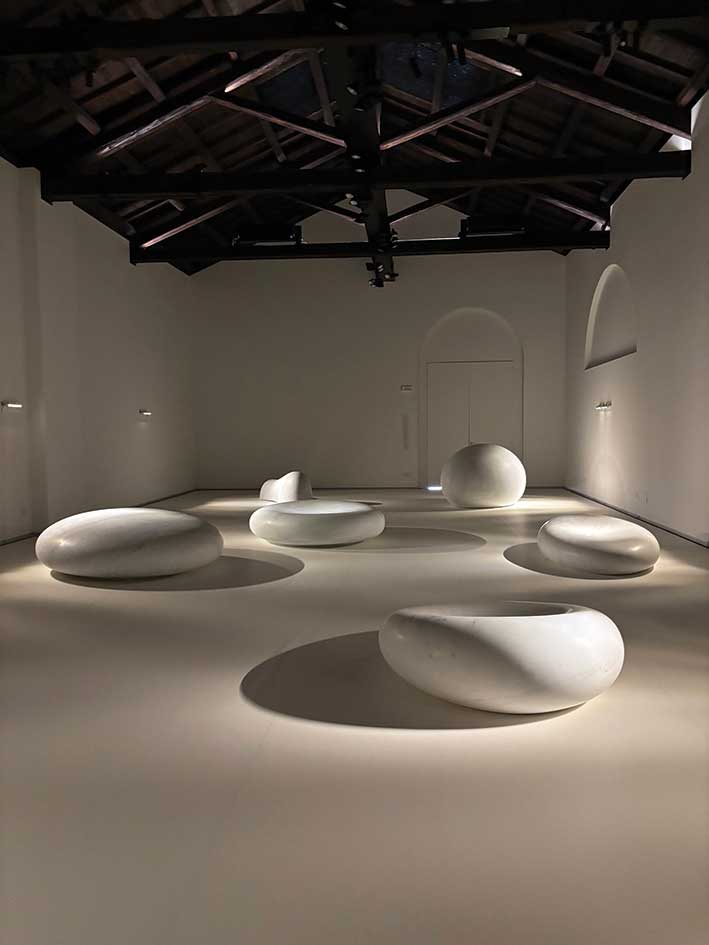
With an installation completely in sync with the Biennale’s motto, the Japanese Kan Yasuda (b 1945) created a haven of peace at the heart of Venice. Located at the Wilmotte Foundation, his Islands of Silence brings together several marble sculptures, which the artist encourages the audience to interact with to experience the surface and the shapes of the works. Turandot: to the Daughters of the East brings together 11 female artists, among them Mona Hatoum (b 1952, Lebanon), Huma Bhabba (b 1962, Pakistan), and Tala Madani (b 1981, Iran). Turandot refers to the ancient Persian meaning of Turandokht, a region in today’s Central Asia where these artists come from, providing that area with a voice.
Chinese artist Su Xiao Bai (b 1949) draws from the country’s long-standing tradition of lacquer art to complete his paintings, using the medium not as a coating, but as a surface. Based on wood, his pieces accumulate up to 20 layers of an emulsion primarily made of pigments and powder that he mixes, further exploring the boundaries of the medium. In Under one Moon, Ronald Ventura (b 1973, Philippines) connects Venice and Manila, pointing to the struggles and challenges both cities are facing in terms of industrialisation and growth. His paintings and sculptures look at a glorious past while identifying some of the threats towards the ecosystem and architectural legacy.
In addition to the Biennale and its collateral events, some exhibitions worth seeing include Ding Yi (b 1962, China) at the Fondazione Querini Stampalia and Amar Kanwar (b 1964, India) at the Palazzo Grassi (until 10 January 2027), the latter an introduction to his major exhibition on view at the Serpentine North in London.
Similarly to previous Biennales, ‘In Minor Keys’ provided a snapshot of the global contemporary art world, even though artists from Latin America, beyond their national pavilions, were largely absent from the exhibition. Overall, it is striking how in their work, countless artists express apprehension towards the future when it comes to their national identity, culture and traditions, geographical borders, or identity. Following historical and present wrongdoings, there seems to be a certain helplessness on how to preserve the past and what we have now without it crumbling and disappearing as we move forward.
BY OLIVIA SAND
The Venice Biennale runs until 22 November 2026, labiennale.org


