

A new exhibition at the British Museum, Korea 2000 Years, is exploring Korea’s history through artworks originally from a private collection, the historic bequest donated by the late Samsung Chairman Lee Kun-Hee (1942-2020) to the National Museum of Korea. The gift comprises over 23,000 objects covering all areas of creativity – books, calligraphy, ceramics, metalwork, painting, and furniture dating from the prehistoric period (around 5000 BC) through the early 20th century.
Through these objects, this exhibition explores over two millennia of Korean art and culture, aiming to offer a fresh perspective on the peninsula’s rich creative history. This is the first major exhibition on Korea’s art and history at the British Museum since Treasures from Korea: Art Through 5000 Years opened in 1984. The show reveals how the country’s artists and craftspeople have continually demonstrated creativity, resilience, and superb technical skill, while absorbing outside influences to create a distinctive and enduring cultural identity.
Recent exhibitions, such as the popular Hallyu! (the Korean Wave) exhibition at the Victoria and Albert Museum in 2022 showed how the country’s contemporary creativity, especially through film and contemporary art, had helped Korea’s meteoric rise on the global cultural scene. This exhibition takes another angle and looks at what makes Korean culture different from its powerful neighbours China and Japan and how these traditions in the arts help form Korea’s unique cultural identity today.
Korean National Treasures
Korea 2000 Years traces this artistic and cultural history chronologically, bringing together important works, many designated National Treasures, on loan from the National Museum of Korea and the National Museum of Modern and Contemporary Art, alongside works from the British Museum. These objects are used to explore various periods of Korean Peninsula history and the creativity that arose during these periods of war, famine, political unrest, and the adoption of Buddhism and Neo-Confucianism as state religions.
These cross-cultural influences shaped Korean society and cultural taste. To show this development, historic national treasures sit alongside modern and contemporary works, creating a dynamic conversation across time. From the technical mastery of Goryeo celadon, renowned for its luminous blue-green glaze and intricate inlay, to the restrained elegance of Joseon porcelain shaped by Confucian ideals, historic objects are recontextualised through their relationship with contemporary society. This approach reveals how artists across the centuries have continually revisited and reinterpreted the past, sustaining a living tradition while pushing creative boundaries.
In ancient times, Silla (57 BC-AD 935) was one among three kingdoms on the Korean peninsula that rose to prominence in the late 4th and early 5th century under the rule of a hereditary monarchy. This period is known today largely through material unearthed from elaborate burial sites in Gyeongju. Here, the tombs of kings, queens, princes, royal relatives, and other elites have stood, from the time of their construction, as symbols of political authority and cultural grandeur.\
The Silla Kingdom represented in Korea 2000 Years
Silla gradually expanded its power and territory by defeating neighbouring states and eventually conquered most of the Korean peninsula by the second half of the 7th century. In the ancient world, the Silla kingdom was renowned as ‘the country of gold’. This small kingdom, by conquering its neighbours, rose to prominence, embraced cosmopolitanism, and eventually gained control over much of the Korean peninsula. Political ties and trade with Tang-dynasty (618–907) China placed Silla firmly within the vast network of connections between East and West that characterised the Silk Road that brought new ideas, religion, and goods to the kingdom.
Art connected to Buddhism flourished in the Silla kingdom, as it had been sanctioned as the state religion in 528, when it completely transformed Silla society and culture, spurring the creation of new imagery and changes in burial customs, such as the disappearance of large, impenetrable mounds and the adoption of cremation. Perhaps the most vivid visual clue to this shifting cultural landscape lies in the use and re-use of gold. Once the material of choice for imperial and personal adornments, this precious metal would later be used primarily to create Buddhist art as sculptures played an essential role in disseminating the Buddhist faith and embodying divine power.
Exquisite sculptures and reliquaries fashioned from bronze and gold, such as the Bodhisattva triad with a single halo, on show in the exhibition, exemplify the height of artistic achievements stimulated by the new religion. This sacred art became infused with a distinctively native aesthetic, reinterpreting styles found in China and South Asia, reflecting the pan-Asian nature of this religious tradition. Other early Buddhist works on show includes the Flower Garland Sutra from the Goryeo dynasty (918-1392), written in gold on indigo-dyed paper. In the Buddhist world, copying or commissioning a sacred sutra was an act of profound devotion.
Ceramics – Celadons
Ceramics are also an important part of Korean tradition and are in show in Korea 2000 Years. One of the most enduring ceramic traditions is celadon, a refined blue-green glaze of varying hues, which began to take root in the Korean peninsula from the late 9th century onwards. Celadon technology from Song-dynasty China (960-1279) had reached Korea by sea, with the first experiments being conducted at the Cholla Province kilns on the south and southwest coast. However, the desired grey-blue, or blue-green, hue could only be achieved in the 12th century. The finest products designated for the Goryeo court at Kaesong were then shipped to the far north.
A well-known reference to Korean celadon had been made by the Song-dynasty Emperor Huizong’s emissary, Xu Jing, when he visited Kaesong in 1123. His account, Xuanhe fengshi Gaoli tujing (1124), the Illustrated Record of the Xuanhe Envoy to Korea, which mentions the lustre of celadon at court and its predilection for silverware. It reached its zenith in the 12th century, when koryo ch’ongja, Goryeo celadons, became the most technologically advanced. The term ‘goryeo’ formed the basis for the modern name of the country, as was its Chinese name, gaoli, which morphed into goryeo when Korea emerged from the Unified Silla (668-935) period to enjoy extensive trade with Song China (960-1279) via the ports of Guangzhou in southern China. It is from this time that a large variety of luxury goods, including silk and particularly celadon objects from the Yue kilns in Zhejiang reached the Korean peninsula. In the exhibition is a gourd-shaped ewer with a chrysanthemum motif, dated around 1200-1300, featuring the sanggam inlay technique, where designs incised into unfired clay are filled with slip, revealing vivid motifs against the glaze after firing.
The Joseon Dynasty
After the establishment of the Joseon dynasty (1392-1910), the early kings worked to stabilise and unify Korean society and moved its capital to the new city of Hanyang (present-day Seoul). The new system was based on governance assisted by the emerging sadaebu (scholar-officials) ruling class. This brought about the merging of Confucian ideology with the legacy of the preceding Goryeo dynasty that led to a blossoming of art and literature centred on the royal family and sadaebu. The adoption of new technologies and improvement of the governance system also encouraged the development of art and crafts. The Joseon dynasty also fostered mutually influential relationships with the Ming dynasty (1368-1644) in China (as a vassal state) and close diplomatic ties with the Muromachi shogunate (1336-1573) in Japan. These engagements brought international cultural exchanges, which resulted in the development and arrival of a variety of art forms.
From the start, Neo-Confucianism was adopted as a state ideology of the Joseon dynasty (this clearly differentiated between the status of master and servant, man and woman, and senior and junior). The Buddhist clergy of the preceding Goryeo period was removed and all vestiges of Buddhism destroyed. Confucianism from China was known in 4th-century Korea, but it only came to dominance at the beginning of the Joseon dynasty, forming a new foundation for society and state. As Neo-Confucian ideology grew increasingly orthodox, ornament, design, and colour were considered excesses and dismissed, no longer seen as objects of taste.
A faceted bottle in Korea 2000 Years emphasises the taste of Joseon’s Neo-Confucian elite, with the plain white porcelain embodying the purity of an upright character and its restraint a rebuke to ostentation. However, Buddhism managed to survive in Korea despite losing royal patronage. Monks retreated to remote mountains and the countryside and despite official persecution, the suppression was eased after the Japanese invasions of the Imjin Wars (1592-1598).
True-View Landscape Painting on show in Korea 2000 Years
Painting styles had also changed in the Joseon dynasty – by the 18th century, ‘true view’ landscape painting emerged in Korean art. Within this genre, the court painter Yi Inmun (1745-1821) is considered one of the great landscape painters of the 18th century and associated with the Chinese Northern School. In the exhibition, there is a painting traditionally attributed to Yi Inmun, The Poet Lee Baek (Li Bai) Watching a Waterfall.
Lee Tae-ho, writing in The International Journal of Korean Art and Archaeology, considers true-view landscapes, stating: ‘True-view landscape paintings of the late Joseon dynasty represent an important artistic trend in the history of Korean culture. While there is nothing extraordinary about Joseon artists painting their native land, the development of true-view landscape painting, including the work of Jeong Seon (1676-1759), is considered a landmark in the literary and artistic history of the late Joseon dynasty. One reason is that it represents a quantum leap from the early Joseon mode of landscape painting, which was largely inspired by Chinese styles from the Song and Ming dynasties.
‘The emergence of true-view landscape painting (jingyeong sansuhwa), therefore, embodies the will of contemporary Korean artists to turn their attention back to their native land, refusing to follow Chinese ideals of landscape beauty. Ultimately, it was a notable shift from illusionary idealism to truthful realism’. Continuing, ‘As an increasing number of painters sketched on site after close inspection, true-view landscape painting further developed in the late 18th century with Yi Inmun taking an interest in sketching from actual sites’.
A highlight of Korea 2000 Years is a landscape, Clearing After Rain on Mount Inwang by Jeong Seon (1676-1759). Created when Jeong Seon was in his 70s, this painting captures a peak he had known intimately – its rain-soaked rocks heavy with moisture, mist rising through the valleys below. A pioneer of ‘true view’ landscape painting, Jeong Seon rendered not just the mountain’s form but its mood, producing a work of such exceptional beauty that it has been designated a National Treasure.
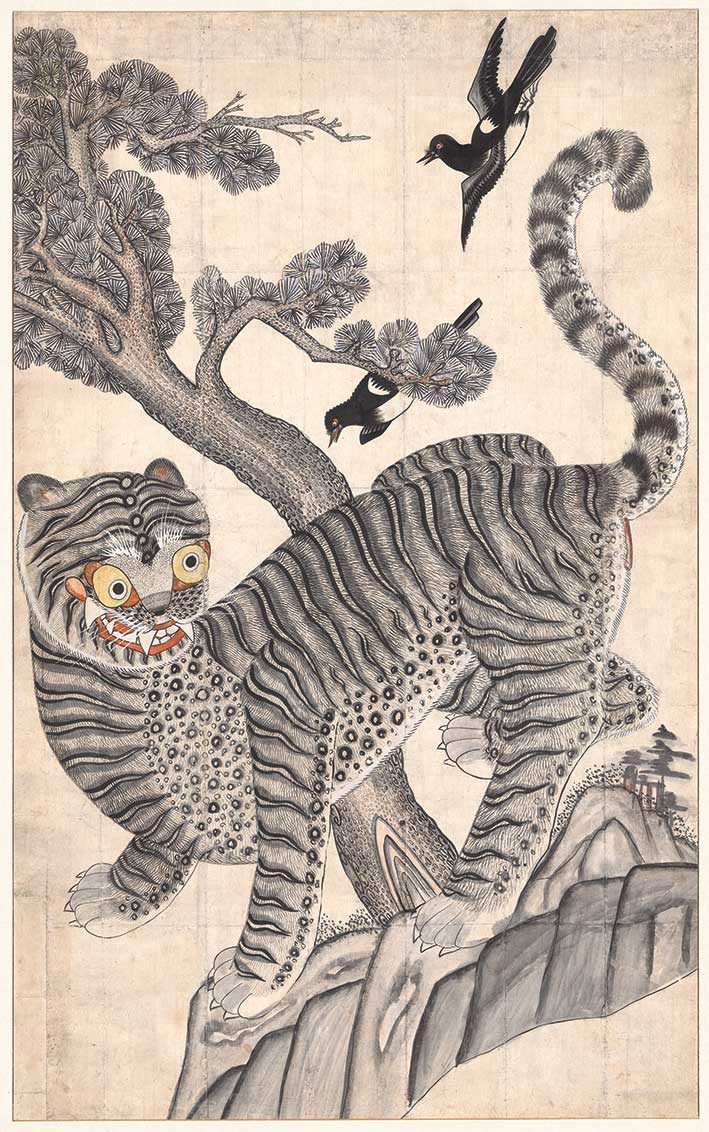
In Korea, animal themes have been popular since ancient times with the tiger occupying a prominent place in Korean painting. It is seen as a royal animal, a protector and symbol of the kingdom. He is also the companion and messenger of Sansin (the Shamanic mountain deity), as well as many other shamanic entities derived from Taoism. In an iconography almost unique to Korea, the tiger is figured at the foot of a pine tree on which is perched a bird (hojakdo, magpie), messenger of the gods. In popular traditions, such as minhwa (folk painings), the tiger can evoke the arrogance of the yangban (the elite class of landowners and administrators in Neo-Confucian society) with the bird, depicting commoners or the lower classes reluctant to be suppressed. Often displayed at New Year to protect the family from bad luck throughout the coming year, they bring good tidings to the household.
Contemporary Works
Sitting alongside Joseon-dynasty paintings in Korea 2000 Years is a work by Nam June Paik (1932-2006), the visionary artist widely regarded as a pioneer of video art. His artwork and ideas were a major influence on late 20th-century art and continue to inspire a new generation of artists through his radical new vision for an art form that he knew would be embraced around the world and that would change visual culture forever. Another contemporary work is a new acquisition for the British Museum by internationally acclaimed Do Ho Suh (b 1962), which features as another key highlight, connecting themes of identity, migration and memory. Presented alongside historic objects, it underscores the exhibition’s central theme: the enduring dialogue between Korea’s past and present, and the ways in which cultural identity is continually redefined.
Sang-ah Kim, Curator of Korean Collections at the British Museum, sums up the concept of the exhibition, ‘By diving deep into the circumstances under which objects were made, this exhibition offers insight into makers and patrons across the centuries. A sutra inscribed by a deposed queen, an ink landscape of a mountain in Seoul, a painting of quasi-nude figures ambling through an imagined paradise, and sketches inscribed on cigarette foil: these images not only illuminate Korea’s history but also carry personal messages that resonate across time and cultures.’ The exhibition does indeed show Korea as a country of progression and change, of adaptation, and innovation. It also offers important insights into how creativity, technical skill, and cultural dynamism have defined Korean art and culture across time.
SARAH CALLAGHAN
Korea 2000 Years, from 1 October to 31 January 2027, British Museum, London, britishmuseum.org
Catalogue available, Korea 2,000 of Creativity, ISBN 9780714137032


