

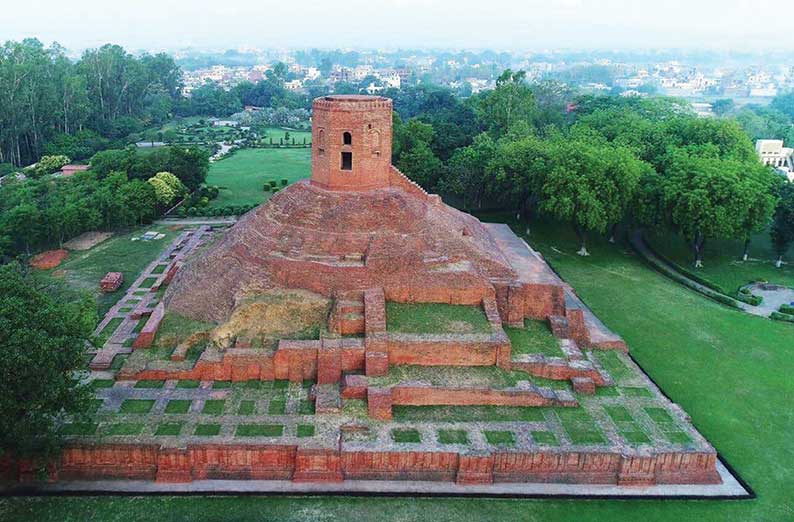
During the World Heritage Committee Session over the summer, meeting in Busan, South Korea, the ancient Buddhist site of Sarnath was one of the group of 25 new sites inscribed on the list. The complex contains the architectural and archaeological remains of Sarnath, the sacred site where the Buddha is believed to have delivered his first sermon in the 6th century BC and met his earliest disciples. Identified by the Gautama Buddha himself as one of the four principal Buddhist pilgrimage sites, alongside Lumbini, Bodh Gaya, and Kushinagar. Sarnath grew over many centuries through royal, monastic, and lay patronage, resulting in the construction of numerous stupas, temples, and viharas.
After flourishing as a major Buddhist centre, Sarnath declined in the 12th century and fell into obscurity until its rediscovery in the 18th century. In 1794, Babu Jagat Singh, a chief minister to Raja Chait Singh of Benares, had workers retrieve building material from ruins and uncovered a small chamber lined with brick and a relic casket. He later sent notification to the British resident superintendent at Benares, Jonathan Duncan, who also happened to be a member of the Asiatic Society of Bengal. Jagat Singh’s men brought the objects to Duncan, who noted in his report that the men had been digging for stones from the subterraneous materials of extensive and ancient buildings in the vicinity of a temple called Saranuth’. These ruins were well known as they dominated the local landscape with two large mounds of brick and stone with obvious remains of other buildings. Duncan subsequently published an account of this discovery in 1799 in the journal Asiatic Researches, published by the Asiatic Society of Bengal.
Decades later, Colonel Colin Mackenzie, acting as the first Surveyor General of India, initiated the first systematic investigation and excavation at Sarnath after reading Duncan’s account in Asiatic Researches. Colin Mackenzie had risen steadily through the ranks from army officer and after 30 years’ service before he was appointed the first Surveyor General of India. His initial documentation of the Amaravati Stupa in 1797-98 sparked a lifelong quest to map India’s ancient past, leading him to initiate early formal explorations at Sarnath in 1815 during his tenure as first Surveyor General of India. Along the way, he developed a passion for collecting and researching with the help of his Indian Brahmin assistants.
First Systematic Investigation at Sarnath
As an avid orientalist and active member of the scholarly community in India, Colin Mackenzie read Duncan’s account and later tracked the provenance of stones used in Benares back to Sarnath, prompting his own exploratory visit to the site, undertaking minor excavations. Although he commenced the first structured and documented effort to map and examine the archaeological remains, he stopped short of major structural breakthroughs, as early efforts had revealed few dramatic, intact artefacts. Mackenzie was exploring Sarnath during the same broad phase of his career where precise knowledge of early Indian Buddhism was virtually non-existent among European scholars, leaving both early Amaravati and Sarnath studies reliant on preliminary visual recording rather than correct sectarian context.
Following in his footsteps, decades later, Sir Alexander Cunningham, as the first Director-General of the Archaeological Survey of India (ASI), continued excavations at Sarnath. As British territorial expansion stabilised in the mid-19th century, the urgent need for raw military mapping receded, while intellectual and imperial interest in documenting India’s monumental and cultural heritage grew. Between Colin Mackenzie’s tenure as the first Surveyor General of India (1815-21) and Alexander Cunningham becoming the first Director General of the ASI (1871-1885), the institutional approach to India’s past shifted from private, military-led cartographic and antiquarian collection to a formalised and specialised government department dedicated to archaeology and architectural heritage.
Archaeological Survey of India
The establishment of the ASI grew out of this change in direction and Cunningham was appointed as the initial Archaeological Surveyor in 1861 and later became the first Director-General when the organisation was established as a formal department in 1871. Formerly an army engineer, he showed a great enthusiasm for Buddhist relics and proposed that the survey be geographically guided after examining the accounts of the two celebrated Chinese Buddhist pilgrims, Faxian in the 5th century and Xuanzang in the 7th century. It was Cunningham that formally attributed Sarnath with the Buddha’s life after supervising methodical excavations at Sarnath between 1834 and 1836, and later in 1837, opening up key monuments including the Dhamek, Dharmarajika, and Chaukhandi stupas, and uncovered foundational monastic complexes and sculptures in the area.
Although excavation work continued at Sarnath from the mid-19th century onwards, it was the archaeologist Friedrich Oertel in 1904-05 that carried out the next significant excavation revealing new discoveries. He was employed as the Executive Engineer of Benares Division and during road-building operations the workers had uncovered an almost intact Buddha image at Sarnath. It was to become one of the most celebrated finds at Sarnath – a sandstone figure of Buddha preaching the first sermon – Turning the Wheel of Law (Dharmachakrapravartana). He requested to carry out a series of digs at the site for months ‘every Cold Weather’, near the Jagat Singh’s raid on the great stupa over a century earlier.
Friedrich Oertel, Engineer and Amateur Archaeologist
This project was supervised by John Marshall, the Director General of the ASI from 1902-28. Oertel maintained detailed records of his work, carrying out a systematic dig documenting finds using a scientific basis. He had already amassed considerable experience in the field and was known for his report on the monuments of Burma published in 1893. He found some of the most significant discoveries at Sarnath. These include 476 sculptural and architectural remains, along with 41 inscriptions. A figure of a Bodhisattva dated to the Kushana King Kanishka (r 78-144), the foundation of a sangharam (monastery), the original complex where Gautama Buddha had preached his first sermon, several images of Buddhist and Hindu deities, and the important Ashoka pillar bearing the edicts of Mauryan Emperor Ashoka (3rd BC). The most significant find was the Lion Capital that had originally crowned an Ashokan pillar that was unearthed a short distance away from where it was found. This was one of the many pillars commissioned by Ashoka across the subcontinent, to spread the message of Buddhism after he converted to the faith. Although many Ashokan pillars have been discovered over the decades, the Sarnath lion capital is among only seven capitals of Ashokan pillars that have survived.
In 1904, Marshall founded the site museum at Sarnath to house and protect the delicate sculptures, terracottas, and inscriptions unearthed during the digs locally rather than moving them away. After Oertel’s transfer in 1906, John Marshall took over the excavations restoring the complex to what is recognisable to visitors today. Now preserved as two archaeological zones, it remains both a revived pilgrimage site for Buddhists worldwide and an important tourist destination.
Visit the Sarnath Museum website for more information


