
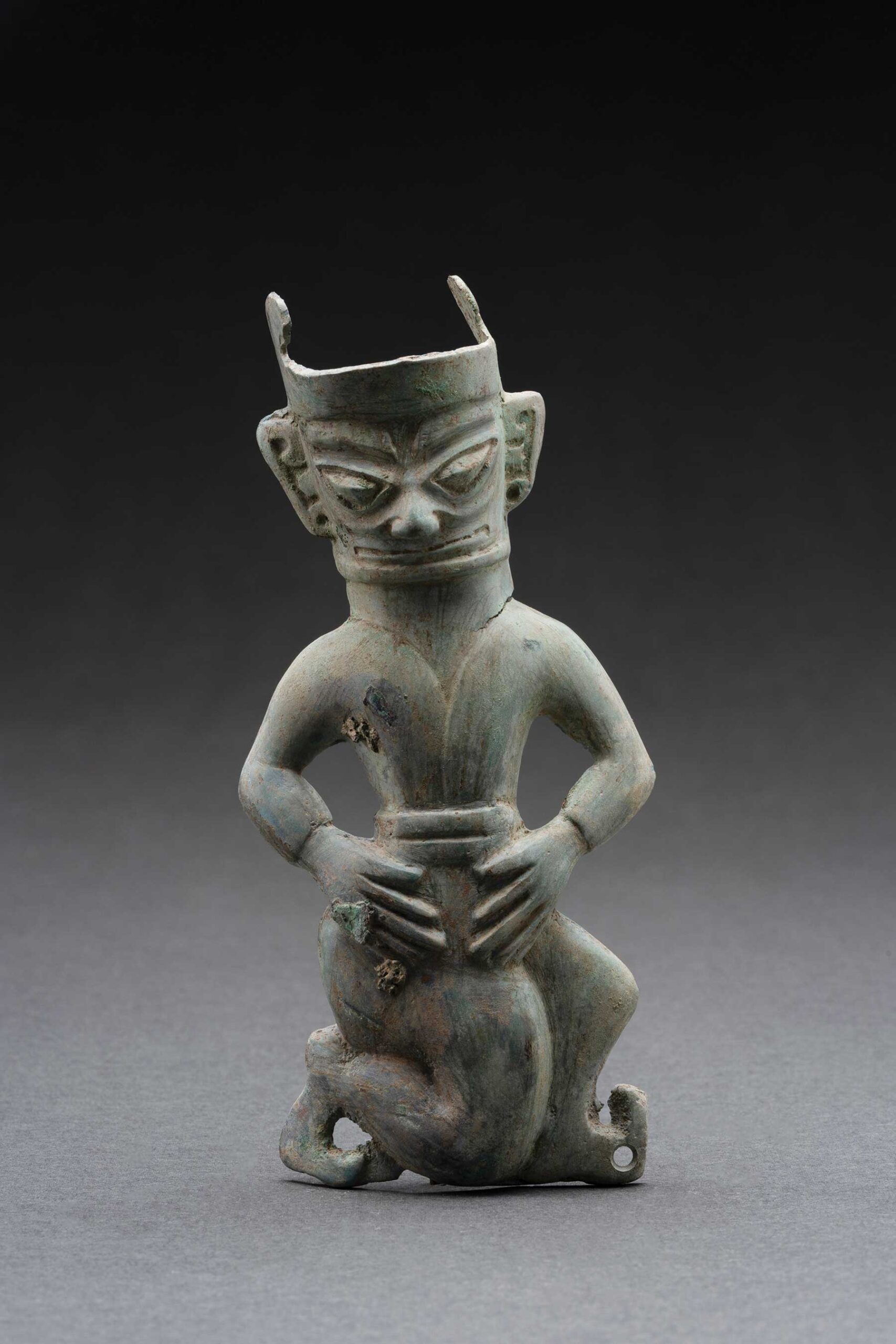
In partnership with the Sichuan Provincial Museum, the Guimet Museum is presenting significant works from six museums and cultural institutions from southwestern China, some of which are being exhibited outside of China for the first time.
Sanxingdui and Jinsha are two major hubs of ancient China located in Sichuan Province, connected to the Shu kingdom. In 2019, after the discovery of six extra sacrificial pits at the Sanxingdui site, the resulting archaeological digs unearthed hundreds of new artefacts – including gold masks. Due to the scale and originality of the objects unearthed, Sanxingdui and Jinsha now rank among the most important archaeological sites discovered in China over the last 50 years. These large bronzes, strikingly shaped masks, and ritual objects reveal the existence of a powerful, previously largely unknown, cultural hub in Sichuan that refocuses attention back to the sophisticated culture of ancient China.
Archaeological excavations at Sanxingdui have greatly changed the face and knowledge of Chinese prehistory and archaeology. Situated 40 km northeast of Sichuan’s modern capital, Chengdu, Sanxingdui appears to have been a political and religious centre for over 600 years. Interacting with the middle Erlitou culture (1900-1500 BC) of the Yellow River basin in the Central Plains in the later Shang dynasty, it also had contact with the middle and lower Yangtze River cultures, such as the settlement at Erligang.
This made it the most extensive Bronze Age settlement in the Chengdu Plain, yielding ritual, sacrificial, and funerary artefacts. The site continues to challenge established theories about the nature of Chinese civilisation, previously believed to stem from a single source, in the Yellow river basin in the north. However, Sanxingdui points to an early China that was pluralistic, with multiple sites, including a previously unknown centre in the Yangtze river basin of Sichuan. Once considered a backwater in archaeological terms, Sichuan is now thought critical to understanding the evolution of China’s ancient past.
Defining the culture unique to Sanxingdui are objects that have no parallel in Bronze Age China – specifically large bronze masks, heads, and figures that appear to be physical manifestations of the supernatural. The latest discoveries, uncovered since 2019, emphasise the remarkable achievements of the ancient Shu civilisation, presenting the ‘diversity in unity’ developmental pattern of Chinese civilisation. The ancient Shu, represented by the Sanxingdui culture, is an integral part of the development of early civilisations and demonstrates the remarkable achievements of the contemporaneous cultures in the upper Yangtze River region.
Dating from between 1600 and 800 BC, the sites of Sanxingdui and Jinsha reveal a unique local civilisation imbued with a rich and complex culture. The latest artefacts unearthed, amounting to more than 17,000 objects, also attest to both a remarkable level of artistic and technological mastery and the existence of exchange networks between these two sites, as well as the rest of China. While artefacts unearthed at Sanxingdui prior to 1986 were exhibited at the Hôtel de Ville in Paris in 2003, the current exhibition at the Guimet Museum unveils some of the finds made between 2020 and 2022 in the six new pits. These pits yielded many more objects made of bronze, jade, and gold, as well as elephant tusks.
The earlier archaeological digs in the mid-1950s had discovered dense deposits in the vicinity of a ‘three-star mound’, which led to the site’s current name – Sanxingdui. Excavations in 1963 yielded further evidence of bronze material, suggesting the developmental stages of a complex ancient culture. The existence of an archaeological culture at Sanxingdui was only confirmed in the early 1980s when the duration of the site was estimated by radiocarbon, dating it to the late Neolithic era (circa 2500-1000 BC) from the end of the Shang, to the beginning of the Western Zhou (circa 1100-771 BC).
By 1986, the most extensive excavation so far of the remaining mound unearthed two major ‘sacrificial pits’. Dated a hundred years apart, the first pit, K1, uncovered 400 objects, and the second, K2, 800 objects, including bronze masks, heads and images, jade tablets and implements, copper objects, and pottery. They proved the material culture of an elite – consistent with that of an ancient metropolis, which previously had no precedent in Bronze Age China.
Bronze technology at Sanxingdui was of a high order; the ancient Chinese bronze alloy used incorporated varying proportions of copper, lead, and tin. Throughout the Bronze Age, three formulae for alloys were regularly used: copper-tin, copper-lead, and copper-tin-lead. These sources were rare in north China and were usually accessible from the south and southeast. Managing the exact composition for each bronze would have been difficult to control, with the main method of producing the best mix of alloys for casting probably done by eye – assessing the colour – and adding alloy to molten metal before casting if needed.
Analysis of Sanxingdui’s bronze elements suggests they were reliant on sources closer to Yunnan. Jay Xu, in his chapter ‘Bronze at Sanxingdui’, in Ancient Sichuan: Treasures from a Lost Civilisation (2001), which accompanied the exhibition at the Seattle Art Museum, explains that at Sanxingdui, as elsewhere in ancient China, bronzes were made by casting in clay moulds of two or more parts. The only exceptions are miniature ornaments of birds, fish, animals, leaves, and forked blades made from very thin, hammered, sheet bronze. Heavy reliance on casting, and on section-mould casting in particular, is the hallmark of the bronze industry that originated at Erlitou (1900-1500 BC) and Erligang (1600-1400 BC) in the Central Plains, and to find the same reliance at Sanxingdui is strong evidence that Sanxingdui got its bronze technology from the Zhongyuan people (from the Yellow River area in northern China, primarily covering modern-day Henan Province and parts of neighbouring provinces like Shandong, Shanxi, Hebei, Shaanxi, and Anhui), locations seen as the birthplace of Chinese civilisation.
The Shu people apparently practised ancestor worship and adopted a system of avian iconography. The bird was an icon in bronze art and a totemic symbol of the sun, appearing also as bells and finials. The names of Shu emperors such as Cancong, Boguan, and Yufu were also used as bird appellations. Zoomorphic bronze sculptures from Sanxingdui include birds, roosters, dragons, snakes, and tigers. The snake seems to have held importance as a traditional deity of Sichuan and was an ancient ‘gate keeper’ of the Chengdu Plain that is prominent in Shu iconography.
The Paris exhibition is organised into eight thematic sections dedicated to the many treasures and questions surrounding the civilisation. It begins with the Sanxingdui site, tracing its history from the chance discovery of stone and jade artefacts in 1927 to the most recent excavation campaigns. The works on display reveal the key cultural symbols of the archaeological site – such as the bird, the sun, the dragon, and the tiger – which appear on many of the objects recovered from the pits.
The legends and beliefs of the Bronze Age are also revealed to help understand the culture and legacy of the Shu. The artefacts – often in hybrid forms – allow visitors to explore an ancient civilisation that is redefining the ancient Chinese world. Seeing close-up these three-dimensional, complex works created by Sanxingdui’s bronze smiths, allows the viewer an insight into the techniques, functions, and votive significance of the pieces on display. The large statues that were unearthed have also been reassembled, making their original ritual context clearer.
However, it is another group of bronzes that has become the symbol of Sanxingdui – the anthropomorphic bronze heads – as fascinating as they are baffling. With their bulging eyes, atypical faces, and singular proportions, they seem to belong to a world apart from the traditional canons of ancient China. More than 100 life-size bronze heads have been found. The question arises, are they kings, priests, mythical ancestors, or deities? Despite decades of research, these figures remain largely enigmatic, perfectly embodying the exceptional nature of Sanxingdui, a civilisation whose beliefs and ritual practices continue to challenge and intrigue archaeologists today.
Jinsha, the other major site, discovered in 2001, succeeded Sanxingdui as the latter went into decline. The findings at both sites share many similarities – most notably a large number of Asian elephant tusks, which point to a specific cult centred on this animal. The exhibition also explores the extensive exchange networks these cultures maintained with the Central Plain, the middle and lower reaches of the Yangtze River, Northwest China, and even further afield, reaching as far as Southeast Asia and the Indian Ocean.
This exhibition shows that the artisans of Sanxingdui and Jinsha created exceptional works of art, although the meaning of these pieces continuing to be the subject of ongoing study and debate today. Beyond their artistic appeal, the objects offer a unique window into the symbolic world of ancient China – a world defined by distinct regional characteristics.
The Bronze-Age Sichuan settlements continue to challenge previously established theories about the nature of early Chinese civilisations; they were once believed to stem from a single source. Now Sanxingdui points to an early China that was pluralistic with cultures based at multiple sites. Once considered a backwater in archaeological terms, these sites in Sichuan are now recognised as critical to understanding the evolution of China’s ancient past.
Until 1 March 2027, Guimet Museum, Paris, guimet.fr. A Research Collection of Archaeological Discoveries in Sanxingdui and Jinsha:
Academic Achievement – Civilisational Dialogue and the Study of Chinese Culture edited by Fei Tang and translated by Bei Yang and Yige Wang is due to be published by Springer Verlag in January 2027.


