
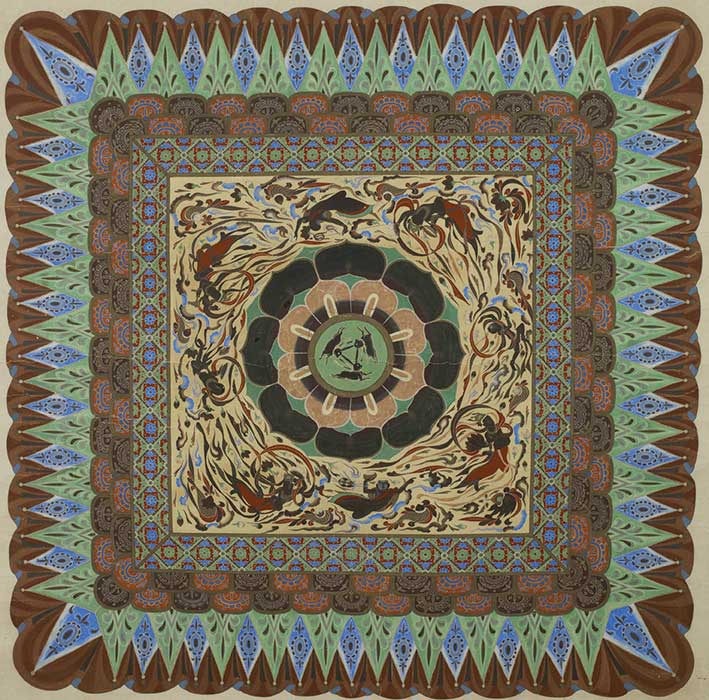
For over a thousand years, Dunhuang was one of the great crossroads of the ancient world. Located in present-day Gansu province in northwest China, this oasis city connected China, India, the Middle East, and beyond, serving as a vital centre of exchange along the Silk Road. The web of energy produced by trade, faith, culture, and ideas transformed the lives of people it encountered, giving rise to a more tangible element in the buildings and monuments that remain, such as the Mogao Caves, a vast complex of Buddhist cave temples carved into the cliffs at the edge of the Gobi Desert. Today a UNESCO World Heritage Site, these grottoes preserve one of the world’s most extraordinary collections of Buddhist art, including paintings, sculptures, manuscripts, and devotional objects. Created between the 4th and 14th centuries, the objects found in the Mogao Caves preserve an extraordinary record of everyday life along the Silk Road.
In Singapore, a new exhibition explores this world through Buddhist art, bringing the ancient world’s beliefs to life. In collaboration with the Dunhuang Academy, the Asian Civilisations Museum is presenting life-size grotto reproductions alongside original works of art from the Mogao Caves for the first time in Southeast Asia. The exhibition is a rare opportunity to see life-size cave reproductions alongside original works of art, many of which are seldom exhibited outside China. Highlights include a reconstruction of Cave 45 – one of the best-preserved Tang-dynasty caves at Mogao (705-781), with monumental sculptures of the Buddha, his disciples, bodhisattvas, and guardians. The central sculptural group portrays the Buddha preaching the dharma from an important sutra, surrounded by major disciples (Kashyapa and Ananda), bodhisattvas, and heavenly kings (lokapalas), illustrating the path from suffering to awakening.
During this golden age of Buddhist art in China, artists moved away from the rigid, geometric styles of earlier eras, opting instead for organic fluidity, psychological realism, and a harmonious balance between divine idealisation and human anatomy. Coming from the Mahayana tradition, the cave combines elements of Pure Land Buddhism and the veneration of the salvation bodhisattvas. Sensuously modelled, the main group of figures demonstrates the influence of Indian sculpture on Tang Buddhist art, which can be seen in the central group of figures and in the murals depicting the Lotus and Amitayus Contemplation Sutras, the foundational texts of Pure Land Buddhism in East Asia that include the Saddharmapundarika and Amitayurdhyana.
The reproduction of Cave 45 allows visitors to experience it in exceptional detail, as access to the original cave is strictly limited for conservation reasons. The south wall of the cave is painted with scenes of Avalokiteshvara (Guanyin) from a chapter in the Lotus Sutra, featuring the 33 manifestations of Guanyin and scenes of salvation from perils. Below, the Bodhisattva is seen rescuing those in danger – merchants threatened by bandits, sailors caught in storms, and a man awaiting execution.
The north wall (on the right when facing the main western altar niche) features an illustration of the Amitayus Contemplation Sutra and the heavenly Western Pure Land, connected to the Amitabha Buddha, depicting divine deliverance from harm. The background shows multi-storeyed palaces, pavilions, and towers that arise directly out of the ‘Seven-Treasure Lotus Pond’. The buildings are interlinked by detailed open-air corridors that replicate the architectural styles used in elite house courtyards during the Tang dynasty when these murals were first created. Painted figures of Avalokiteshvara and Ksitigarbha have also been added beside the sculptural group, alongside later additions – graffiti – showing how generations of visitors continued to reshape the cave long after it was first created.
Cave 249 is also reconstructed. Created during the Western Wei dynasty (535-556), this cave combines Buddhist and Chinese mythology to present a striking vision of the universe. The mural at its centre shows the colossal four-eyed, four-armed Asura (a demigod), who is supporting Mount Sumeru (Mount Meru), the sacred mountain at the centre of Buddhist cosmology, while holding the sun and moon. Around him are the Chinese gods of thunder, lightning, wind, and rain, together with the Daoist Eastern Lord and Queen Mother of the West, the animals of the four cardinal directions, and other figures. In addition to the two main Daoist deities, this cave is also painted with a large number of characters from traditional Chinese mythologies and Daoist themes.
This is the only cave model in the exhibition reproduced entirely by hand – the others were created using digital scanning and printing. The cave was documented by the French Sinologist Paul Pelliot during his 1908 mission (he assigned it the number Cave 101 in Pelliot’s system), and later systematically preserved, restored, and renumbered as Cave 249 by the Chinese scholars of the Dunhuang Research Academy. Early photographs of the cave were taken by the expedition’s photographer, Charles Nouette, and published in Pelliot’s six-volume portfolio, Les Grottes de Touen-houang, from 1914-24. The photographs are still seen as an important record for archaeologists as they show the exact physical state of Cave 249’s ceiling murals, for example, the Asura and the Wind god, and its central painted sculptures before 20th-century wear and restorations took place. The original glass plate negatives and prints of Pelliot’s expedition are now held by the Guimet Museum and Bibliothèque nationale de France and available online through the International Dunhuang Programme.
Also reproduced is Cave 3, dating to the Yuan dynasty (1271-1368) – the only surviving cave in Dunhuang devoted entirely to Avalokiteshvara, the Bodhisattva of Compassion. On both side walls, Avalokiteshvara stands with eleven heads and a thousand arms fanned out like a halo, each palm marked with a watchful eye, signifying the bodhisattva’s capacity to perceive and assist all sentient beings. Although this version of Avalokiteshvara originated in esoteric Buddhism, it was later worshipped widely across China. Avalokiteshvara also appears elsewhere in the cave, including around the niche and beside the entrance, bestowing wealth and nectar. Although the cave is modest in size, its murals are celebrated for their extraordinary brushwork. Flowing lines give flesh, robes, and hair distinct textures and a sense of movement, revealing the extraordinary skill of the artists who painted them. The cave is completely closed to the public at Mogao to protect the fragile artwork.
To complement the reconstruction of the caves, other objects are also on show, including a bodhisattva from the Thousand Image Pagoda that was built in 1910 by the Daoist abbot Wang Yuanlu (1850-1931) – the self-appointed keeper of the Mogao Caves (also known as the Thousand Buddha Caves). As Wang repaired the caves, he buried damaged sculptures he found in this pagoda, and when it was excavated in 1951, many sculptures were recovered. The loss of the outer layers on the figures exposed the internal supports, revealing the ancient techniques used in their manufacture, allowing historians to gain greater insight into the production of the statues. It was found that sculptors used curved pieces of wood to support figures standing in an S-curve or used forked branches for figures with their legs apart when modelling.
Wang Yuanlu had moved to the area around 1899 and began to raise funds for the restoration and upkeep of the caves. The Thousand Buddha complex had remained a place of continuous worship over the centuries. By the late 19th century, it was not a popular pilgrim destination and was gradually falling into disuse. In June 1900, when Wang was clearing the sand from the corridor of a large cave-temple, he stumbled upon the concealed entrance to a small room – the most well-known cave today, Cave 17 or the ‘Library Cave’ – containing tens of thousands of manuscripts, printed documents, paintings, and textiles. The discovery reached Sir Aurel Stein in 1907, who subsequently visited the site. This marked the beginning of the newly found hoard – and the greater cave complex – allowing it to become better known in the wider world, after centuries of neglect.
The neglect was a consequence of Chinese technical advances in ocean-going vessels and navigation techniques that naturally affected the relevance of the Silk Road, enabling its decline. Dunhuang became a backwater alongside other centres of culture and trade, such as Bezeklik, Karadong, and Dandan-uilik – all slipping back into the desert sands of the Taklamakan.
Dunhuang had to wait until the turn of the 20th century to be rediscovered and brought to international attention. An institution to record and conserve the site was initially established in 1944 and grew into a major conservation programme, helped by the Getty Conservation Institute, in the late 1980s. A later development, the International Dunhuang Project, was formed in 1994, and brings together online collections from the Eastern Silk Roads, academic research, and promotes understanding of the history and cultures of the region.
Until 7 March 2027, Asian Civilisations Museum, Singapore, acm.org.sg


