
The word kaiho, the title of an exhibition showcasing the art of Japanese women artists, translates from Japanese to English as ‘liberation’. With the Second World War coming to an end in 1945, the future of Japan was uncertain. Meanwhile, the American occupation completely shifted Japan’s political system by imposing a democratic constitution.
From then on, the country rebuilt itself, while its people rediscovered their own voices, free from the imperialist pressures and influences of the previous Head of State. It was only in 1946, when women were allowed to pursue their studies at The University of Tokyo, and during the 1950s and 60s, their artistic achievements began to gain attention through the flourishing of the avant-garde art movement. For women, this era held a long overdue promise to platform their artistic talents and pursuits, stepping out of the shadow made by a prevailing gender divide.
Mudam Luxembourg is presenting a first-in-Europe exhibition dedicated entirely to celebrating the craft of 39 Japanese women artists whose work spans the post-war era from 1945 until the turn of the 21st century. The featured names include Atsuko Tanaka, Mao Ishikawa, Ruth Asawa, Yoko Ono, Fujiko Nakaya, Tomie Ohtake, Yoshiko Shimada, Mariko Mori, Yayoi Kusama, and Chiharu Shiota, and many others.
Among those names, it is likely that most people would have primarily heard of Yoko Ono and Yayoi Kusama, despite the fact that all have made a tremendous impact on the global artistic landscape through their contrasting practices and bold ideas. Notably, Ono gained fame largely through her creative collaboration with The Beatles and widely covered marriage to musician John Lennon. Yayoi Kusama, meanwhile, made groundbreaking soft sculptures and Infinity Net paintings in the 1950s and 60s, which would later influence artist Andy Warhol, and yet her impact is often underacknowledged.
Historically, women artists have been overlooked in comparison to their male counterparts in the industry, especially in regard to Japanese art. Despite the post-war liberation and increased artistic opportunities for women in Japan, their art has still been sidelined in the international exhibition context. The 120 works exhibited demonstrate how the artists’ contributions were, and remain, vital in exploring national and gender identity.
The show approaches the time span through six chapters: ‘Prelude’, ‘Witnessing History’, ‘New Abstraction’, ‘Do It Yourself’, ‘Self-Discovery’, and ‘Environmental Consciousness’. Prelude sets up the viewers’ experience of the artwork, showcasing Saori Akutagawa’s portraits. Akutagawa’s work is often linked to Primitivism, a style that escapes Western artistic ideals and instead draws from early human histories as a way of counteracting modern industrialised standards. Tribal symbolism, along with African, Oceanic, and pre-Renaissance artistic influences, also merge in this unique style.
Akutagawa’s rare and striking 1955 portraits from her Women series illuminate the hopes, challenges, and transformations of post-war Japan. Her work encapsulates the transition from Imperialism to the emergence of a democratic society, in which broader creative opportunities greeted women artists and their aspirations. The vibrant colours, as well as playful shapes and large scale, convey an excitement for the future and the sense that the women are finally able to confidently take up space.
What follows Akutagawa’s optimistic, lively prelude to the rest of the exhibition is a chapter that addresses the complexities of the period it investigates, critically examining the repercussions of war on national memory, and how that comes into contact with gender history. Witnessing History opens with the 1950 Hiroshima Panels by Toshi and Iri Maruki, which then enters into dialogue with the works of Mao Ishikawa, Taeko Tomiyama, and Yoshiko Shimada. The panels are visceral, their colours blood-stained and full of inky blacks. The people burn, collapse, and blend into a hurricane of devastation: it presents the impact of war on Hiroshima in a brutally honest, unapologetically horrifying way. Toshi and Iri Maruki’s profound understanding that permeates the panels is underscored by personal experience. Mere days after the bombing in 1945, the couple travelled to Hiroshima to help the surviving members of Iri’s family, coming face to face with the tragedy and the colossal force of the bomb.
Shimada’s diptych etching, Balloon Bomb, Rising Sun, is at first glance an illustration of the Japanese flag, but on closer examination, an image of a Fu-Go balloon bomb. These were hydrogen-filled paper balloons used as weapons by Japan against the United States. They were designed with the goal of igniting wildfires and causing public upheaval. The work faces the difficult reality of Japan’s nationalism and wartime actions, and how that is entangled with women’s positions both as victims and aggressors. Shimada herself has contributed widely to research around feminism and alternative art education, dissecting the impact of imperialism not just historically, but in the present day.
After the war, Japan experienced rapid industrialisation and economic growth. The following chapter, New Abstraction, brings this period of technological hope and ideas of a futuristic utopia into focus. Atsuko Tanaka is one of Japan’s leading avant-garde artists who explored technological advancement, its connection to the body and surrounding space. Her paintings portray travelling electric currents, and the lines allow us to trace the movements as the paint moves and drips in circular shapes, like circuits, or free-flowing lines that seem to wrap around the canvas.
Other artists in this chapter, including Tsuruko Yamazaki with her metal sculptures and Tomie Ohtake, who worked in São Paulo on painting unique abstract shapes, enter the artistic dialogue with visions of liberty and innovation. The imaginative work presented in this chapter carefully foregrounds the next: Do It Yourself, where experimentation, collaboration, and instruction-based practices come under the spotlight.
The artists featured in this section include Yoko Ono, Mieko Shiomi, and Takako Saito. What bonds the three is the 1960s international avant-garde network Fluxus, which blurred the boundaries between art, music, performance, and the quotidian. Ono explored the art of instruction in her whimsy-filled art book Grapefruit (1964), using brief written prompts to directly involve the reader in the experience: ‘Listen to the sound of the earth turning.’ Shiomi is a composer and performance artist who, too, played with the idea of instruction in her Spatial Poem series (1965-75), a mail-art project that collected participants’ responses to her prompts.
The idea, which she initially proposed to Fluxus organiser George Maciunas, was grounded in the vision of the following, as quoted from Shiomi: ‘a do-it-yourself work that takes place on the whole earth as its stage, on which many people living away from me can interpret the event in their own ways and send me their reports.’ Saito’s work, meanwhile, drew on consumer participation a little differently; her Spice Chess were sensory, interactive art pieces that cannot be played conventionally. Instead, they were to be distinguished by smell, sound or texture, including white pawns made of cinnamon, rooks of nutmeg, and knights of ginger. Interactive in nature, they put people at the centre of art, giving full freedom to interpret.
The penultimate chapter of the exhibition, titled Self-Discovery, features Tari Ito, Sayako Kishimoto, and Mako Idemitsu’s masterful use of photography, performance, video, and installation to convey the evolution of societal attitudes towards gender, femininity, and cultural identity in Japan and beyond. Indeed, discovering the self equates underscoring individuality and self-possession. In her groundbreaking 1996 performance piece, Jigazo (Self-Portrait), Ito came out as a lesbian, using her words and body to communicate the challenges she and her community underwent. As an activist, her art combines the deeply personal with the political, confronting issues often concealed.
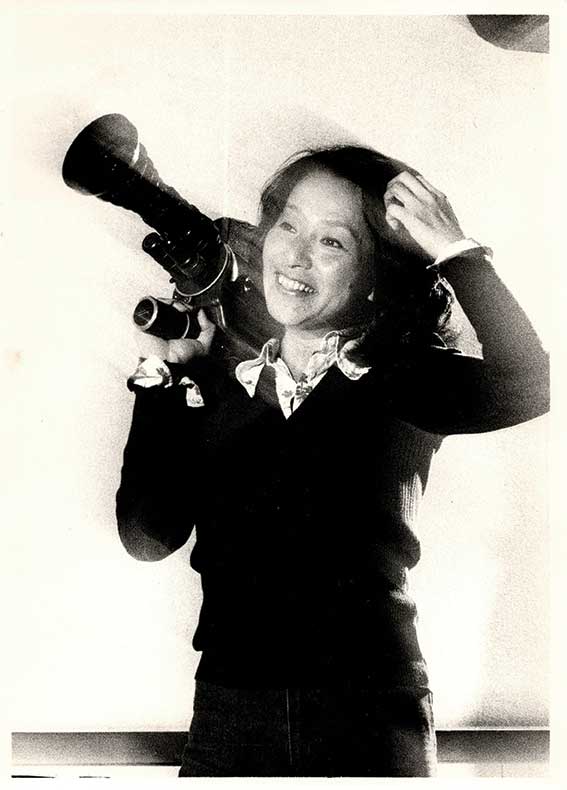
Mako Idemitsu is a feminist, experimental film and video artist, who first began by teaching herself the creation of video art with an 8mm film camera. Upon joining a consciousness-raising group with ties to the Women’s Liberation Movement in 1970, Idemitsu further expanded her craft into using a 16mm camera. Her work explores what it means to be a woman in Japanese society, and how gender conventions and expectations impact women’s understanding of their own identities. Kishimoto, an avant-garde artist, explored similar themes as well as the complexities of Japan’s relations with the US, through painting and performance. Later, her work also imagined a utopian world in which one aims to dismantle the hierarchy by reaching for its bottom. Her idealistic political ideas manifest in unique artistic allegories with motifs of abstract animals and fantastical imagery, creating a world that breaks away from social convention.
But the world, as we know it, is not ideal, and the final chapter Environmental Consciousness delves into the artists’ perception of ecology and the reciprocity between various living systems. Here, Shigeko Kubota’s media fountain Niagara Falls I (1985-87), Toshiko Takaezu’s ceramic Moon series, and Yayoi Kusama’s Infinity Room: Fireflies on the Water (2002) intertwine.
Kubota has been described as a ‘video sculptor’ throughout her career. Her work Niagara Falls I (1985-87) combines sculpture and TV. As the sound of the waterfall plays in the background, various television monitors display views of the Niagara Falls and the nature around it. A puddle of water spilling out in front glistens through the shards of glass floating inside. Technological advancement and nature curiously meet in this installation, raising questions on the shifting global landscape.
Takaezu’s ceramic Moon series of spherical ceramic objects has the effect of found alien artefacts. With painted mystical colours and patterns, it reimagines what we know the moon to look like through playful, marbles-like art objects. Finally, Infinity Room: Fireflies on the Water by Kusama is a room-sized installation where walls are lined with mirrors, and a pool of water extends underneath dock-like viewing platforms, allowing the viewer to enter a magical world filled with 150 small lights that descend from the ceiling. Light is reflected, and the room becomes everlasting, inviting a reflection on fleeting beauty and an all-encompassing cosmos.
The artists, with their works stretching over the chapters of the exhibition, meet in their ability to bring individual experiences into a wider discussion of societal issues, progress, and how those questions become situated in time. Their practices differ; however, they all display a degree of experimentation, using materials, technology, paint, or even their own bodies to create groundwork that continues to speak to contemporary artists, and the viewer, in the present day.
BY LIZA GLUSHAK
Until 14 February 2027, Mudam Luxembourg, mudam.com. A catalogue is available


