

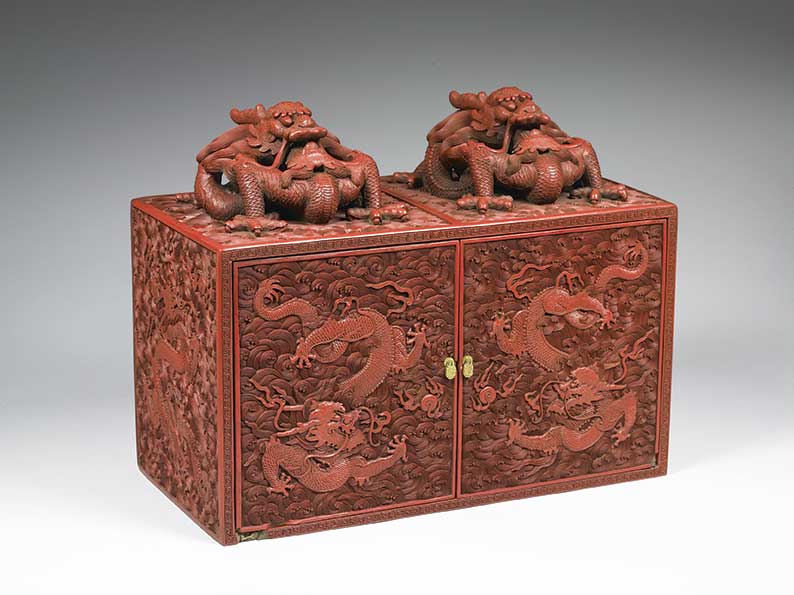
Dragons, unlike in the West where they were often seen as evil, were seen in China as largely benign and auspicious spirits that dwelt in the sky and were closely related to the element of water. East Asian dragons have serpentine bodies, four legs but no wings, but they can fly. They are wise and powerful but can also be dangerous as well as helpful. Their association with water gives life to the earth – they were thought to bring rain clouds during drought, but were also blamed for great floods. Found throughout all periods of Chinese history, dragons are beneficent beings linked to rain and water as well as being identified with the emperor and the imperial court.
To explore this mythical world, works from the heritage collections of the National Palace Museum in Taipei were shown in Paris at Musée du quai Branly, to explore the history of dragon iconography and the importance of this powerful symbol in Chinese imperial arts.
The Imperial Dragon
From the Yuan dynasty (1271-1368) onward, the imperial dragon is commonly depicted chasing the flaming pearl amidst the clouds, alone or in pairs. The pearl represents thunder and evolution, in reference to a legendary belief that pearls were born from the fertilisation of seashells by thunder. This motif is also considered a magical jewel – cintamani in Buddhist contexts – the ‘precious pearl which grants all desires’.
The Three Teachings (Taoism, Confucianism, and Buddhism), as well as folklore, have attributed countless forms and meanings to the dragon, manifesting it as a master of rain, lord of the waters and mountains in local nature cults. Merging with the mythical Indian serpent (naga), the dragon also becomes the guardian of the Buddha, while Daoism makes it one of the four fundamental creatures and a mount for immortals. Alongside the Black Tortoise of the north, associated with water, the White Tiger of the west, associated with metal, and the Vermilion Bird of the south, associated with fire, the Azure dragon of the east, associated with wood.
Dragons are also part of the zodiac, where they are granted a special status: among the 12 animals of the cycle, the dragon is the only mythical creature. Even today, being born in the Year of the Dragon is a sign of strength of character and charisma, foreshadowing great success.
With the dragon’s history spanning nearly 5,000 years, appearing as early as the Bronze Age in the Yellow River Valley, where it influenced social, political, spiritual, and artistic life. A symbol of strength, prosperity, natural vitality, and authority, dragons acquired an emblematic dimension in the Chinese world. At once terrestrial, aquatic, and aerial, they populate tales and myths, developing their own majestic aesthetic. Evoking wisdom, harmony, and, conversely, indomitable power, the dragon has inspired the creativity of artists and artisans for centuries, crossing ancient and contemporary Chinese civilisations, influencing the arts and traditions of a vast cultural area.
Jade in Chinese Culture
In China, jade and jade carved objects, are considered the most precious material with calligraphy revered as the most prestigious art form. As the supreme animal of the bestiary, the dragon has been associated with these disciplines since ancient times, first appearing in the Neolithic period.
The earliest dragon-like images, such as the ‘pig dragon’, appeared in the Neolithic Hongshan (4700-2900 BC) and Xinglongwa cultures in Northern China, located in present-day Mongolia and northeastern China. It is characterised by a snout, small ears, and a long, coiled body. The connection to the dragon is purely symbolic, as the use and meaning of this type of jade remain hypothetical due to a lack of written sources. The dragon figure also took shape during the Bronze Age (2700 to 800 BC), before becoming the emblem of the emperors, holders of the Mandate of Heaven.
Legend suggests the Yellow Emperor (Huangdi) created the first dragon totem by incorporating the animal emblems of defeated tribes, making it a composite creature. While initially simpler, the dragon evolved, according to the Erya, one of the oldest Chinese dictionaries, into a beast that has deer antlers, a camel’s head, hare’s eyes, a serpent’s body, a mollusc’s belly, carp scales, eagle’s claws, tiger’s paws, and ox ears. The Paris exhibition also explores the dragon in this earlier period of Chinese art through jade sculptures, alongside later objects such as bronze vases adorned with animal motifs, calligraphy, and funerary objects – all recalling the dragon’s central role in the beliefs and rituals of ancient China onwards.
The Number Nine
In Chinese civilisation nine, is considered the most perfect number, being the square of three. It represents the triad of heaven, earth, and humankind upon which the balance of the universe rests. The emperor, son of heaven, wore a robe adorned with nine dragons – each dragon a combination of nine different animals – covered in 81 scales. This number was considered auspicious and its multiples are even reflected in the architecture of the Forbidden City, which is said to contain 9,990 rooms in buildings with nine beams, 81 columns, and 270 tiles.
Legend also recounts that the dragon has nine sons, notably represented in architecture: Bixi, with the body of a tortoise, supports pillars; Chiwen, resembling a fish, protects roofs from fire; Pulao adorns the handles of bells; Bi’an surmounts the gates of courthouses and prisons; Taotie appears on bronzes; Gongfu on bridges; Yazi on the hilts of swords and axes; Suanni on incense burner lids, in the form of a lion; and Jiaotu on door knockers.
At the centre of the imperial palace, representing a microcosm of the world, stood the dragon throne, marking the fifth cardinal point, at the junction between earth and heaven. Holder of the Mandate of Heaven, the emperor exercised dual political and religious power, as commander of the armies but also as master of the rituals ensuring earthly prosperity and harmony.
As a benevolent and noble symbol, the yellow dragon, the colour of the zenith, adorned the objects of the sovereign and his entourage. From the Zhou dynasty (1045-221 BC) to the Tang dynasty (618-907), the animal was traditionally depicted with three claws. From the 11th and 12th centuries onwards its form changed when it was shown with four or five claws. A 12th-century edict prohibited its use outside official art, and the yellow, five-clawed dragon remained the official emblem reserved for sovereigns until the end of the empire in 1911.
Chinese Silk Robes
Silk dragon robes, lung pao (dragon robe) were worn by the emperor, his family, and imperial ministries and were seen as emblems of their office. Imperial roundels embroidered with dragons were also worn by the imperial princes. Specific regulations determined the various configuration of dragons that would be worn by the imperial family and at court. Judith Rutherford writes in Celestial Silks, Chinese Religious and Court Textiles that ‘according to the regulations, five-clawed long dragons could be worn only by the emperor and close members of the imperial family, although they could also be awarded to nobles and officials.
The four-clawed mang dragon could be worn by lower ranking members of the imperial household, officials, and other courtiers. Mandarin civil and military officials also wore square badges that showed their rank at court. The dragons depicted on the robes are an ancient symbol of authority, good fortune – they were seen holding or chasing the flaming Pearl of wisdom and truth, symbolising the wearer’s desire to attain inner wisdom. This is the wishing jewel or cintamani, which was introduced to China with the arrival of Buddhism along the Silk Road during the Han dynasty.
Today, it still remains an emblem for China, as well as a powerful cultural symbol throughout East Asia and for Sinicised communities worldwide. Through popular objects and festivals, the images and depictions of the dragon are endlessly varied. The mythical creature continues to play its role as an intercessor between heaven and earth, bringing strength and prosperity to humankind. As a benevolent and honourable animal, the dragon continues its transformations, appearing on a multitude of objects in contemporary material culture. Its hybrid and fluid body particularly lends itself to a graphic and decorative motif, making it capable of elegantly adapting to all types of media and formats. From children’s toys to ancestral altars, it adorns both secular and ritual objects to this day.
Lion Dances in Chinese Culture
Associated with the lion, the dragon also accompanies dances that, drawing inspiration from martial arts, bring protection and prosperity during the Lunar New Year, the opening of businesses, or other local festivities. To the sound of drums and firecrackers, these choreographies drive away malevolent spirits and help to balance the invisible forces governing the land and buildings.
These lion dances are performed throughout the world and not just at the Lunar New Year – they are present at other major traditional, cultural, or religious festivals to bring good luck, prosperity, and drive away evil spirits. They are also commonly featured at business openings, weddings, and to honour special guests with the costumes and masks used for lion and dragon dances illustrating the contemporary vitality still seen in these ancient traditions.
Dragons was at Musée quai Branly – Jacques Chirac, Paris, from November 2025 to 1 March, 2026. Catalogue available


